

More news on this day
Tucked into the hills outside Luang Namtha in northern Laos, the small village of Ban Nam Di is emerging as an unexpected highlight for travelers, thanks to a centuries-old bamboo paper craft that transforms humble stalks into luminous handmade sheets.
Get the latest news straight to your inbox!
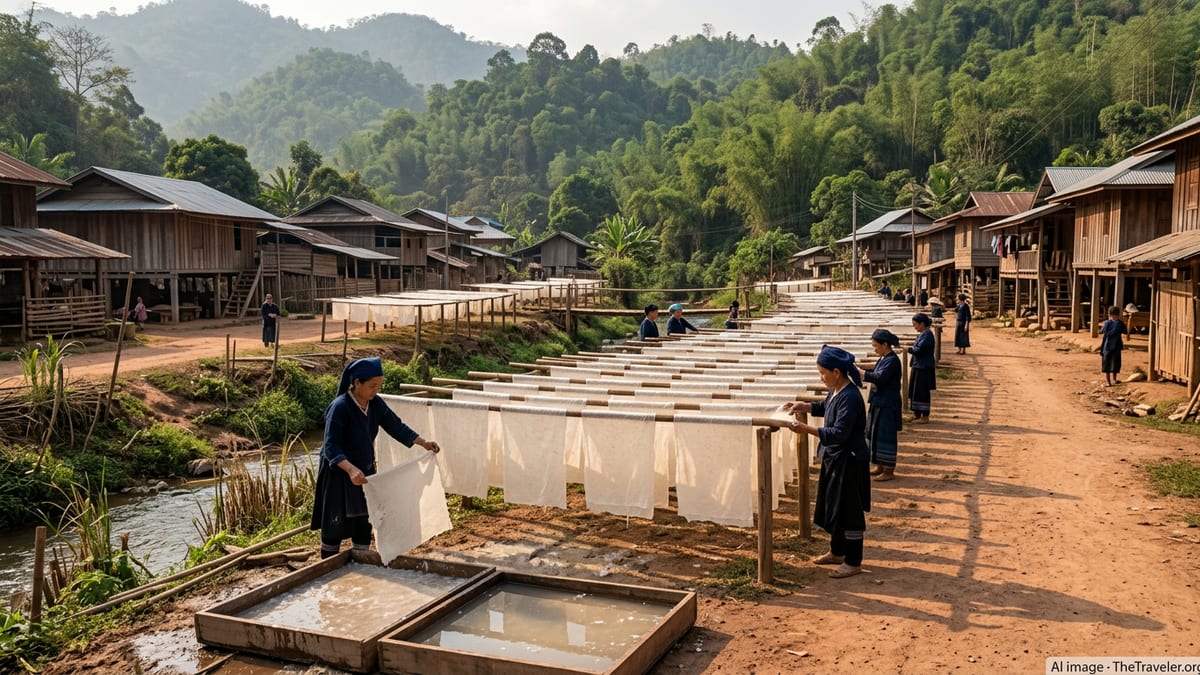
A Hill Village Turning Bamboo Into Art
Ban Nam Di, sometimes written Nam Dee, lies roughly six kilometers northeast of Luang Namtha town, along a narrow road that quickly trades concrete for rice paddies, forest and wooden houses on stilts. Publicly available descriptions characterize it as a Lanten ethnic village where traditional crafts remain closely woven into daily life, with bamboo papermaking standing out as its hallmark.
Reports from tour operators and recent traveler accounts describe how young bamboo culms are harvested, stripped and boiled before being beaten into a fibrous pulp. That pulp is then spread across framed screens, smoothed by hand and left to dry in the sun, creating thin, slightly translucent sheets that are used for lanterns, notebooks and ceremonial objects. The process is simple but intensely tactile, and visitors are often struck by how much manual labor is packed into each finished piece of paper.
Unlike machine-made paper, the surface of Ban Nam Di’s bamboo sheets carries visible textures and minute imperfections, evidence of individual hands at work. Subtle variations in color and thickness have become part of the appeal, with travelers describing the finished paper as both rustic and surprisingly refined.
The village’s reputation has grown gradually over the past decade, helped by regional tourism campaigns that promote community-based experiences in northern Laos. While still comparatively quiet, Ban Nam Di now appears regularly in Luang Namtha tour itineraries that combine short hikes, waterfalls and cultural workshops.
Inside the Bamboo Paper-Making Process
Public guides to the area outline a multi-step craft rooted in local forest resources. Young bamboo is selected for its flexible fibers, then cut into smaller sections and soaked or boiled for several hours. This softening stage helps break down the lignin that binds the fibers, leaving a pale, workable material.
After boiling, the bamboo is rinsed repeatedly in nearby streams or large basins until the water runs clear. The fibers are then pounded with wooden mallets to create an even pulp, a step that determines much of the final paper’s smoothness and strength. Descriptions of the process emphasize that rhythm and experience matter; artisans adjust how long they beat the fibers depending on the desired texture.
The pulp is mixed with clean water in shallow vats, and framed screens made from fine mesh are dipped in at an angle, catching a thin layer of fibers across the surface. As the water drains, the fibers interlock, forming a delicate sheet. The frames are then carried into open spaces and leaned against wooden supports so the paper can dry naturally in the sun.
On clear days, visitors report seeing lines of drying sheets glowing almost white against the green backdrop of banana trees and bamboo groves. Once fully dry, the paper is carefully peeled from the screens, pressed flat and sometimes dyed with natural pigments or decorated with simple motifs for sale in nearby towns.
Tourism Arrives Quietly in a Lanten Community
Ban Nam Di’s bamboo paper craft has become a focal point for small-scale tourism in Luang Namtha Province. Recent tour listings describe afternoon trips from Luang Namtha town by tuk-tuk or bicycle, with itineraries that include a walk through the village, a hands-on paper-making session and introductions to other local practices such as natural dyeing and weaving.
According to these publicly advertised programs, visitors can try scooping bamboo pulp onto frames and watch their own sheets dry while exploring the village. Some packages extend into overnight homestays, with simple accommodation in wooden houses, shared evening meals and participation in cultural activities that vary by season and occasion.
Reports indicate that families involved in papermaking now sell finished products directly to visitors, offering notebooks, greeting cards, lantern shades and small artworks. This has provided a modest but valuable income stream that supplements farming and wage labor, particularly in the dry season when agricultural work slows.
Observers of the region note that Ban Nam Di’s experience reflects a broader shift in northern Laos, where community-based tourism is being promoted as a way to support ethnic minority livelihoods while encouraging the continuation of traditional skills. The village’s bamboo paper craft, visible at every stage from raw stalk to finished sheet, offers a tangible example of how local knowledge can anchor new economic opportunities.
Balancing Preservation, Access and Sustainability
As more travelers arrive, questions about cultural and environmental sustainability are gaining prominence in public discussion of Ban Nam Di and similar villages. Bamboo is a fast-growing, renewable resource, and reports suggest that harvesting practices in the area remain small-scale, with collection typically done near existing forest margins rather than in untouched primary forest.
Tour programs marketed for Ban Nam Di frequently emphasize “low-impact” visits, highlighting small group sizes, short travel distances from Luang Namtha and activities that rely on existing village infrastructure. Observers point out that these elements, if maintained, can help limit pressure on local resources and minimize disruption to daily life.
At the same time, documentation on community-based tourism in northern Laos underscores the need for ongoing dialogue around benefit-sharing, cultural representation and visitor behavior. For a craft like bamboo papermaking, which holds spiritual as well as practical meaning in some Lanten traditions, there is particular sensitivity around how demonstrations are staged and how certain ritual uses of paper are presented to outsiders.
Travel information currently available encourages visitors to ask permission before taking photographs of people or private homes, dress modestly and purchase crafts directly from makers whenever possible. Such practices, advocates argue, can help ensure that Ban Nam Di’s growing popularity as a destination does not come at the expense of the very culture that draws people there.
Planning a Visit to Ban Nam Di Today
For travelers in 2026, Ban Nam Di is most commonly accessed from Luang Namtha, a provincial hub served by domestic flights and road connections from other parts of Laos and neighboring countries. Local agencies and guesthouses advertise half-day and full-day excursions that pair the village with nearby attractions, making it a straightforward addition to an itinerary focused on northern landscapes and ethnic diversity.
Publicly available travel descriptions recommend visiting in the dry season, typically from November to March, when unpaved access roads are more reliable and the paper-drying process can be seen outdoors. During wetter months, the experience can still be rewarding, but rain showers may push more activities under shelter.
Despite its growing profile, Ban Nam Di remains a quiet village rather than a developed tourist complex. Facilities are basic, and guides encourage visitors to arrive with realistic expectations around comfort, bringing essentials such as drinking water, sun protection and sturdy footwear. Those opting for homestays can expect simple bedding, shared bathrooms and home-cooked meals based on local ingredients.
For travelers seeking a closer look at how traditional crafts continue to evolve in northern Laos, Ban Nam Di offers a rare opportunity to watch bamboo fibers turn into paper in the place where the technique has been refined over generations. With careful management and respectful visitation, its hillside drying racks and riverside workshops are likely to remain among Luang Namtha’s most quietly memorable sights.