

I had seen Belém Tower in a thousand photos before I ever set foot in Lisbon. It is one of those monuments that seems to appear on every postcard and every “must see” list. So when I finally decided to go inside, I was less interested in another pretty exterior shot and more curious about what actually happens once you cross the tiny bridge and step through the door.
After queuing, climbing, and squeezing past hundreds of other visitors, I came away with a very clear picture of what you really see on each level and what feels worthwhile versus what feels more like a box-ticking exercise.
Practicalities: Tickets, Timings, and the First Reality Check
I visited Belém Tower on a weekday, arriving late morning, which in hindsight was not ideal. By that time, the ticket line was already winding across the riverside path, and it took me around 25–30 minutes just to buy a ticket. The tower is currently run as a paid monument; opening hours are generally from late morning to early evening, though they close on certain holidays and on Mondays. I found it necessary to double-check hours and any special closures the night before, as information can shift seasonally and around holidays, and I still saw some people turned away at the door because they had not checked.
Advance ticket options exist, including combination tickets with other nearby monuments, but even with a ticket you cannot skip the reality of the crowd control at the tower’s narrow staircase. What the websites and brochures tend to gloss over is that once you are inside, your visit is mostly structured by the staircase traffic system. Staff manage visitors with a red/green style scheme, allowing people to ascend or descend in waves. It is necessary for safety, but it means you spend a surprising amount of time simply waiting on landings, pressed against cold stone, rather than freely wandering.
The first reality check came before I even went in. I had this romantic idea of a lonely watchtower feeling out on the edge of the Tagus River, but in practice the immediate surroundings are very busy. Tour buses idle nearby, souvenir sellers set up along the path, and the noise from the waterfront blends with the chatter of multiple tour groups. It is not unpleasant, but it is not the tranquil, isolated maritime lookout that glossy travel photos suggest. If you go in peak season or at a popular time of day, you should be mentally prepared for a very touristic experience from the first minute.
I also noticed that, over time, access rules have tightened. Group sizes are monitored, some areas are roped off for preservation, and the interiors are more regulated than older guidebooks sometimes describe. I did not find any last-minute closure of the interior when I went, but I could see how maintenance or conservation work could occasionally close sections on short notice. That is the risk when visiting a historical monument that is lean and vertical: you do not have many alternative spaces inside if one level becomes inaccessible.
Crossing the Threshold: The Ground Level and Battery Terrace
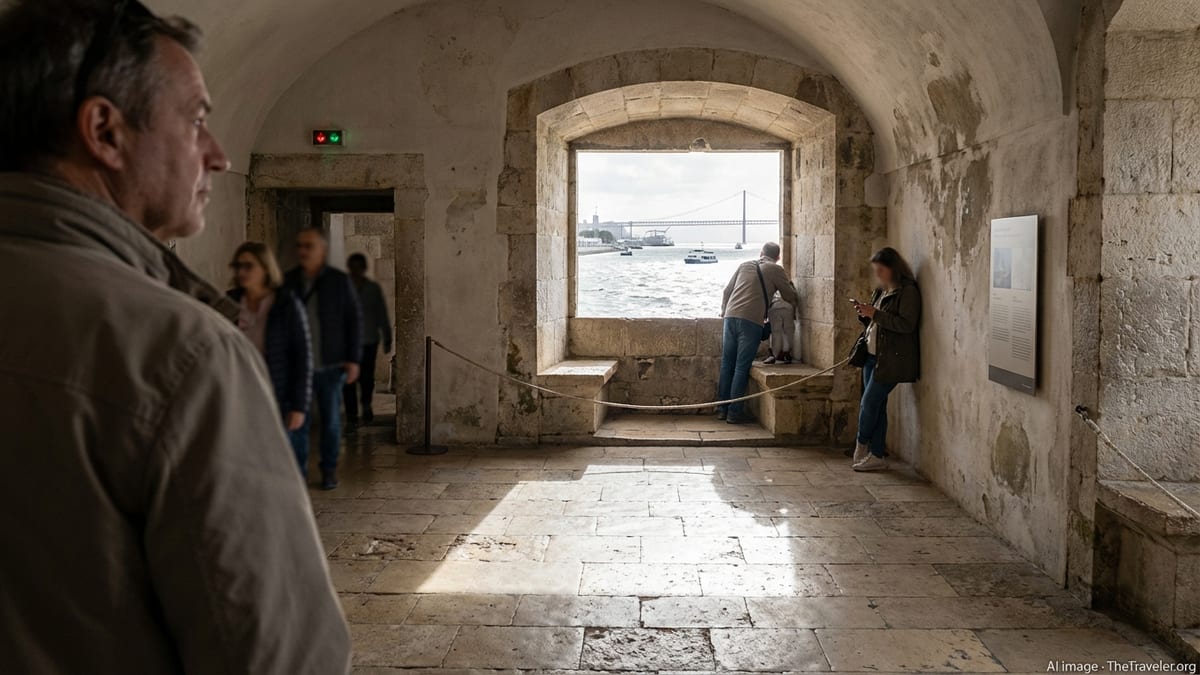
Stepping into Belém Tower for the first time, I realized how much of its impact comes from the sudden transition from exterior spectacle to quite sober interior. From across the water, the tower looks ornate and almost delicate, with its sculpted balconies and stonework. Inside, the ground level is far more functional: low ceilings, heavy stone, and the sense of a military outpost rather than a palace. This is where the artillery battery once operated, and the view of the river through the wide embrasures helps you imagine cannon pointing outward.
One of my favorite moments was actually right here, before the vertical climbing began. I walked along the low battery level and paused at the openings facing the Tagus. The river sits right there, broad and windy, and the modern traffic on the water contrasts sharply with the centuries-old geometry of the firing positions. The space feels surprisingly compact, and I was slightly surprised by how small-scale it all is. On photos the tower looks grand, but you quickly discover that it is essentially a relatively narrow vertical structure with only a few usable rooms per level.
The architectural details on this level are more subtle than on the upper terraces. The stone is worn and cool to the touch, and some of the decorative elements show their age in a good way: eroded edges, softened carvings, patches of discoloration. The interpretive signage, however, left me wanting more. There are explanations in multiple languages, but the panels are not especially detailed. They give a short overview of the tower’s defensive function, trade routes, and the Age of Discoveries, yet stop just when it starts to get interesting. I found myself wishing for fewer generic historical summaries and more specific, grounded anecdotes about events that happened in those rooms.
This was also where I began to feel the tension between preservation and visitor comfort. The temperature inside the stone shell can be quite variable. On my visit it was reasonably cool, which was a relief, but in high summer I can imagine this space becoming warm with the crowd. There are no modern comforts here: no seating apart from the stone edges, no wide areas where you can spread out. It feels authentic in that sense, but authenticity comes at the cost of comfort. If you visit with mobility issues, this ground level is where you would likely spend most of your time, as the climb ahead is not gentle.
The Infamous Staircase and Intermediate Landings
To reach the upper levels, you have to tackle the narrow spiral staircase at the core of the tower. I had read warnings about it, but experiencing it in person was still a shock. The steps are steep, worn, and very tight; only one person can pass at a time in most places. On my visit, staff stood at the top and bottom with a simple control system, pausing people until the previous group cleared. The result was a series of stop-start movements: climb 15 or 20 steps, wait on a cramped landing pressed between other visitors, then climb again when the signal changed.
Objectively, this is a necessary safety measure, and I appreciated that the staff took it seriously. Subjectively, it was tedious and occasionally claustrophobic. At times I felt stuck in a stone funnel, with very little airflow and a constant background of shuffling feet on uneven steps. If you dislike enclosed spaces or have balance issues, this staircase can be a real challenge. I saw a few people turn back after the first landing, and I understood why. The tower is historic, which means there is no option for a wider, modern staircase or a lift.
The intermediate landings themselves are small, transitional spaces that give you brief glimpses of the outside through narrow windows. In theory, they function as mini viewing points. In practice, they become holding pens for visitors waiting for the next movement cycle. I tried to look out over the river and take a moment to appreciate the view, but it was hard to fully enjoy when I could feel the line behind me compressing and the line above me not moving. This is where the crowds directly affect your experience of the architecture in a way that is hard to ignore.
One thing that did surprise me in a good way was how solid and well-maintained the staircase felt, given its age and the volume of visitors. The stone steps are worn smooth in the middle, but I never felt unsafe underfoot. Handholds cut into the central column provide something to grip, which I was grateful for, especially on the descent. Even so, I would strongly advise visiting with appropriate shoes. I saw several people in flimsy sandals negotiating the steps and looking genuinely nervous. It is not a casual climb; you need to be reasonably sure-footed and patient.
The Governor’s Room: History in a Bare Stone Shell
Emerging from the staircase into the Governor’s Room, I initially had a sense of slight anticlimax. The space itself is essentially a large, almost empty chamber with a high ceiling and a few openings to the exterior. Historically, this room served an administrative function, and it retains an austere, somewhat impersonal character. From outside photos, I had imagined a more ornate interior or at least a space with more furniture or staging to help you picture how it was used.
What you actually get is a mostly bare stone room with some signs explaining its purpose and a few decorative details around the windows and fireplace. Once I let go of my expectation for a richly furnished historic interior, I began to appreciate the scale and the acoustics. The room carries sound in a way that makes every whisper echo slightly, and when the crowd thins out for a minute, you can feel how commanding this central chamber must have been when decisions were made about ships and defense here.
The windows in the Governor’s Room offer some of the first really rewarding views of the surroundings. Through the stone-framed openings you can look back toward the Belém waterfront, take in the nearby monastery, and appreciate the tower’s positioning as a gatekeeper. I spent a few minutes watching the light shift across the river and the passing ferries, which helped ground the historical narratives in the reality of a working harbor. Still, the number of people sharing this space made it hard to linger for long without feeling in the way of someone else’s photo.
I found the interpretive content here serviceable but not exceptional. There was just enough information to rationalize why the room mattered, but not enough to make me feel genuinely transported into its past. I kept thinking how much more vivid the experience could be with a few well-chosen projections, soundscapes, or a rotating exhibit giving more personal stories from the people who actually used the tower. As it is, the Governor’s Room is more of an atmospheric volume than a truly engaging museum space.
The King’s Chamber and Chapel: Decoration, Detail, and Disappointment
Climbing higher, I entered the level often described as the royal or king’s chamber. This is the floor where the tower’s decorative ambitions become clearer. Windows become more elaborate, there are small balconies with finely carved balustrades, and the stonework carries more ornament. I could see why guidebooks frame this level as the aesthetic heart of the interior. It feels lighter and more ceremonial, with better light and more visual interest than the levels below.
At the same time, I felt a slight disconnect between the royal moniker and the reality of the space. The room is historically associated with the king’s use when present, but it is not a grand hall by the standards of royal residences elsewhere. It is relatively compact, and like the other rooms, it is almost entirely empty. Any expectations I had of richly decorated interiors with tapestries or period furniture were quickly dismantled. The experience here is more about stone geometry and views than about royal luxury.
Adjacent to this area is the small chapel space. I found the chapel quietly moving in a minimalist way, with its simple vaulting and a sense of solemnity that survives the constant flow of visitors. The religious function is evident, but again, the lack of objects or detailed interpretation makes it more of a structural hint than a fully developed story. I appreciated the chance to stand in a more intimate space after the open central chambers, though I had to wait several times for people to clear so I could step in without feeling like a blockage.
My main disappointment on this level was again the clash between historic atmosphere and modern crowd management. The rooms simply do not have enough floor space for everyone to move slowly, contemplate the architecture, and take photos without constantly negotiating around each other. I felt myself hurrying more than I would have liked, partly because I did not want to be yet another person blocking someone else’s shot. It is not the fault of the tower as a building, but it does affect how deeply you can engage with each interior detail.
The Roof Terrace: The Rewarding View at the Top
The climb culminates in the roof terrace, which for me was the clear highlight of the interior visit. When I finally stepped out into the open air, the sense of release from the narrow stairwell and crowded rooms was immediate. The terrace circles the top of the tower with parapets and battlements, giving you panoramic views of the Tagus River, the 25 de Abril Bridge in the distance, the Belém waterfront, and the monastery complex behind you. On the day I visited, the sky was clear, and the light on the stone and water was almost theatrical.
I stayed on the terrace longer than anywhere else inside the tower. This is the level that feels most like a reward for the effort it takes to get there. The interpretation is minimal, but the context is self-explanatory when you look at the river mouth and imagine ships heading out toward the Atlantic. The wind carries sounds from the promenade below, and the combination of height and exposure gives you a visceral sense of the tower’s strategic position. Even though many people were up there at the same time, the open sky made it feel less confined and more bearable than the lower floors.
Still, even at the top, I had to navigate the same choreography of bodies lining up along the parapets for photos. The best viewpoints often involved waiting behind a cluster of people filming themselves against the river. I managed to find a quieter corner for a few peaceful minutes, but it confirmed my feeling that, for a truly contemplative experience, you would need to be among the first or last visitors of the day. Midday and midafternoon bring a level of busyness that transforms the terrace into a continuous rotation of photo ops.
From a practical standpoint, this is also where I fully realized that the entire visit inside the tower does not offer facilities like restrooms or seating areas. Everything is structured as a linear path: in through the battery level, up through the rooms and staircases, out to the terrace, and then down again. If you are tired, hungry, or dealing with small children, the top is not a place to rest so much as a place to quickly enjoy the view before starting the descent. I found myself carefully adjusting how long I stayed, knowing I had the same narrow stairwell to navigate on the way down.
Coming Back Down: Descent, Flow, and Overall Atmosphere
The descent from the terrace repeats the same spiral staircase experience in reverse, and in some ways it is more challenging. Going down steep, uneven steps with a line of people in front and behind requires focus, especially when the lighting is dim in certain sections. Again, the staff-controlled flow made sense to avoid collisions, but the waiting on landings resumed. At one point I felt a wave of impatience rise in me, realizing that I was spending more total time in vertical transit than actually standing in the rooms on each level.
That said, the descent did give me another look at the architectural details I had rushed past on the way up. Through some of the small windows, the angle of view shifts slightly, and I was able to catch quieter glimpses of the river. The sound in the staircase column is distinctive: shoes scraping on stone, occasional laughter, and the intermittent echo of a guide trying to keep a group together. It is not a peaceful place, but it does have a particular character that comes from centuries of use and constant adaptation to modern tourism.
By the time I emerged back onto the lower level and finally out toward the drawbridge, the interior visit as a whole felt shorter than the time I had invested in queuing and climbing. I am glad I went in at least once, but I was genuinely surprised at how quickly the interior levels pass when you subtract waiting time. Each room is relatively small and minimally furnished, so unless you are someone who likes to stand and closely inspect stone details, you will likely move through each space in a matter of minutes.
Emotionally, I came away with a mix of admiration and mild frustration. Admiration for the endurance of the tower, the way it holds its own against the river and the centuries, and how the rooftop view truly situates you in Lisbon’s maritime story. Frustration at how the realities of mass tourism compress the interior into a regulated pipeline with little space for lingering. I did not feel cheated, exactly, but I did feel that the interior visit is best understood as a brief, structured supplement to the far more photogenic experience of the exterior.
Was Going Inside Worth It, and What Would I Do Differently?
Before my visit, I assumed that going inside Belém Tower was a non-negotiable part of “doing it properly.” Afterward, my view is more nuanced. The interior gives you important context and a few memorable moments, especially on the roof terrace and in the battery level by the water. However, the overall experience is more constrained, more crowded, and less richly interpreted than I expected. If you are already short on time in Lisbon, you should know that your strongest memories of the tower might still come from the outside.
Looking back, I would change several things about how I planned my visit. First, I would arrive right at or very near opening time to minimize both the ticket queue and the bottlenecks in the staircase. The environment inside would feel very different with fewer people, and I suspect I would have noticed details I simply did not have the mental space to absorb while jostling politely for room. Second, I would tie my interior visit to my schedule at other Belém attractions, rather than treating it as an isolated event. That way, any time spent waiting would feel like part of a broader half-day exploring the neighborhood rather than a single monument.
I would also adjust my expectations around the interiors themselves. Instead of picturing richly furnished historical rooms, I would frame them in my mind as largely empty defensive and administrative spaces that you walk through to understand the building’s structure and vantage points. Seen through that lens, the bareness becomes less disappointing and more honest. The tower was primarily a fortification and a ceremonial gateway, not a palace, and its rooms reflect that functional past.
In terms of whether I would personally go inside again, I probably would not repeat the full interior climb unless I was accompanying someone who had never been and really wanted to go. I would happily return to the exterior promenade, photograph the tower in different light, and enjoy the river views from the shore. The inside, for me, is a one-time experience: worthwhile for context and curiosity, but not something that demands repeat visits.
The Takeaway
Belém Tower’s interior is a compact, vertical journey through stone: a ground-level battery that whispers of cannons and trade routes, a series of austere rooms that hint at administrative and ceremonial history, and a rooftop terrace that rewards the climb with a sweeping view over the Tagus. It is not a lush museum, it is not especially comfortable, and it is often crowded and slow-moving. But it does have a stubborn, authentic presence that you can only fully appreciate by stepping inside at least once.
If you go in expecting grand, opulent interiors and immersive storytelling, you will likely be disappointed. What you get instead is more raw: bare walls, simple interpretive panels, and the physical reality of a centuries-old military outpost adapted to modern tourism. For some, that stripped-back honesty will feel refreshing; for others, it may feel underwhelming compared to more polished heritage sites nearby.
In my view, going inside Belém Tower is worth it if you fit certain conditions. If you are physically comfortable with steep, narrow stairs and moderate crowding, if you enjoy architectural spaces even when they are not heavily staged, and if you are willing to arrive early or be patient with queues, then the interior will add real depth to your understanding of Lisbon’s maritime history. The rooftop alone, on a clear day, is a strong argument in its favor.
If, on the other hand, you have limited time, mobility constraints, or a low tolerance for bottlenecks, you can appreciate much of what makes Belém Tower famous from the outside. Walking around its base, watching the light shift on its carved stone, and seeing it set against the river already gives you the postcard image and a solid sense of place. The inside is a valuable but optional chapter in the story, best reserved for those prepared for a simple, sometimes crowded, but undeniably evocative climb through one of Lisbon’s most recognizable silhouettes.
FAQ
Q1: Is it really necessary to go inside Belém Tower, or is seeing it from the outside enough?
For many visitors, seeing Belém Tower from the outside is actually the most memorable part of the experience. The exterior views from the riverside are spectacular and free. Going inside adds context and gives you access to the rooftop terrace and interior rooms, but the spaces are fairly bare and the visit is often crowded and structured by the narrow staircase. I would say the interior is worthwhile if you care about architecture and history and do not mind queues, but not strictly essential if you are short on time.
Q2: How long should I plan for a visit inside the tower?
From the moment you join the ticket line to the time you exit, you should allow at least 1.5 to 2 hours, especially in busier months. The actual time you spend in the rooms on each level is relatively short; a lot of the visit is taken up by waiting for the staircase to clear and moving with controlled groups. If you go right at opening or during a quieter period, you may be able to do it in around an hour.
Q3: How difficult is the staircase, and is it suitable for people with mobility issues or young children?
The staircase is steep, narrow, and spiral, with worn stone steps and limited space. Only one person fits on most sections at a time, and there are controlled flows of people going up or down. If you have mobility issues, balance problems, claustrophobia, or are traveling with very young children or bulky strollers, the staircase will be challenging and potentially unsafe. In such cases, I would recommend enjoying the tower from the outside and staying on the more accessible ground level if you do go in.
Q4: Are there any facilities inside, like restrooms, seating, or a café?
Inside the tower itself there are no restrooms, no café, and very limited places to sit. The spaces are preserved as historic interiors and circulation areas, not equipped as a modern museum building. You should use facilities elsewhere in Belém before entering and be prepared to stand and walk throughout the visit. Plan accordingly, especially if you are visiting with children or anyone who tires easily.
Q5: What is the best time of day to visit to avoid crowds?
In my experience, arriving at or very close to opening time offers the best chance of avoiding the thickest crowds and the longest waits in the staircase. Late afternoon closer to closing can sometimes be quieter too, but that depends on the season and day. Mid-morning to midafternoon, especially in high season and on weekends, tends to be very busy with tour groups and individual visitors converging at once.
Q6: Can I buy tickets in advance, and does that skip the line?
There are advance ticket options and combination tickets that include Belém Tower and other nearby sites. These can save you time at the ticket office, but they do not completely eliminate waiting, because interior access is limited by the narrow staircase and staff still regulate how many people can be inside at once. Think of advance tickets as smoothing the process rather than guaranteeing a fast-track experience.
Q7: Are there good views from inside if I do not make it to the very top?
Yes, there are several windows and openings on the lower levels, especially in the Governor’s Room and the king’s chamber, that offer nice views of the river and the Belém waterfront. However, the most expansive and impressive panorama is definitely from the roof terrace at the top. If you cannot or do not want to climb all the way up, you will still get a sense of the tower’s position, but you will miss the full 360-degree perspective.
Q8: Is the interior child-friendly or interesting for kids?
Children who enjoy castles, towers, and the idea of climbing up to a rooftop usually find Belém Tower appealing, but the experience is not specifically designed for kids. There are no interactive exhibits or dedicated children’s activities inside. The staircase can be tough for smaller children and stressful for parents trying to keep them safe in tight, crowded spaces. I would say it suits older children who are steady on their feet and comfortable with heights and confined stairways.
Q9: How informative is the visit? Will I learn a lot about Portuguese history inside?
The interpretive panels inside give you a basic overview of the tower’s role in defense and exploration history, but they are relatively brief. You will get a general sense of its significance in the Age of Discoveries, but you will not come away with a deep, museum-level understanding. If you want detailed historical context, it helps to read up beforehand, use a guidebook, or join a guided tour that includes the tower as part of a broader narrative about Belém and Lisbon.
Q10: Who would I most recommend the interior visit to, and who might want to skip it?
I would recommend going inside Belém Tower to travelers who are reasonably fit, patient with crowds, interested in architecture and maritime history, and keen to see Lisbon from a distinctive vantage point on the river. These visitors will likely find the climb and rooftop view worth the effort. I would advise skipping or limiting the interior visit for those with mobility issues, strong claustrophobia, very tight schedules, or a preference for more spacious, object-rich museum environments. For them, appreciating the tower from the outside and spending more time at nearby sites may be a better use of their energy and time.