

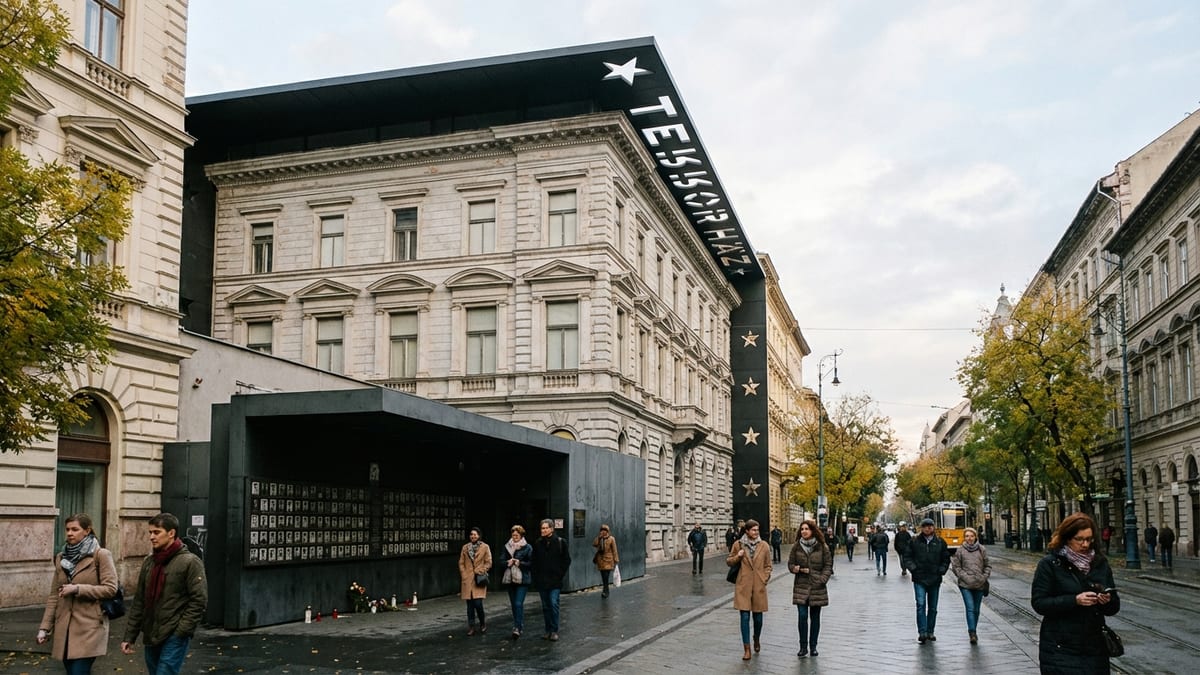
In the heart of Budapest, on elegant Andrássy Avenue, a sober, stone-faced building tells one of Central Europe’s darkest stories. The House of Terror Museum is not a conventional attraction. It is part historical exhibition, part memorial and part emotional gauntlet, guiding visitors through the overlapping fascist and communist dictatorships that scarred Hungary in the 20th century.
To walk through its dim corridors and reconstructed cells is to confront how ideology, occupation and fear reshaped an entire society, and to understand how those traumas still echo in Hungary and across Europe today.
From Grand Townhouse to Headquarters of Terror
The building at Andrássy út 60 began life far from the world of secret police and torture. Completed in 1880 in an ornate neo-Renaissance style, it originally functioned as an upscale residential townhouse in one of Budapest’s most fashionable districts. At the turn of the 20th century, Andrássy Avenue symbolized cosmopolitan prosperity: a grand boulevard lined with mansions, cafés and theaters that reflected the confidence of a rapidly modernizing city.
That world collapsed with World War II and the subsequent dismemberment of Hungary’s interwar political order. In the late 1930s, as radical nationalist forces gained strength, the property was taken over by Ferenc Szálasi’s Arrow Cross Party, Hungary’s homegrown fascist movement. By 1937, it had become their headquarters and detention center, known grimly as the House of Loyalty. Here, party militants organized street violence, harassment of Jews and political opponents, and paramilitary activity that helped normalize political brutality in everyday life.
On October 15, 1944, after a failed attempt by Hungary’s regent to exit the war, German forces backed a coup that brought the Arrow Cross formally to power. Their rule lasted only a few months, but it was catastrophic. Thousands of Jews and government critics were arrested, tortured and murdered in Budapest, many of them processed through this address before being shot along the Danube embankment or deported to camps. For survivors, Andrássy út 60 became synonymous with terror long before the communists arrived.
In early 1945, as the Arrow Cross regime collapsed and Soviet troops entered Budapest, the building’s function shifted but its role as a machinery of fear remained. The newly formed communist political police, organized along Soviet lines, chose Andrássy út 60 as their headquarters. Over the next decade, the successive security organs known as PRO, ÁVO and ÁVH turned the house into the nerve center of Hungary’s Stalinist repression. From here, officers oversaw surveillance, arbitrary arrests, show trials and a system of prisons and labor camps that reached deep into Hungarian society.
Fascism and Communism: Double Occupation, Twin Dictatorships
The House of Terror Museum presents Hungary’s 20th-century tragedies as a story of “double occupation.” The first came with Nazi Germany’s military intervention in March 1944, which ended what remained of the country’s sovereignty. The second was the consolidation of Soviet-backed communist rule after 1945, which replaced one form of dictatorship with another. While their ideologies and imagery differed, both regimes used terror as a central tool of governance, and both saw Andrássy út 60 as an ideal base of operations.
Under the Arrow Cross, terror was immediate and often openly brutal. The party’s militias rounded up Jews, Roma, leftists and perceived traitors, beating and killing them with little pretense of law. The museum’s early rooms on the second floor reconstruct the chaos of that period: propaganda banners, uniforms and shards of everyday domestic life jumbled together to suggest how quickly the normal fabric of society was ripped apart. The message is clear: extremism did not come from nowhere, but grew out of economic crisis, nationalist grievance and a gradual erosion of democratic norms.
Communist rule brought a different, more bureaucratic face of fear. After the war, many Hungarians initially hoped for democracy and postwar renewal. Instead, a Soviet-modeled system of one-party control, forced nationalization and collectivization emerged. The political police in Andrássy út 60 built extensive networks of informers, conducted nocturnal arrests and ran interrogations that extracted confessions through psychological pressure and physical torture. The museum’s exhibits draw direct parallels between the methods of the fascist and communist secret police, highlighting how both used isolation, intimidation and ritualized violence to break individuals.
One of the curators’ central arguments is that these two dictatorships should not be understood as opposites simply because they claimed different ideological banners. By placing Arrow Cross and communist imagery side by side, the exhibition invites visitors to focus on their shared contempt for pluralism, individual rights and the rule of law. Whatever their rhetoric, both regimes reduced citizens to instruments of a political project, and both justified extreme cruelty in the name of a supposedly higher historical mission.
Inside the Exhibition: Architecture of Memory
The House of Terror’s permanent exhibition begins on the upper floors and descends gradually into the building’s basement, mirroring the visitor’s journey from the visible mechanisms of dictatorship down into the hidden spaces where repression was physically enacted. The architecture and sound design are carefully choreographed. Stark lighting, narrow passageways and a minimalist color palette create a mood of unease that is more theatrical than conventional museum design, intended as much to be felt as to be intellectually parsed.
The second floor introduces the chronology of occupation, collaboration and the installation of both fascist and communist rule. In the “Double Occupation” hall, dates and documents highlight how external powers shaped Hungary’s fate from 1944 onward. Adjacent rooms focus on the Arrow Cross, with installations that evoke the randomness of violence in those months: scattered furniture, shards of personal belongings, and looping newsreel footage that juxtaposes official slogans with the reality of mass murder and forced marches.
Further along, the exhibit turns to the Soviet labor camp system and its Hungarian victims. A large floor map traces the sprawling Gulag archipelago, while personal testimonies and objects recall the fate of the roughly 700,000 Hungarians deported to camps in the Soviet Union. The physical scale of the map underlines how far from home prisoners were taken, and how unlikely their return. It is one of the museum’s most quietly devastating spaces, emphasizing the long shadow of imprisonment on families who often had no idea where their relatives had gone.
On lower levels, attention shifts from the macrohistory of occupations and treaties to the microhistory of how control worked day to day. Rooms devoted to propaganda, everyday life in the 1950s, and the pervasive presence of Soviet advisors reveal the mechanisms used to reshape society: rigged elections, collectivized farms, party schools and staged celebrations that hid the reality of shortages and fear. The curators underline that dictatorship was not just a matter of secret police, but a complete system that infiltrated workplaces, schools, churches and even private conversations around kitchen tables.
Basement Cells and the Mechanics of Repression
For many visitors, the emotional center of the House of Terror lies in its basement. Here, reconstructed and in some cases preserved cells, isolation boxes and interrogation rooms show the spaces where physical coercion took place. Narrow corridors lead past heavy metal doors into windowless chambers with low ceilings and damp walls. Some cells are too small to stand upright in, others have only a wooden plank for a bed, or a bucket in the corner. The effect is deliberately claustrophobic.
The museum emphasizes that these rooms are not generic stage sets but are based on the actual layout used by both Arrow Cross interrogators and their later communist successors. Former prisoners have contributed testimonies that shaped the reconstructions, recalling the sensory details of light, sound and smell. One particularly unsettling feature is the so-called “gym,” an interrogation room where beatings, stress positions and sleep deprivation were reportedly employed. The starkness of the space, with few objects beyond a table and a chair, draws attention to the human relationships at the core of terror: the interrogator, the prisoner and the hierarchy that made cruelty routine.
The descent into the basement is slowed by an elevator ride accompanied by a video in which a former guard explains the process of executions. As the lift moves down at an almost painfully slow pace, his matter-of-fact description contrasts with the horror of what he recounts. It is a calculated device aimed at forcing visitors to sit with the moral dissonance of ordinary individuals participating in a system of killing. When the elevator doors open onto the cellars, the silence that typically follows among visitors is telling. The museum relies on that silence as part of its narrative, offering little in the way of text panels here, preferring the mute eloquence of concrete and rusted bars.
The basement concludes with a gallows room, a stark evocation of judicial murder in both the late 1940s show trials and the reprisals following the 1956 uprising. Rather than dwelling on graphic detail, the space focuses on procedure and bureaucracy: documents, orders and signatures that transformed political vendettas into formal sentences. Visitors come away with a visceral sense of how legal language and institutional routines can be harnessed to violent ends, and how fragile safeguards are when courts become extensions of political power.
Victims, Perpetrators and the Politics of Remembrance
The House of Terror does more than recreate scenes of suffering. It also insists on naming and individualizing both victims and perpetrators. Near the end of the exhibition, a memorial space often called the “Hall of Tears” lists the names of those killed or whose lives were destroyed by the regimes that operated from this address and beyond. Photographs, letters and brief biographies humanize what might otherwise remain a list of statistics. The curators’ goal is clear: to remind visitors that each number represented a life interrupted, a family altered, a community bereft.
Facing the victims’ memorial is another, more controversial installation: the so-called perpetrators’ wall. Here, photographs and short notes identify individuals who served the fascist or communist security apparatus, from high-ranking officials to local functionaries. In some cases, the text indicates that they faced trial or public disgrace. In others, the notes suggest that many went on to live quietly after 1989, rarely answering for what they had done. For supporters of the museum’s concept, this naming serves as a long-delayed act of moral accounting. For critics, it risks oversimplification and personalizes blame in ways that may obscure broader structural forces.
This tension mirrors wider debates about memory in post-communist Europe. Since its opening in 2002, the House of Terror has been praised by some international observers and historians for its bold confrontation with totalitarian pasts, and its director has described it as a “memorial site dedicated to Hungarian freedom.” Others, particularly within Hungary’s academic community, have questioned whether the exhibition gives sufficient space to the complexities of collaboration, the variety of experiences under communism, or the specific responsibility of Nazi Germany in Hungary’s wartime crimes. There is also ongoing discussion of how the narrative aligns with the priorities of Hungary’s contemporary political leadership.
For visitors, these debates are part of what makes the museum so thought provoking. To walk its halls is not simply to absorb an official version of history, but to encounter a particular interpretation shaped by choices about what to highlight and what to leave in the background. The House of Terror’s unmistakably dramatic style underlines that remembrance is never neutral. It is shaped by present-day concerns, competing narratives of national identity and the desire to draw lessons for the future. Engaging critically with the exhibition can deepen rather than diminish its impact.
Experiencing the Museum: Practicalities and Emotional Impact
On a practical level, visiting the House of Terror requires a degree of preparation. The museum is centrally located near Oktogon, reachable by Budapest’s historic underground and several tram lines. Entry is by ticket, with concessions for students, seniors and families. Audioguides in multiple languages, including English, are available and highly recommended, as many of the original texts and archival materials are in Hungarian. Plan for at least two hours inside, and more if you want to absorb the details at a measured pace.
The museum’s house rules reflect its dual nature as exhibition and memorial. Photography and video recording are generally prohibited in the exhibition spaces, with the notable exception of the striking Soviet tank displayed in the inner courtyard. Large bags and all backpacks must be left in a free cloakroom or in lockers that operate with a small coin deposit, which is returned at the end of the visit. There is no café on-site, and there are few places to sit inside the exhibition, so it is wise to arrive rested and to plan a meal or coffee break elsewhere on Andrássy Avenue either before or afterward.
Accessibility has been taken seriously. Elevators connect the various floors, and the museum provides step-free access and accessible restrooms, making it feasible for visitors with limited mobility to experience the full exhibition route. That said, the confined spaces of the basement and the intentional use of dim lighting and sound effects may feel overwhelming for some visitors, including those with claustrophobia or sensory sensitivities. Earplugs or short breaks in quieter areas can help mitigate the intensity.
Parents should be aware that the content is emotionally and thematically heavy. While children under 14 can enter if accompanied by an adult, the graphic descriptions of torture, executions and persecution, even when not visually explicit, can be deeply disturbing. Each family will need to judge their children’s maturity and capacity to engage with such material. For teenagers and young adults, however, the museum can be an invaluable tool for understanding how fragile freedoms can be, and how quickly authoritarian systems can take hold.
Contextualizing Hungary’s Dark Century
To fully appreciate what the House of Terror attempts to convey, it helps to situate Hungary’s 20th-century experience within a broader European story. The country entered World War I as part of the Austro-Hungarian Empire and emerged from it dramatically reduced in size and population. The traumatic Treaty of Trianon in 1920, which stripped Hungary of two-thirds of its territory, fostered a deep sense of grievance that shaped politics for decades. Between the wars, conservative-nationalist governments navigated a difficult path between revisionist desires, economic constraints and the growing influence of both Nazi Germany and the Soviet Union.
Against this backdrop, the rise of the Arrow Cross and the later imposition of communist rule were not mere aberrations, but extreme outcomes of longer-term pressures: economic crises, traditions of authoritarian governance and the openness of elites to foreign patrons who promised restored prestige or security. The House of Terror’s focus on the period from 1944 to the mid-1950s captures the most intense phase of this process, when choices made in Budapest, Berlin and Moscow set the course for decades.
The story does not end with Stalinism. After the death of Stalin and rising tensions in Central Europe, Hungarians rose up in October 1956 in a nationwide revolt that briefly toppled the communist government and demanded free elections, national independence and an end to Soviet control. The revolution was crushed by Soviet tanks, with thousands killed and many more imprisoned or forced into exile. The House of Terror touches on this episode particularly in its sections on resistance, highlighting the bravery of men and women who organized underground groups or openly confronted the regime, often at the cost of their lives.
In the decades that followed, Hungary evolved into what some called “goulash communism,” a somewhat softer, more economically liberal variant of the Soviet model. Repression shifted from mass terror to more targeted controls and an unspoken social contract that traded limited material comfort for political quiescence. The museum’s narrative depicts this period more briefly, concentrating on the earlier era when Andrássy út 60 functioned as a true epicenter of terror. Yet the legacies of fear, conformity and selective memory from those later decades still shape public debate about just how far Hungary has traveled from its authoritarian past.
The Takeaway
Leaving the House of Terror Museum, visitors often step back into the light of Andrássy Avenue in reflective silence. The tram bells, café chatter and eclectic architecture of modern Budapest can feel strangely out of step with the darkness just witnessed. That dissonance is, in many ways, the point. The museum exists to ensure that the horrors of Hungary’s fascist and communist dictatorships are neither sanitized nor forgotten, and to remind a democratic society how quickly normal life can be upended when power is unchecked and fear becomes a tool of governance.
For travelers, the museum offers more than a history lesson. It is a key to understanding present-day Hungary and, by extension, the broader post-communist region. Debates over national identity, historical responsibility and the meaning of freedom are not abstract in Budapest; they are rooted in lived experience that institutions like the House of Terror work to preserve and interpret. Visiting this space is an invitation to think critically about how societies confront their own shadows, and about the role of memory in sustaining or undermining democratic values.
As an experience, the House of Terror is demanding, sometimes emotionally draining and occasionally controversial in its choices. Yet it is precisely this combination that makes it so compelling. For anyone seeking to grasp how the 20th century shaped Central Europe, and why seemingly distant events continue to influence politics and culture today, a visit to Andrássy út 60 is difficult to forget. It asks not only what happened here, but what responsibilities the living bear toward the dead, and how the hard-won freedoms of the present can be protected from the mistakes of the past.
FAQ
Q1. What exactly is the House of Terror Museum?
The House of Terror Museum is a historical museum and memorial in Budapest that examines Hungary’s experience under both fascist and communist dictatorships in the 20th century, using the former headquarters of the Arrow Cross and communist secret police as its setting.
Q2. Why is the building at Andrássy út 60 historically significant?
The building is significant because it served first as the center of the Arrow Cross Party’s operations and detention in the 1940s, and later as the headquarters of the communist political police, making it a central site of state terror under two different regimes.
Q3. How long does a typical visit to the museum take?
Most visitors spend between two and three hours inside, depending on how closely they follow the audioguide and how much time they devote to reading documents and reflecting in the memorial areas.
Q4. Is the museum suitable for children?
The museum allows children under 14 accompanied by adults, but the subject matter is very heavy and some installations are disturbing, so parents should carefully consider their child’s age, sensitivity and prior exposure to difficult historical topics.
Q5. Are there English explanations and guides?
Yes, there are audioguides in English and other languages, and many exhibition texts are available in translation, which makes the museum accessible to international visitors who do not speak Hungarian.
Q6. Can I take photos inside the House of Terror?
Photography and video recording are generally not permitted in the exhibition spaces, with the usual exception of the Soviet tank in the central courtyard, where visitors are typically allowed to take pictures.
Q7. Is the museum accessible for visitors with limited mobility?
The museum has elevators and step-free routes connecting its floors, along with accessible restrooms, so visitors with limited mobility can usually experience the full exhibition, including the basement.
Q8. How emotionally intense is the experience?
Many visitors find the House of Terror deeply affecting, especially the reconstructed basement cells and execution-related exhibits; it is advisable to approach the visit prepared for strong emotional reactions and to allow time afterward to decompress.
Q9. Does the museum present a neutral version of history?
The museum offers a particular interpretation that emphasizes the similarities between fascist and communist dictatorships and highlights Hungarian victimhood and resistance, and while it is grounded in historical events, it also reflects contemporary debates about memory and national identity.
Q10. Why should a traveler include the House of Terror on a Budapest itinerary?
Including the House of Terror provides crucial context for understanding modern Hungary, offering insight into how decades of occupation, dictatorship and resistance shaped the city and its people, and turning a visit to Budapest into a deeper engagement with Europe’s turbulent 20th century.