

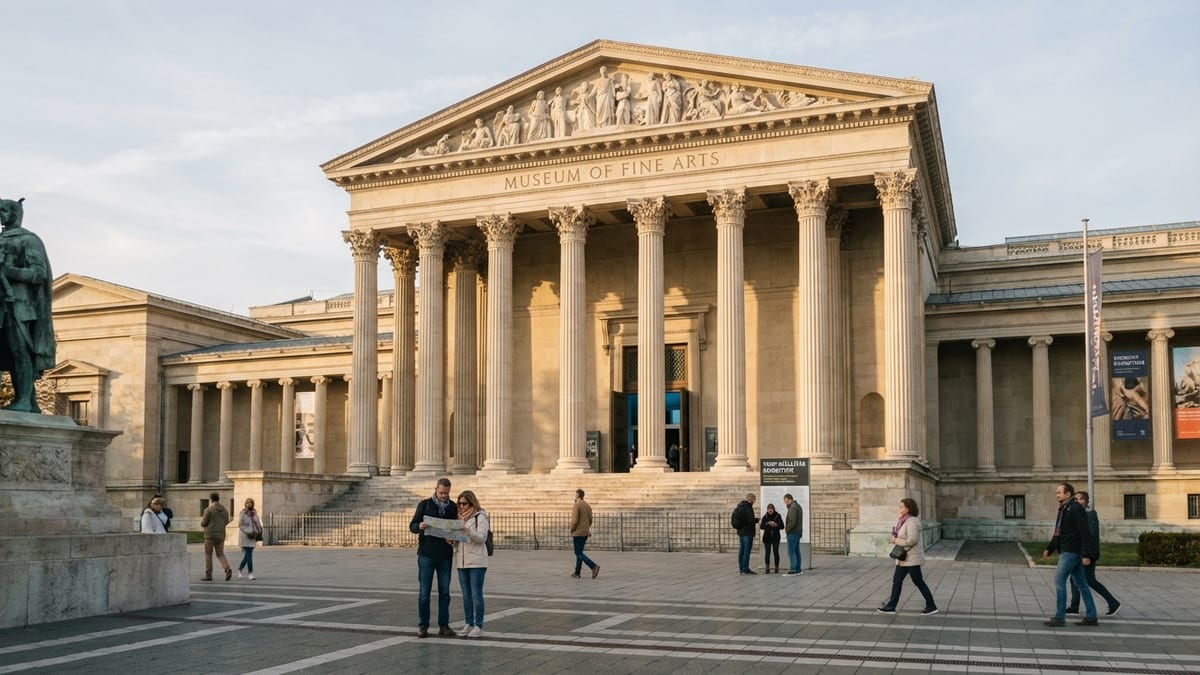
Inside a columned palace on Budapest’s Heroes’ Square, the Museum of Fine Arts guides visitors from the sands of ancient Egypt to the bold colors of modern painting.
Reopened in 2018 after a major renovation, the museum today combines an encyclopedic survey of European art with a renewed focus on Hungarian masters, all set within some of the most atmospheric galleries in Central Europe. For travelers, it is not only a place to admire masterpieces but an ideal lens for understanding how art evolved from antiquity to the present.
Arriving at Heroes’ Square: Your Gateway to the Museum
The Museum of Fine Arts stands on the left side of Heroes’ Square, one of Budapest’s most symbolic public spaces and part of a UNESCO World Heritage ensemble. The museum’s façade, modeled on an ancient temple with a wide flight of steps and a Corinthian colonnade, sets the tone before you even step inside. Approaching from Andrássy Avenue, you see at once that this is not a small city gallery but a national statement about culture, history and identity.
Completed in 1906, the building was designed by architects Albert Schickedanz and Fülöp Herzog in an eclectic mix of neoclassical and neo-Renaissance styles. The exterior pediment and colonnade evoke Greek and Roman temples, while the interior sequence of monumental halls pays tribute to the great periods of European art, from Romanesque to Baroque. This deliberate historicism turns the building itself into part of the exhibition, a three-dimensional introduction to the art history that unfolds inside.
As you climb the main staircase and pass under the colonnade, the noise of the square recedes. The heavy doors, cool stone floors and filtered light of the lobby signal a transition from the everyday city to a curated world of images, objects and stories. Practicalities are equally well handled: ticket counters, information desks and security checks are all immediately accessible, and the signage in Hungarian and English makes navigation straightforward, even for first-time visitors.
Because the museum is popular with both locals and tourists, especially on weekends and during major temporary exhibitions, timing your arrival matters. Doors typically open at 10 a.m. Tuesday through Sunday, and arriving early in the day makes for a quieter experience in the most famous galleries. Late afternoon can also be peaceful, with the added bonus of stepping back onto Heroes’ Square at golden hour, when the square and museum façade photograph beautifully.
A Brief History of a “Universal” Museum
The Museum of Fine Arts was founded with a clear mission: to offer an overview of world art, with a particular focus on European painting and sculpture from antiquity to around 1800. Its core collection grew out of royal and aristocratic holdings, including the important Esterházy family collection of Old Master paintings, purchased by the Hungarian state in the 19th century. From the beginning, this was never simply a Hungarian national gallery but a “universal” art museum in the European sense, akin to institutions in Vienna or Munich.
The building opened to the public in December 1906, in the presence of Emperor Franz Joseph. At that time, Budapest was one of the major cities of the Habsburg Empire, and there was a strong desire to showcase the capital’s cultural stature. Over the decades that followed, the museum expanded its collections and scholarship, becoming a key art-historical reference point between Vienna and Saint Petersburg. War and political upheaval, however, left their mark. During the Second World War, parts of the building were damaged, some collections were evacuated, and the grand Romanesque Hall was later reduced to a storage space.
After 1945, Hungary’s Communist period brought changes in cultural policy, but the Museum of Fine Arts retained its broad, international focus. Hungarian works predating the 19th century were gradually shifted to the Hungarian National Gallery on Buda Castle Hill, a separation that fragmented the narrative of national and European art. Administratively, the two institutions were reunited in the early 21st century. As part of this process, pre-1800 Hungarian art has been returning to Heroes’ Square, making it possible again to see Hungarian and European works of the same era side by side.
Between 2015 and 2018, the museum underwent the most extensive renovation in its history, affecting a large portion of the building. The project modernized climate control, lighting and visitor facilities, while restoring original architectural details that had been obscured or neglected. Crucially, the reorganization of the permanent collection reasserted the original chronological and thematic concept: a journey from ancient civilizations through the medieval Christian world, the Renaissance and Baroque, and on toward the 19th and early 20th centuries.
Ancient Worlds Below Ground: Egyptian, Greek and Roman Antiquities
An ideal visit begins literally from the ground up. On the subterranean and ground levels, the museum’s collections of Egyptian and classical antiquities provide the foundation for everything that follows. These galleries showcase thousands of years of visual culture, allowing you to see how artistic conventions, religious symbols and ideas of the human body first took shape.
The Egyptian collection is among the most significant in Central Europe. Visitors encounter painted coffins, mummies, funerary stelae, ushabti figurines, amulets and fragments of tomb decoration. These objects, many of them linked to beliefs about the afterlife, illustrate how art and religion were inseparable in ancient Egypt. Hieroglyphic inscriptions, careful profiles of gods and pharaohs, and the stylized poses of figures emphasize continuity and order, offering a sharp contrast with the naturalism of later Greek art upstairs.
Nearby, the Greek and Roman galleries trace the birth of classical art. Marble statues, terracotta vases and small bronze figures show how artists in the Mediterranean world began to explore anatomy, movement and expression with unprecedented sensitivity. Black-figure and red-figure painted vases present scenes from mythology, daily life and athletics, each one a window into ancient storytelling and social ideals. Reliefs and architectural fragments hint at the splendor of temples and public buildings, while Roman portrait busts introduce a more individualized, realistic approach to depicting the human face.
Spending time in these ancient galleries is more than an archaeological detour. It sets up a visual vocabulary that recurs throughout the rest of the museum. When you later encounter Renaissance artists who revive classical drapery or Baroque painters who stage scenes like ancient theater, you will recognize how deeply European art draws on these early models. The arrangement of the Museum of Fine Arts encourages this longitudinal reading, making it especially rewarding for travelers curious about the long arc of Western visual culture.
Medieval and Renaissance Treasures: Faith, Humanism and the Birth of Perspective
From the antiquities, you move upward into the world of medieval Christendom and the Renaissance. These galleries capture a profound shift in how artists saw their role and how viewers understood images. In the medieval rooms, religious panels, altarpieces and sculptures in wood and stone dominate. Gold backgrounds, stylized figures and hieratic compositions place spiritual truth above earthly realism. Saints, martyrs and the Virgin Mary appear in rigidly ordered scenes that reflect the theology and liturgy of the time.
Hungarian medieval works now reinstalled in the Museum of Fine Arts underscore how local traditions participated in broader European developments. Gothic sculptures and painted panels from churches within the historical Kingdom of Hungary display the same elongated figures and courtly elegance you might recognize from France or Germany, yet with regional iconographic details and donors. Seeing these works alongside foreign pieces helps travelers grasp Hungary’s place within the larger medieval Christian world.
As you progress chronologically, the Renaissance announces itself with a different visual language. Here, the collection truly shines. Italian masters introduce linear perspective, volumetric bodies and a renewed attention to the natural world. The museum’s most famous Renaissance painting is the “Esterházy Madonna,” attributed to Raphael and dated to the early 16th century. This intimate depiction of the Virgin and Child, with its delicate modeling and serene harmony, encapsulates the ideals of High Renaissance art: balance, grace and a union of human tenderness with divine subject matter.
The Italian galleries are complemented by Northern Renaissance works, where artists in Germany and the Low Countries turn their sharp observational skills on both sacred and secular subjects. Portraits rendered with almost microscopic detail, moralizing genre scenes and altarpieces filled with symbolic objects offer a different, though equally sophisticated, path away from medieval abstraction. Together, these rooms convey how Renaissance humanism encouraged artists to study the real world, the human body and individual character, without abandoning spiritual concerns.
Baroque Drama and Enlightenment Realism: Old Masters in Their Prime
The 17th and 18th centuries occupy a central place in the Museum of Fine Arts, both in terms of the collection’s strengths and its architectural setting. The Baroque Hall, reopened after a long renovation, now frames this period with an environment as theatrical as the paintings and sculptures it houses. High ceilings, lavish ornament and strategic lighting evoke the grandeur of Baroque churches and palaces, immersing the visitor in a world of spectacle and emotion.
The Old Master paintings galleries feature exceptionally strong holdings in Spanish, Italian, Dutch and Flemish art. Works by El Greco, including several compelling altarpiece fragments and devotional images, stand out for their elongated figures, intense colors and spiritual fervor. Spanish Baroque masters explore the play of light and shadow on humble and exalted subjects alike. In neighboring rooms, Dutch and Flemish artists such as those following in the tradition of Rembrandt and Rubens bring an almost cinematic realism to portraits, interiors and landscapes.
Baroque art was not only about visual drama. It also reflected the political and religious conflicts of the era. Counter-Reformation altarpieces, with saints caught in ecstatic visions and clouds parting to reveal divine light, testify to the Catholic Church’s effort to rekindle piety through emotionally charged imagery. Still lifes laden with fruit, flowers and luxury objects carry symbolic messages about mortality and the fleeting nature of worldly goods. The Museum of Fine Arts presents these themes clearly, allowing even non-specialists to read the stories embedded in the compositions.
Moving into the 18th century, the tone softens. Rococo elegance and Enlightenment clarity appear in portraits and mythological scenes where aristocrats pose amid carefully arranged landscapes, or classical gods become vehicles for playful eroticism and wit. This is also the moment when art begins to address the tastes of a broader collecting public. Genre scenes depicting middle-class interiors or everyday amusements hint at the social changes that will culminate in the 19th century, setting the stage for the rise of modern art and new museums, including this one in Budapest.
The Romanesque and Renaissance Halls: Architecture as Exhibition
One of the distinctive pleasures of the Museum of Fine Arts lies in its sequence of monumental architectural halls on the ground floor. These spaces are not mere neutral containers for art but historical recreations that immerse visitors in the aesthetics of earlier eras. The Romanesque Hall, the Renaissance Hall and the Baroque Hall each embody a particular style, making them destinations in their own right.
The Romanesque Hall, severely damaged in the Second World War and closed to the public for some 70 years, reopened in 2018 after painstaking restoration. Designed to resemble a medieval basilica, it features arcades, painted arches, decorative vaults and a richly carved wooden ceiling. For decades, this cavernous space served as a storage area, filled with plaster casts and sculptures invisible to visitors. Today it is once again one of the most atmospheric rooms in the building, a place where medieval-style architecture amplifies the impact of the sculptures and reliefs installed within it.
The Renaissance Hall, located near the main entrance, evokes an Italian palace courtyard with its rhythm of arches, pilasters and ornate decoration. Often used for high-profile temporary exhibitions, it offers a grand but more open and luminous atmosphere than the Romanesque Hall. Visitors passing through to reach other parts of the museum can pause here to absorb how Renaissance architects sought balance, proportion and a harmonious relationship between structure and ornament, ideals mirrored by the paintings on display in nearby galleries.
Together with the Baroque Hall, these reconstructed interiors help visitors feel the progression of European architectural taste in a way that flat floor plans or photographs cannot match. You walk from the heavy, fortress-like rhythms of the Romanesque to the poised elegance of the Renaissance and then into the exuberant splendor of the Baroque. The experience deepens your understanding of how the spaces for viewing art have changed over time and how architecture, sculpture and painting have always been intertwined.
From Romanticism to Modernism: The Road to Contemporary Sensibilities
While the museum’s core mission stops around the late 18th century, its collections extend into the 19th and early 20th centuries, bridging the gap to modern art. These later galleries highlight how artists reacted to industrialization, political revolutions and the emergence of the modern city, even as they wrestled with the immense legacy of the Old Masters.
In paintings from the Romantic era, you see heightened emotion, dramatic landscapes and a fascination with historical or exotic subjects. Artists turn to storms at sea, mountain vistas and scenes of revolution to explore the individual’s relationship with nature and society. Academic history painting, with its large-scale narratives and polished surfaces, dominated official art institutions, yet even these canvases often betray undercurrents of doubt or critique when viewed closely.
By the second half of the 19th century, Realism and early forms of modernism appear. Artists pay close attention to workers, peasants and everyday urban life, treating them as worthy subjects in their own right. Changes in brushwork and color mark a move away from the smooth finish of academic painting toward a more direct, expressive handling of paint. Visitors familiar with French Impressionism and Post-Impressionism will find echoes here, as Central European artists engaged with and adapted international trends.
Hungarian art of this period is of particular interest. As some historical Hungarian works have been reintegrated into the Museum of Fine Arts, visitors can trace how painters and sculptors from this region negotiated national identity, cosmopolitan influences and rapidly changing political realities. Portraits of writers, statesmen and bourgeois patrons, as well as landscapes and scenes from rural life, speak to a society balancing tradition and modernization at the dawn of the 20th century.
Planning Your Visit: Practical Tips and Experiences
To get the most out of the Museum of Fine Arts, it is worth planning your route and timing in advance. The museum is usually open from Tuesday to Sunday, closing on Mondays for maintenance and exhibition changes. Standard opening hours run from mid-morning to late afternoon or early evening, but visitors should verify exact times and any special closures before arrival, particularly around public holidays and during major exhibition installations.
Tickets are typically divided between the permanent collection and temporary exhibitions. Entry to the permanent galleries, which include the ancient, medieval, Renaissance and Baroque holdings, is generally less expensive than admission to blockbuster temporary shows, which may require a separate ticket and sometimes timed entry. Concession pricing is available for students, seniors and other groups, and families can often benefit from bundled or discounted options. Because the museum can become crowded when a major international exhibition is on display, booking tickets ahead of time and selecting early time slots can make for a calmer experience.
Audio guides and temporary exhibition booklets are available for visitors who want structured commentary. Many wall labels and gallery texts are bilingual, providing context on artists, styles and historical background without being overly technical. For travelers with a special interest in a specific period, it can be wise to organize your visit around that area, rather than attempting to see everything in one go. The museum’s scale is substantial, and fatigue is a real factor. Planning a break at the café, or even stepping outside to breathe in the atmosphere of Heroes’ Square before re-entering, keeps your eye and mind fresh.
Accessibility has improved since the renovation, with elevators, ramps and updated facilities making it easier for visitors with mobility challenges to navigate the building. Cloakrooms help lighten the load of coats and bags, especially in winter, and a well-stocked shop offers catalogues, prints and design objects related to the museum’s collections. For many travelers, combining a visit to the Museum of Fine Arts with a stroll in the adjacent City Park or a soak at the historic Széchenyi Baths creates a full day of culture and relaxation within a compact area of Budapest.
The Takeaway
Inside the Museum of Fine Arts in Budapest, art history unfolds as a continuous narrative, beginning with the ritual objects of ancient Egypt and culminating in the changing visions of the 19th and early 20th centuries. The institution’s recent renovation has not only refreshed its grand architecture but also clarified its mission: to show how ideas, beliefs and ways of seeing have evolved over thousands of years, and to situate Hungarian creativity within a broader European context.
Visitors leave with more than a list of famous names. They carry with them a sense of how medieval faith shaped image-making, how Renaissance humanism transformed the depiction of the body and space, how Baroque artists harnessed drama and light to move the soul, and how modern painters confronted a rapidly changing world. The building’s Romanesque, Renaissance and Baroque halls reinforce this journey, turning a museum visit into an experience of walking through time.
For travelers seeking to understand Budapest beyond its river views and thermal baths, the Museum of Fine Arts provides a powerful key. It reveals the city as a crossroads of empires and ideas, a place where international masterpieces and national heritage meet under one neoclassical roof. Allow several hours, move slowly, and let the sequence from ancient to modern art explain itself. The story told here is not only about Hungary or even Europe, but about the enduring human need to make meaning and beauty visible.
FAQ
Q1. Where is the Museum of Fine Arts located in Budapest?
The Museum of Fine Arts stands on the left side of Heroes’ Square at the end of Andrássy Avenue, next to City Park, in central Budapest.
Q2. What are the usual opening days and hours?
The museum is typically open from Tuesday to Sunday, from mid-morning to late afternoon or early evening, and closed on Mondays; visitors should check current hours and holiday schedules before visiting.
Q3. How much time should I plan for a visit?
Most visitors spend between two and four hours in the museum, but those with a deep interest in art history can easily spend a full day exploring the collections and taking breaks in between.
Q4. Which collections are must-sees for first-time visitors?
For a first visit, focus on the Egyptian and classical antiquities, the medieval and Renaissance galleries featuring works like the Esterházy Madonna, and the grand Romanesque, Renaissance and Baroque Halls.
Q5. Does the museum display Hungarian art as well as international works?
Yes, the museum shows pre-1800 Hungarian works alongside European art of the same periods, allowing visitors to see how local artists participated in broader artistic movements.
Q6. Are there audio guides or tours available in English?
Audio guides are generally available in multiple languages, including English, and the museum sometimes offers guided tours or special programs; information and booking options are usually provided at the entrance or visitor desk.
Q7. Is the Museum of Fine Arts suitable for children?
Yes, many families visit with children; while young visitors may not engage with every gallery, the dramatic halls, Egyptian mummies and vivid paintings can be very appealing, especially with some guidance from adults.
Q8. Can I take photographs inside the museum?
Non-flash photography is often permitted in the permanent collection for personal use, but policies can vary by exhibition, so visitors should observe posted signs and follow staff instructions.
Q9. How does the Museum of Fine Arts differ from the Hungarian National Gallery?
The Museum of Fine Arts focuses on international and historical Hungarian art up to roughly the late 18th and 19th centuries, while the Hungarian National Gallery, located in Buda Castle, specializes in Hungarian art from the medieval period through the modern and contemporary eras.
Q10. Do I need to book tickets in advance?
While same-day tickets are often available, advance booking is strongly recommended during weekends, holidays or major international exhibitions, when time slots can sell out and queues become long.