

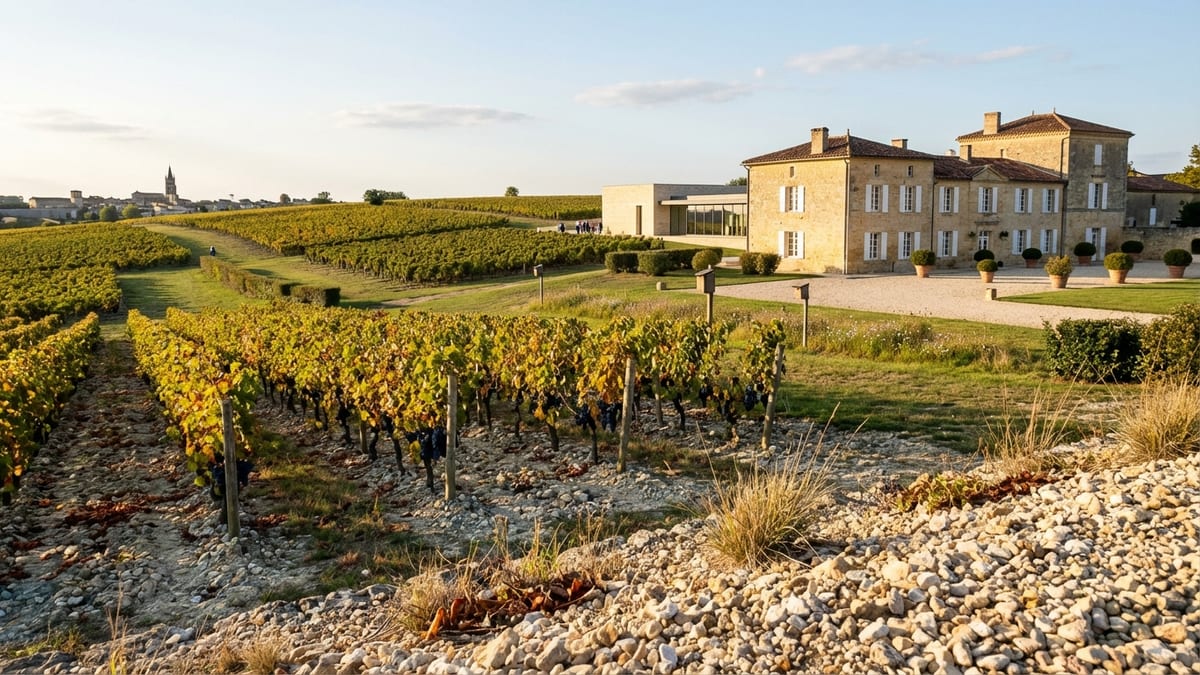
In the rolling vineyard landscape just outside the medieval village of Saint Émilion, Château Figeac has long been a connoisseur’s secret: a right bank Bordeaux that thinks like a left bank classic.
In 2022, the estate’s steady ascent was formally recognized when Figeac was promoted to the top rank of the Saint Émilion classification as Premier Grand Cru Classé A, placing it alongside only one other estate at the summit of the appellation. Yet for many wine travelers and collectors, the question lingers: what exactly makes Château Figeac so distinctive in a region dominated by Merlot and limestone, and why do its wines taste so unlike their neighbors?
A Historic Estate With One Foot in the Past and One in the Future
Château Figeac’s story begins in antiquity, when a Roman villa occupied the site, leaving traces that still feed the château’s mythology. The estate acquired its present name from the Figeacus family in the Middle Ages, and over centuries its holdings were gradually shaped, divided and reassembled. Many properties bearing the Figeac name today are in fact offshoots of this original domain, a reminder of how prized this particular corner of Saint Émilion has long been.
By the late nineteenth century, Figeac had entered a crucial modern chapter. In 1892, the Manoncourt family acquired the estate, ushering in a continuity of ownership that would become one of its defining strengths. Under their stewardship, Figeac navigated phylloxera, economic crisis and war, but the decisive turning point came in the mid twentieth century when engineer and visionary winemaker Thierry Manoncourt took charge. His rigorous approach to both vineyard science and traditional craftsmanship laid the foundations for Figeac’s contemporary style.
Manoncourt’s response to the devastating 1956 frost was especially important. Rather than simply replant with the usual right bank emphasis on Merlot, he made a bold choice to rebuild the vineyard with an unusually high proportion of Cabernet Sauvignon and Cabernet Franc, convinced that Figeac’s gravel soils could ripen these grapes reliably. This decision was radical in Saint Émilion at the time, yet it became the cornerstone of the estate’s singular identity. Today, the Manoncourt family and a new generation of technical leaders continue to refine that vision, combining cutting edge research with a deep respect for Figeac’s history.
For visitors, the estate offers a palpable sense of continuity. Historic chartreuse buildings, manicured gravel courtyards and a contemporary, light filled winery illustrate how the château has evolved without losing its soul. That juxtaposition mirrors the wines themselves: rooted in Bordeaux tradition, yet increasingly precise, polished and expressive of their own place.
A Saint Émilion Outlier: Terroir on Three Gravel Knolls
To understand what makes Château Figeac so distinctive, it is essential to look beneath the vines. While much of Saint Émilion is defined by limestone and clay, Figeac sits on three pronounced knolls of Günzian gravel, rich in quartz and flint, with a subsoil of iron tinged blue clay. This configuration is far more reminiscent of the gravel croupes of the Médoc than the nearby limestone plateau, and it confers a completely different personality on the wines.
Gravel soils are naturally well drained and heat retaining. During the growing season they warm quickly, reflecting heat back toward the vine canopy and promoting even ripening of late maturing varieties. In wet periods they shed excess water, encouraging vines to send roots deep in search of steady moisture. At Figeac, these conditions suit Cabernet Sauvignon and Cabernet Franc perfectly, allowing them to achieve full phenolic ripeness while retaining freshness, even as climate patterns grow warmer and more erratic.
The presence of three separate gravel outcrops within a single, contiguous 54 hectare estate is unusually complex for Saint Émilion. Each knoll has subtle differences in soil depth, stone content and clay underlay, which translate into nuanced variations in fruit character, tannin profile and aromatic expression. Rather than blending away these distinctions, Figeac’s team leverages them by vinifying vineyard parcels separately, then using blending to compose a wine that is layered, precise and unmistakably site driven.
Equally important is the estate’s size and integrity of land. With around 41 hectares under vine in one block, all classified at the highest level, Figeac has the flexibility to select rigorously for its grand vin. This scale also allows for long term experiments in rootstocks, massal selections and canopy management adapted specifically to gravel, building resilience as climate conditions evolve. In short, Figeac’s terroir is not just unusual for Saint Émilion; it is actively being reinterpreted through modern viticultural research.
The Cabernet Edge: An Unusual Grape Blend on the Right Bank
In most of Saint Émilion, Merlot is king. Many leading estates lean heavily on this early ripening grape, which thrives on cooler clays and limestone and gives plush, approachable wines with rich plum and chocolate notes. Figeac, by contrast, is known for almost the reverse logic. Its vineyard plantings are built on an approximate triptych of 35 percent Cabernet Franc, 35 percent Cabernet Sauvignon and 30 percent Merlot, making it one of the most Cabernet focused wines on Bordeaux’s right bank.
This unusual blend reshapes expectations. Cabernet Sauvignon contributes structure, backbone and a recognizably Médoc like profile of blackcurrant, graphite and cedar. Cabernet Franc adds aromatic lift, floral tones, spice and a finely etched tannic line. Merlot, though the minority partner, plays a vital role in providing mid palate flesh, supple fruit and an inviting texture that softens the more angular edges of the Cabernets. The result is a wine that can be both firm and velvety, serious yet seductive.
Over the past two decades, with warmer growing seasons, Figeac’s decision to rely so heavily on Cabernet has looked increasingly prescient. The estate can harvest ripe, expressive Cabernets at lower potential alcohol than many Merlot dominated neighbors, preserving vibrancy and moderate alcohol levels. In hot, dry vintages, deep rooted vines on gravel maintain access to water and remain physiologically balanced, which is critical for achieving tannins that are ripe but not coarse.
For tasters, the Cabernet edge shows in the glass as well. Young Figeac often displays notes of cassis, wild raspberry, violet, graphite, cigar wrapper and pencil shavings, layered over dark plum and black cherry. The palate is typically medium to full bodied, with linear energy, bright acidity and finely polished tannins that carry a saline, mineral signature. Compared with some richer, more voluptuous Saint Émilions, Figeac feels taut, chiselled and built for the long haul, more akin in style to a great Pauillac or Graves than its immediate neighbors.
Winemaking Philosophy: Precision, Gravity and 100 Percent New Oak
While terroir and grape varieties provide the raw material, Château Figeac’s distinctiveness is sharpened in the cellar. The estate’s winemaking philosophy blends traditional Bordeaux craft with contemporary precision. Grapes are hand harvested on a plot by plot basis, reflecting the differing ripeness curves of Cabernet Sauvignon, Cabernet Franc and Merlot across the three gravel knolls. Only healthy fruit is retained after sorting, which is now assisted by optical systems.
Fermentations take place in a mix of stainless steel and temperature controlled wooden vats, with an emphasis on gentle extraction. Rather than aggressively chasing color and tannin, the team aims for slow, even macerations that preserve aromatic purity and textural finesse. The winery has been designed around gravity flow, reducing the need for pumping and therefore lowering the risk of damaging delicate compounds in the juice and young wine. Each plot is vinified separately, giving the blending team a wide palette of components with distinct personalities.
One feature that often surprises visitors is Figeac’s commitment to aging its grand vin in 100 percent new French oak barrels. On paper, such a regime risks overwhelming the wine, yet at Figeac the choice is calibrated to the power and structure provided by the high Cabernet content. The wines spend around 15 to 18 months in barrel, during which time they gain additional aromatic complexity, polish and subtle notes of cedar, tobacco and exotic spice, without losing their underlying fruit or freshness.
Consulting input from leading oenologists has helped Figeac refine its style without sacrificing identity. Over the last decade, many critics have noted an increase in precision, clarity of fruit and tannin refinement in vintages from the mid 2010s onward, culminating in exceptionally praised recent years. Behind the scenes, investments in vineyard mapping, intra plot vinification and careful extraction contribute to this impression of effortlessness, even in challenging harvests. The overarching goal is not power for its own sake, but equilibrium and recognizability from one vintage to the next.
Environmental Commitment and Biodiversity at the Estate
As the climate shifts and consumers scrutinize sustainability, Château Figeac has also distinguished itself through strong environmental commitments. In 2013, the property’s 54 hectares were officially registered as a natural wildlife reserve, acknowledging the mosaic of habitats that coexist with the vines, from hedgerows and grassed alleys to ponds and wooded areas. This status reflects a philosophy that a healthy vineyard is inseparable from a healthy broader ecosystem.
The estate has adopted an integrated, sustainable viticulture model supported by scientific partnerships. It holds High Environmental Value (HVE Level 3) certification and operates within an ISO 14001 certified environmental management system, which requires continuous monitoring and improvement of its impact. Collaborations with institutions such as the French League for the Protection of Birds and national agricultural research bodies focus on studying and safeguarding biodiversity, including bats, bees and other pollinators that play key roles in vineyard health.
Practically, this means reduced reliance on synthetic inputs, meticulous observation of disease pressure, and a focus on soil life and structure. Cover crops, organic matter management and precise interventions help vines maintain resilience against hydric stress and disease. As gravel soils can be more vulnerable to drought, understanding how to preserve moisture and reduce erosion is especially crucial for Figeac. These efforts not only align with environmental values but also contribute to the finesse and consistency of the wines.
For travelers, this environmental focus adds another dimension to visiting Figeac. Estate tours often highlight the coexistence of vines and wild spaces, inviting guests to see the château not just as a grand building with a famous label, but as a living agricultural landscape in transition. It is a reminder that the elegance in the glass begins with complex interactions between soil, plant, climate and the myriad unseen organisms that sustain them.
From Premier Grand Cru Classé B to A: Why the Promotion Matters
The Saint Émilion classification, first established in the 1950s and periodically revised, has always been both a benchmark of quality and a flashpoint of controversy. While the Médoc and Graves classifications are effectively frozen in time, Saint Émilion’s list is designed to be updated roughly every decade, allowing estates to move up or down depending on performance and reputation. In the 2022 revision, Château Figeac’s elevation from Premier Grand Cru Classé B to the very top tier, Premier Grand Cru Classé A, crystallized decades of rising critical and market recognition.
For Figeac, this promotion was more than a marketing victory. It was an endorsement of a long term strategy that sometimes went against regional norms: betting on Cabernet, championing gravel in a limestone appellation, and committing to a style of wine that prizes balance and longevity over short term opulence. The classification committee’s decision recognized not only recent standout vintages but also the estate’s consistency and singularity over time.
In the new hierarchy, only two estates carry the A designation, underscoring how selective the top rank has become. For collectors and wine lovers, this has several implications. First, it confirms Figeac’s status as a reference point, a wine against which other Saint Émilions are increasingly measured. Second, it has helped push prices upward, reflecting global demand driven by strong critical scores. Third, it has sparked renewed interest among travelers, who are keen to experience one of Bordeaux’s most talked about estates at a moment when it is widely perceived to be at the height of its powers.
Yet the promotion has not fundamentally altered Figeac’s identity. In interviews, the Manoncourt family emphasizes continuity: the classification may bring new visibility and expectations, but the estate’s guiding principles remain the same. If anything, the new status amplifies the responsibility to act as a “flag bearer” for Saint Émilion, showcasing the appellation’s capacity for elegance, complexity and ageworthiness in an era of profound change.
In the Glass: Style, Aging Potential and How to Enjoy Figeac
For many readers, the real test of any grand vin is not its technical pedigree but the experience it offers in the glass. Young Château Figeac, particularly from recent celebrated vintages, is often strikingly aromatic: a lifted bouquet of blackcurrant, red berries and wild hedgerow fruit mingled with iris, peony, graphite, cedar and hints of forest floor. The impression is both precise and layered, with cabernet driven notes of pencil lead and tobacco leaf framing a core of vibrant fruit.
On the palate, the wine tends to sit in a poised middle ground between richness and restraint. Medium to full bodied, it carries a spine of fresh acidity and finely grained tannins that feel chalky yet polished. There is a clear sense of minerality, often described as saline or stony, that runs through the mid palate into a long, tapering finish. Alcohol levels are usually moderate by modern Bordeaux standards, adding to the impression of balance rather than sheer power.
Figeac is built to age. Top vintages can develop gracefully for decades, gradually unfolding tertiary notes of truffle, cigar box, dried roses, leather and earthy spice while retaining a core of sweet fruit. Many enthusiasts find that the wine begins to show its true complexity after 10 to 15 years in bottle, although in recent warm vintages with ultra refined tannins, it can be surprisingly approachable earlier. Decanting young bottles for a couple of hours helps open up the bouquet and soften the structure.
At the table, Château Figeac is exceptionally versatile. Its cabernet backbone pairs beautifully with lamb, beef and game birds, while the wine’s freshness and aromatic nuance work well with dishes that incorporate herbs, mushrooms and root vegetables. Compared with some more opulent right bank neighbors, Figeac’s relative restraint also allows it to complement subtly sauced dishes and refined French cuisine without overwhelming the plate. For travelers seeking to understand Bordeaux’s capacity for finesse and food friendliness, it is a compelling benchmark.
Planning a Visit: Experiencing Figeac in Saint Émilion
For wine travelers, Château Figeac offers a rich counterpoint to a day spent among the limestone terraces and cobbled lanes of Saint Émilion village. The estate lies on the western side of the appellation, close to the Pomerol border, in an area sometimes described as the “Graves of Saint Émilion” because of its distinctive gravel soils. The approach winds past other illustrious names, but Figeac stands out for the serenity of its park like setting and the harmonious blend of historic and contemporary architecture.
Visits, by prior reservation, typically include a tour of the vineyard, cellars and barrel hall, along with a tasting of the grand vin and often the estate’s second wine, Petit Figeac. Guides highlight the geological mosaic beneath the vines, the role of Cabernet in the blend, and the estate’s environmental work, giving guests a deeper context for what they taste in the glass. For many visitors, standing on one of the gravel knolls and feeling the stones underfoot brings the abstract notion of “terroir” vividly to life.
As with most top Bordeaux châteaux, appointments are essential and often need to be arranged well in advance, particularly during peak travel seasons and around the busy period of the primeur tastings in spring. Those planning a broader right bank itinerary can combine Figeac with contrasting experiences at more Merlot dominated estates on limestone and clay, allowing for an illuminating side by side exploration of how geology and grape choices shape wine style.
Back in the village of Saint Émilion, shops, wine bars and restaurants frequently feature Château Figeac on their lists, sometimes offering older vintages at serious but still accessible prices compared with the world’s rarest wines. For travelers who might not be able to secure a visit or who want to deepen their impression after a tour, tasting Figeac alongside other local grands crus is an instructive and memorable way to grasp what makes this estate unique.
The Takeaway
Château Figeac’s ascent to Premier Grand Cru Classé A status did not happen overnight. It is the product of an unusually coherent alignment of terroir, grape varieties, vision and patient investment. On gravel soils that defy regional norms, the estate has crafted a cabernet driven Saint Émilion that resonates with the structure and minerality of the Médoc while retaining the charm and suppleness of the right bank. Its wines are at once classic and contemporary, deeply rooted in tradition yet finely attuned to the demands of a changing climate and an increasingly discerning global audience.
For wine lovers, collectors and travelers, Figeac offers a rare opportunity: to taste and visit a property that genuinely stands apart within one of the world’s most famous appellations, and to witness how thoughtful stewardship can transform an already historic estate into a modern benchmark. Whether discovered in a cellar decades after bottling or in a sunlit tasting room overlooking the gravel knolls, Château Figeac tells a compelling story about place, persistence and the evolving identity of Bordeaux itself.
FAQ
Q1. What makes Château Figeac different from most other Saint Émilion estates?
Château Figeac stands out because it sits on three gravel knolls rather than the limestone and clay more typical of Saint Émilion, and its vineyard is planted with a high proportion of Cabernet Sauvignon and Cabernet Franc. This combination gives the wines a structure, freshness and mineral profile that often feel closer to left bank Bordeaux, while still retaining right bank charm.
Q2. What is the typical grape blend in Château Figeac’s grand vin?
The estate’s vineyards are planted roughly to 35 percent Cabernet Sauvignon, 35 percent Cabernet Franc and 30 percent Merlot, though exact proportions can vary by vintage. This unusually cabernet led blend for the right bank is central to Figeac’s identity, contributing to its aromatic complexity, firm yet polished tannins and strong aging potential.
Q3. How long can a bottle of Château Figeac age?
In good vintages, Château Figeac is designed to evolve gracefully for decades. Many bottles show well from around 10 to 15 years after harvest and can continue to develop for 20 to 30 years or more, depending on storage conditions. Over time, the wine gains notes of truffle, cigar box and dried flowers while retaining a core of fruit and a refined structure.
Q4. What food pairings work best with Château Figeac?
Château Figeac pairs beautifully with classic dishes such as roast lamb, beef, game birds and duck, especially when prepared with herbs, mushrooms or root vegetables. Its balance of freshness and depth also makes it a good partner for refined French cuisine and subtly sauced dishes, where overly rich or heavy wines might dominate.
Q5. Has Château Figeac recently changed its classification status?
Yes. In the 2022 revision of the Saint Émilion classification, Château Figeac was promoted from Premier Grand Cru Classé B to Premier Grand Cru Classé A, the highest rank in the appellation. This promotion recognizes the estate’s long term quality, distinct terroir and consistent excellence across vintages.
Q6. Is Château Figeac committed to environmentally friendly practices?
Château Figeac has made significant environmental commitments, including operating under an ISO 14001 certified environmental management system and holding High Environmental Value (HVE Level 3) certification. The estate is also registered as a natural wildlife reserve and works actively to protect biodiversity, particularly birds, bats and pollinating insects.
Q7. What is Petit Figeac and how does it differ from the grand vin?
Petit Figeac is the estate’s second wine, made from parcels or lots that do not make it into the grand vin blend. It is typically more approachable in its youth, with slightly less structure and complexity, but it still reflects Figeac’s gravel terroir and cabernet influenced style. For many drinkers, Petit Figeac offers a more affordable and earlier drinking introduction to the estate.
Q8. When is the best time to drink a young vintage of Château Figeac?
While top vintages of Château Figeac reward long aging, many recent years have such fine tannins and pure fruit that they can be enjoyed earlier. For a balance of youthful energy and developing complexity, many enthusiasts begin opening bottles between 8 and 12 years after the vintage, decanting for a couple of hours to allow the wine to open up.
Q9. Can visitors tour Château Figeac, and do they need a reservation?
Château Figeac welcomes visitors, but tours and tastings are offered by appointment and should be booked in advance, especially during busy seasons. A typical visit includes a walk in the vineyard, a tour of the winemaking facilities and cellars, and a guided tasting that explains how the estate’s gravel soils and grape blend shape the wines.
Q10. How does Château Figeac compare in style to other top Bordeaux wines?
Stylistically, Château Figeac often sits at an intersection between right and left bank Bordeaux. It shares with leading Médoc and Graves wines a cabernet driven structure, graphite and cassis notes, and strong aging capacity, while also offering the supple fruit and charm associated with Saint Émilion. This dual identity is a key part of what makes Figeac so distinctive and sought after.