

I had seen Cologne Cathedral so many times in photos that I thought I knew what to expect. The blackened twin spires looming over the train station, the epic nave, the Shrine of the Three Kings glowing somewhere near the high altar. What I did not expect was how much of the real experience happens away from the postcard view, once I stepped beyond the main nave and started poking into side aisles, chapels, the treasury and the tower.
Some of it was extraordinary. Some of it was more hassle than it was worth. And some of it simply did not live up to how this place is marketed. This is what it actually felt like to explore inside Cologne Cathedral beyond that first, jaw-dropping glance down the central aisle.
Practicalities: Getting In, Getting Around, Getting Irritated
Arriving at Cologne Cathedral could not have been easier. I stepped out of the main train station and the building was just there, filling my entire field of vision. From the outside plaza it looks almost unreal, like a Gothic movie set. Getting inside, however, required more patience than I expected.
The cathedral is officially open daily from 6:00 to 20:00, but tourist visiting hours are generally 10:00 to 17:00 Monday to Saturday and 13:00 to 16:00 on Sundays, and these are taken quite seriously. I arrived in the mid‑morning, which turned out to be peak visiting time. Security funnels everyone through the main west portal during those hours, and the line was slow but steady. I cleared the bag check in about ten minutes, but I could easily imagine it doubling in high summer or during the Christmas market.
Inside, entry to the main cathedral is free, which still amazes me given the amount of upkeep this place must require. The free access comes with tradeoffs. There is a constant background shuffle of tour groups and school classes, and tour guides competing in different languages can make parts of the nave feel like a convention hall. I found it hard to slow down and absorb details at first, because I was always either in someone’s photo or blocking a group trying to move on. If you want a contemplative experience, be ruthless about timing. The official advice to come early or after 16:00 is not marketing fluff; it is survival strategy.
Finding my way to the areas beyond the nave was not intuitive. The cathedral is huge and spatially complex, yet on the floor there is surprisingly little orientation help. Small signs in German and English point to the treasury and the tower, but if you want to understand where the choir ambulatory or specific chapels are, you are on your own unless you join a guided tour.
I wandered in circles a couple of times trying to figure out where access was still open during services, because areas are cordoned off and re‑opened according to the liturgical schedule. I understand why that happens, but the ad hoc barriers and ropes create a slightly chaotic, improvised feel inside such a major monument.
The cathedral does at least publish clear rules and time windows for tourist access versus worship. In practice, though, I found that the theory and the reality diverged. There were moments when a Mass or special service closed off the entire eastern end, including the choir and shrine, even during official tourist hours. No one explained what was happening; ushers just redirected people with brisk gestures. I do not begrudge the worshippers their priority, but if you are visiting primarily to see specific artworks or spaces beyond the nave, you need to build in the real possibility that one or two of them will be off‑limits during your chosen hour.
First Impressions Inside: Light, Noise, and a Slight Letdown
Stepping into the nave was undeniably impressive. The height of the vaults, the forest of clustered columns, the filtered light from the stained glass, all of it worked exactly as advertised. At the same time, the atmosphere was busier and more commercial than the romantic, spiritual gloom I had secretly hoped for. Donation stands, security posts, roped‑off areas and the continual shuffle of visitors give the central space a restless energy that undercuts some of the grandeur.
From the entrance, the main nave is what everyone sees first, and understandably so. What I noticed, though, is that the further you stand back towards the western end, the more the details blur into a single, greyish mass. The stone is heavily darkened by time and pollution; on an overcast day much of the carving disappears into shadow. Only when I moved closer toward the crossing and side aisles did the cathedral start to feel alive. That was my first hint that the real rewards here were not going to be in the stereotypical postcard view.
I was also slightly disappointed by how hard it was to get a good look at the high altar and the Shrine of the Three Kings from the nave. Ropes and screens keep visitors at a distance during most of the day, so you find yourself zooming in with your phone or squinting across a sea of heads. I had imagined being able to walk right up to the shrine and examine the goldwork, but in reality it felt more like watching it from the other side of a security barrier in a museum. It is understandable given the crowds and the importance of the relics, yet it added to the sense that the nave is more corridor than destination.
Acoustically, the space is magnificent but unforgiving. A single guide speaking into a small microphone in Italian can echo across multiple bays, and the murmur of hundreds of voices turns into a constant hum. Occasionally the organ or a choir rehearsal would break through, and those moments were stunning, a reminder that this is still a functioning church and not just a tourist attraction. More often, though, the soundtrack was camera shutters and whispered commentary. If you want silence, you will be disappointed here during the main visiting hours.
Walking the Side Aisles and Chapels: The Real Soul of the Place
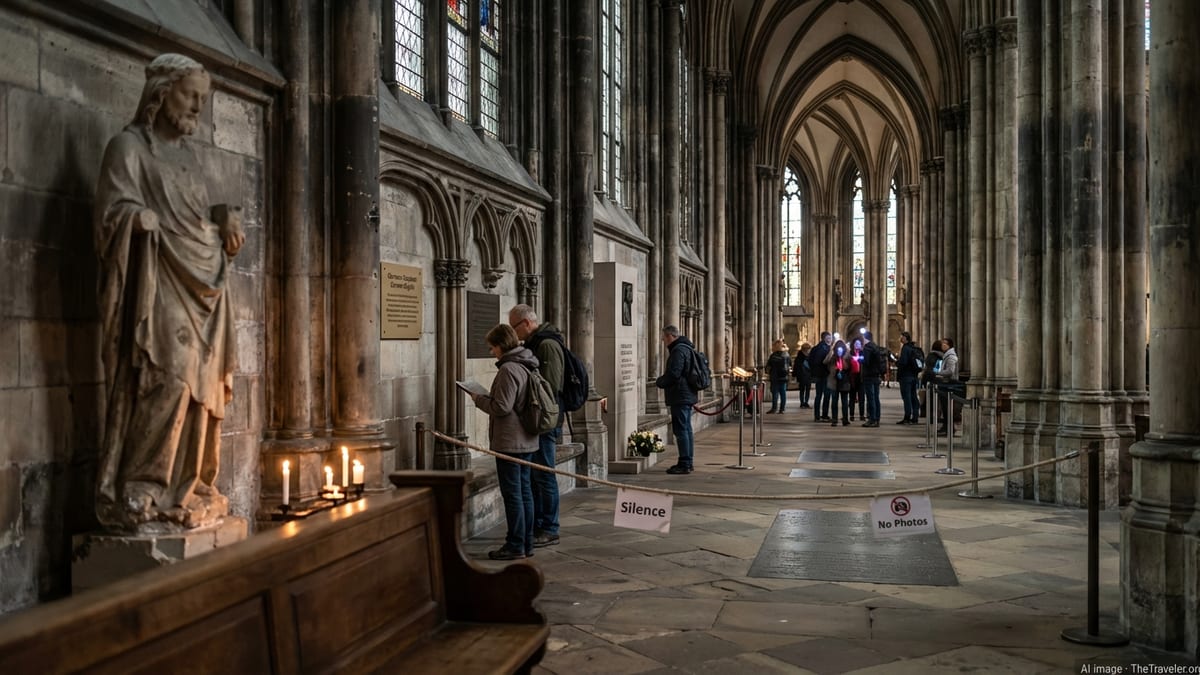
Once I peeled off into the side aisles, the cathedral changed character. The crowds thinned, the noise dropped a notch, and I could finally look at things without being jostled. This is where Cologne Cathedral reveals its layered, sometimes messy history. Each bay along the aisles leads to a chapel or altar, some beautifully restored, others almost austere, and a few frankly not very interesting. It felt less like a perfectly curated monument and more like a living building that had adapted to different eras and needs.
The chapels along the north side, facing the train station, tended to be busier, partly because they are closer to the main flow of traffic. Even so, I found quiet corners where people were praying or lighting candles. One chapel held a modern artwork that contrasted sharply with the Gothic setting; I appreciated the church’s willingness to allow contemporary pieces into the space, even though not all of them worked for me aesthetically. It reminded me that this is not a frozen museum of the 13th century but a place that continues to commission and accept new works.
On the south side, away from the station, I stumbled into spaces that felt almost forgotten. Here the lighting is dimmer and the stone seems older. In one chapel I stood alone for several minutes in front of a battered medieval sculpture, the noise of the nave reduced to a distant murmur. It was one of the first times in the visit that I felt a sense of genuine intimacy with the building. That said, the informational support is minimal. Unless you already know what you are looking at, the small plaques and occasional panels will not tell you much. I found myself wishing for a modest, clearly structured leaflet or a consistently labeled self‑guided route that explained the key chapels and artworks beyond the nave. Without that, a lot of nuance is easy to miss.
There is also an unavoidable tension between devotional use and tourism in these side spaces. Several chapels are clearly reserved for prayer; they are signed accordingly, and visitors are asked not to take photos. I watched people ignore those signs repeatedly, phones raised, flashes firing. The cathedral staff cannot be everywhere at once, and enforcement is sporadic. As a visitor, it left me with a slight ethical unease. I wanted to see the art up close, but I was also conscious of intruding on people’s private moments of faith. If you are willing to be discreet and respectful, you can still spend time here, but it requires a bit of self‑policing that not everyone seems prepared to do.
Around the Choir and Ambulatory: Beauty at Arm’s Length
The eastern end of Cologne Cathedral is dominated by the choir and the ambulatory that wraps around it, and this is where many of the most important medieval elements are concentrated. It is also the part of the building that is most aggressively managed. Ropes and barriers keep tourists from straying too close to the choir stalls or the high altar, and during services large portions are closed entirely. I managed to circle the ambulatory in a lull between Masses, but it was definitely a case of catching the right window.
Walking behind the choir, I finally got closer views of some of the famous stained glass and sculptural programs. The medieval choir windows with their jewel‑like color are genuinely spectacular when the sun is out, and even in flat light they have a rich depth. Unfortunately, the lighting in the ambulatory itself is patchy. Some bays are subtly illuminated; others are left in semi‑darkness, making it hard to appreciate details without straining your eyes. I understand the need to protect artworks from excessive light, but in several spots the compromise felt like a poor one: neither well lit enough for viewing nor dark enough to feel atmospherically intentional.
The ambulatory also gave me my best views of the Shrine of the Three Kings, but here too the experience felt more controlled than moving. The shrine is partially screened and guarded by constant ropes; you queue loosely along a prescribed path, shuffling past while trying to take in the 13th‑century goldwork before the next wave of visitors arrives at your back. I had always imagined being able to linger quietly in front of it. In reality, I felt rushed along by the pace of the crowd and slightly dazed by the reflective surfaces and camera flashes. It is still an extraordinary object, just not one I was able to encounter on my own terms.
That said, the ambulatory is where the cathedral’s verticality and plan make the most sense. Standing behind the choir and looking up at the ring of windows and vaults, I finally understood why this building became such a symbol of Gothic architecture. The proportions are elegant and surprisingly light, considering the massive weight of stone above. If you can tune out the crowds and accept that some areas will be off‑limits, a slow circuit around the choir is one of the most rewarding parts of the interior.
The Treasury: Quiet, Expensive, and Worth It If You Care About Objects
To get beyond the nave in a different sense, I decided to pay for the treasury. Tickets are sold on site, and as of early 2026 they cost 8 euros for adults, with a combined ticket for tower and treasury at 14 euros. I chose the combo, partly out of curiosity and partly to avoid making the decision again later. The ticket‑buying process was straightforward, paid by card, and I appreciated that there was no pressure to pre‑book online for a specific timeslot. On the other hand, the signage explaining what exactly was included and how to sequence the visit was minimal. The staff at the desk were helpful when I asked, but if you are shy about asking questions, it is not obvious from the start.
Descending into the treasury, the atmosphere changed dramatically. The noise of the nave disappeared, replaced by a low museum hush. Photography is not allowed, which I actually welcomed; it meant people were looking at the objects rather than posing with them. The collection itself is rich in medieval reliquaries, liturgical vessels, textiles and sculpture. If you have any interest in church art, metalwork or the material culture of worship, there is a huge amount to see here. I spent a long time peering at tiny chiseled details and inscriptions that would be completely lost at a distance in the main church.
Still, I would not call the treasury an unqualified success from a visitor perspective. The interpretive material is sparse and uneven. Some objects have detailed labels; others, including things that looked quite important, are barely identified beyond a title and date. There is little effort to tell a coherent story about how these objects relate to the cathedral above or to the wider history of Cologne. Instead, the treasury feels like a well‑lit storeroom of treasures, impressive but intellectually underdeveloped. For the price, I had hoped for more context, maybe an introductory film or at least some thematic panels in clear, accessible language.
Despite those frustrations, the treasury was one of the few places inside the cathedral where I could move at my own pace and really focus. The rooms are controlled for numbers, so it never felt crowded, and the enforced no‑photo rule kept the mood calm. I left feeling that the extra fee was worthwhile for me personally, but I would hesitate to recommend it to someone with only a casual interest in medieval church art. If your time or budget is tight, you will not feel that you have missed the essential Cologne Cathedral experience by skipping it.
Climbing the Tower: 533 Steps of Ambition and Second Thoughts
The other major “beyond the nave” experience is the tower climb. The south tower is open seasonally, generally from 9:00 to 18:00 in the warmer months and until 16:00 in winter, with last entry 30 minutes before closing. With my combo ticket in hand, I joined the queue at the tower entrance. It moved slowly, partly because space inside the staircase is limited and staff need to manage how many people are on the steps at once. The posted warning about 533 steps and no elevator is accurate and not melodramatic. You really feel every single one.
The climb starts out wide and manageable, spiraling up inside the thick stone wall. As I went higher, the staircase narrowed and the air got warmer and more humid. Meeting people coming down required a bit of choreography at the tightest points. If you have any issues with claustrophobia or knees, this will not be fun. I am reasonably fit, and by the time I reached the top I was breathing hard and slightly sweaty, in spite of the cool day outside. There are a couple of rest points, but they are cramped and not particularly scenic, which makes them feel more like functional emergency bays than pleasant lookouts.
At the viewing platform, my first reaction was mixed. The views over Cologne and the Rhine are undeniably impressive. You can see the train lines fanning out from the Hauptbahnhof, the river traffic, and on a clear day a broad sweep of the Rhineland. At the same time, the platform is surrounded by a heavy protective grille. It is there for good safety reasons, but it makes photography awkward and slightly kills the feeling of openness. You are also sharing the space with a good number of other people all trying to find a gap in the metalwork for their perfect shot. It took some effort to find a corner where I could simply stand and absorb the view without being elbowed aside.
In retrospect, I am glad I did the tower once, but I would not repeat it every visit. The effort‑to‑reward ratio depends heavily on the weather and your patience for stairs and crowds. On a bright, clear day with moderate numbers, the climb can be exhilarating. On a grey or smoggy day, or when the platform is packed, it starts to feel like a slightly punishing box you have to tick because guidebooks insist on it. If you are short on time or energy, I would prioritize exploring the interior art and chapels over the tower.
Booking a Guided Tour vs Wandering Alone
One of my biggest questions going in was whether to join a guided tour or explore on my own. The cathedral organizes official tours that must be pre‑arranged through their visitor office, and only authorized guides are allowed to lead groups inside. I decided against booking in advance, partly out of laziness and partly because I wanted the flexibility to follow my curiosity. After my visit, I have mixed feelings about that choice.
On the positive side, wandering alone allowed me to linger where I wanted and to duck out when spaces became too noisy or crowded. I could loop back to a side chapel when it emptied out, or skip areas that were clearly overwhelmed with tour groups. For a building as layered as Cologne Cathedral, having that freedom is valuable. I also enjoyed the small discoveries that came from aimless exploration, like finding a modern memorial tucked into a quiet corner that I might have missed on a rigid route.
However, the lack of interpretive material inside the cathedral meant that I repeatedly felt like I was looking at things without really understanding them. I had read about certain works in advance, but once I was there, it was hard to match names, dates and stories to the actual objects in front of me. Listening in on snippets of official tours, I realized that they were getting a far richer narrative about the building’s construction phases, symbolic programs and wartime damage than I was piecing together on my own.
If I visit again, I would probably try to time my visit around a guided tour, ideally after a quick solo walk‑through to get my bearings. For first‑time visitors who care about history and architecture, the tours look like good value. For those who are more interested in atmosphere and photography than information, self‑guiding is fine, but be prepared to accept that you will only skim the surface of what is here.
What I Would Do Differently Next Time
Looking back, my biggest mistake was arriving in the busiest part of the day and assuming I could see everything important in one neat, continuous loop. The cathedral’s own recommendations to visit early in the morning or after 16:00 are grounded in reality. If I could rewind the day, I would start with a very early, quiet visit to the nave and side aisles right after opening, when the doors are open but tour buses have not yet unloaded their passengers. That would give me the contemplative experience I had been hoping for.
After a break outside or in the city, I would come back later in the afternoon specifically for the treasury and, if the weather were good, the tower. By then, I would already have a sense of the building’s layout, and I could decide in the moment whether I had the energy for 533 steps or whether it made more sense to focus on the objects below. Separating the visit into two sessions would also reduce the sense of overload. Cologne Cathedral is visually dense; trying to absorb everything in one push is exhausting.
I would also either book a guided tour in advance or at least pick up a detailed printed guidebook on site before diving into the chapels. Too often I found myself staring at a beautiful altarpiece or sculpture without any real insight into its origin or significance. A small investment in background material would go a long way here. The cathedral relies heavily on visitors arriving already informed or willing to improvise; it does not do as much as it could to hold your hand through the more complex parts of the interior.
Finally, I would set my expectations realistically. Cologne Cathedral is not a perfectly managed, perfectly serene monument. It is a working church, a mass tourism site, and a construction project all at once. There will be scaffolding, closed‑off areas, noise and minor irritations. Accepting that from the start makes it easier to enjoy the genuinely special moments when they appear.
The Takeaway
Exploring Cologne Cathedral beyond the main nave was a lesson in managing expectations and embracing imperfection. I did not get the pure, hushed, mystical experience I had half‑imagined. Instead, I got something messier and, in its own way, more honest: a building that is still adapting to constant use, still figuring out how to balance devotion, tourism and preservation.
There were real frustrations. The crowds, especially in the middle of the day, make it hard to linger where you want. Access to the most important areas fluctuates with the liturgical schedule, and information on the ground does not always keep up. The treasury, while rich in objects, underdelivers on context, and the tower climb demands more physical effort than some marketing blurbs imply. If you arrive with a rigid checklist of things you must see up close, you are likely to leave at least partially disappointed.
Yet there were also moments I would not trade. Standing alone in a side chapel with a worn medieval statue. Catching a shaft of light through the choir windows just as the sun broke through. Feeling the structure of the cathedral in my legs as I climbed the tower, understanding physically what “verticality” means in Gothic architecture. Those experiences did not happen in the postcard view down the nave; they happened when I drifted to the edges and paid attention.
In the end, I would say that going inside Cologne Cathedral and exploring beyond the main nave is absolutely worth it if you approach it with the right mindset. If you care about Gothic architecture, medieval art or the living tension between sacred space and mass tourism, this building will give you plenty to think about. Go early or late to dodge the worst of the crowds, accept that some areas will be closed or imperfect, and do not hesitate to pay for the treasury or a guided tour if you value depth over quick impressions. Under those conditions, the cathedral moves beyond the cliché of a blackened postcard silhouette and becomes what it really is: a complex, sometimes frustrating, always fascinating place that rewards the curious visitor willing to look past the obvious view.
FAQ
Q1. Is it free to go inside Cologne Cathedral, and what costs extra?
Entry to the main cathedral, including the nave and side aisles, is free. You only pay for extras such as the treasury, the tower climb, and special guided tours, which are charged separately on site.
Q2. When is the best time of day to visit if I want to avoid crowds?
In my experience, the quietest times are early in the morning shortly after opening and later in the afternoon after about 16:00. Midday, especially between 11:00 and 15:00, is the most crowded, with large tour groups and school classes.
Q3. How much time should I plan if I want to see more than just the nave?
If you only walk through the nave and side aisles, you can get a superficial impression in 30 to 45 minutes. To explore chapels more carefully, visit the treasury and climb the tower, I would allow at least two to three hours, ideally broken into two visits to avoid fatigue.
Q4. Is the tower climb suitable for children or people with mobility issues?
The tower involves 533 narrow steps and no elevator, so it is not suitable for visitors with mobility problems, heart issues or serious claustrophobia. Children can climb, but they need to be supervised closely, and you should be realistic about their stamina and your own.
Q5. Do I need to book a guided tour in advance?
Official cathedral tours generally require advance booking through the cathedral’s visitor services, and only authorized guides may lead groups inside. You can still visit independently without any reservation, but if you want a structured, in‑depth tour, planning ahead is wise.
Q6. Can I always see the Shrine of the Three Kings up close?
No. The area around the shrine is often partially roped off, and during services the entire choir end may be closed to tourists. Even when it is accessible, you usually view the shrine from behind barriers and may have to shuffle along with other visitors rather than stand in one place for long.
Q7. Is the treasury worth the extra ticket price?
For me, the treasury was worth it because I am interested in medieval art and liturgical objects, and I appreciated the quieter, museum‑like atmosphere. If you are only casually interested or on a tight budget, you may find that the free areas of the cathedral offer enough without paying extra.
Q8. How much physical effort is involved in a full visit?
Just walking the nave, side aisles and chapels is manageable for most people, though there is a fair amount of standing. The real physical challenge is the tower climb, which demands a sustained effort on a steep spiral staircase. If you do everything in one session, expect to feel tired by the end.
Q9. Are there quiet places for reflection inside, despite the crowds?
Yes, but you have to seek them out and be patient. Some side chapels, especially on the south side, can be surprisingly peaceful between tour group waves. Early morning and later afternoon also offer better chances to find a corner where you can sit or stand in relative silence.
Q10. If I only have one hour, what should I prioritize beyond the main nave?
With just one hour, I would focus on walking both side aisles and making at least one full loop around the choir and ambulatory if it is open. That circuit gives you a good sense of the chapels, stained glass and overall plan without the extra time and effort of the tower or treasury.