

More news on this day
In an era when food festivals from San Sebastián to Singapore compete for global attention, a quietly radical event in New Zealand has been redefining what a culinary festival can be.
Hokitika Wildfoods Festival, staged each March on the remote West Coast of New Zealand’s South Island, is at once a celebration of hyper-local ingredients, a test of gastronomic courage and a snapshot of a community that has turned remoteness into a creative advantage.
It has been running for more than three decades, draws thousands of visitors to a town of just a few thousand residents, and yet remains astonishingly under the radar for most global travelers.
Among chefs, adventurous eaters and tourism insiders, however, there is a growing consensus: this might be the best culinary festival in the world that most people still do not know exists.
More News
- TSA Rolls Out $45 ConfirmID Fee for Travelers Without REAL ID at Security
- Flying Blue Launches February 25% Promo Rewards on Transatlantic and Regional Routes
- United Fast-Tracks Starlink Wi‑Fi Across Fleet, Free for MileagePlus Members
A Remote Festival With Global Ambitions
Hokitika is not an obvious place to host a world-class culinary gathering. Wedged between the Tasman Sea and the Southern Alps, the former gold-rush town is reached by winding state highways and small regional flights. That isolation has helped preserve an unusually strong food identity rooted in foraging, hunting and making the most of rugged terrain.
The Hokitika Wildfoods Festival began in 1990 as a modest showcase of West Coast specialties, sparked by local winemaker Claire Bryant. Her gorse flower and rose-petal wines shared stalls with venison, whitebait and homemade preserves. Fewer than 2,000 people attended that first edition. Word of mouth, however, spread fast among New Zealanders drawn by the promise of dishes they could not find in city restaurants, from wild game to foraged seaweeds.
By the early 2000s, the festival was attracting more than 20,000 attendees, a remarkable number given Hokitika’s resident population of around 3,500. Today, crowd numbers are capped to keep the experience manageable for the town and to protect the event’s offbeat character. There are no corporate VIP enclosures dominating the site, no sprawling branded pavilions. Instead, visitors wander a compact, walkable festival ground where local families sell recipes passed down through generations alongside pop-up stalls run by guest chefs.
This willingness to stay intimate while refining quality is one reason food industry observers increasingly single out Hokitika as a benchmark. It has the energy of a grassroots fair with the experimentation of a cutting-edge culinary lab, and that fusion remains rare on the international festival circuit.
What Makes Hokitika Wildfoods Different
Ask regulars what sets Hokitika apart and they tend to give the same answer: there is nowhere else where you can sample food this unusual in such an unpretentious setting. While many festivals pivot around star chefs and high-end restaurants, Wildfoods is built on the idea that almost anything edible can be a starting point for creativity.
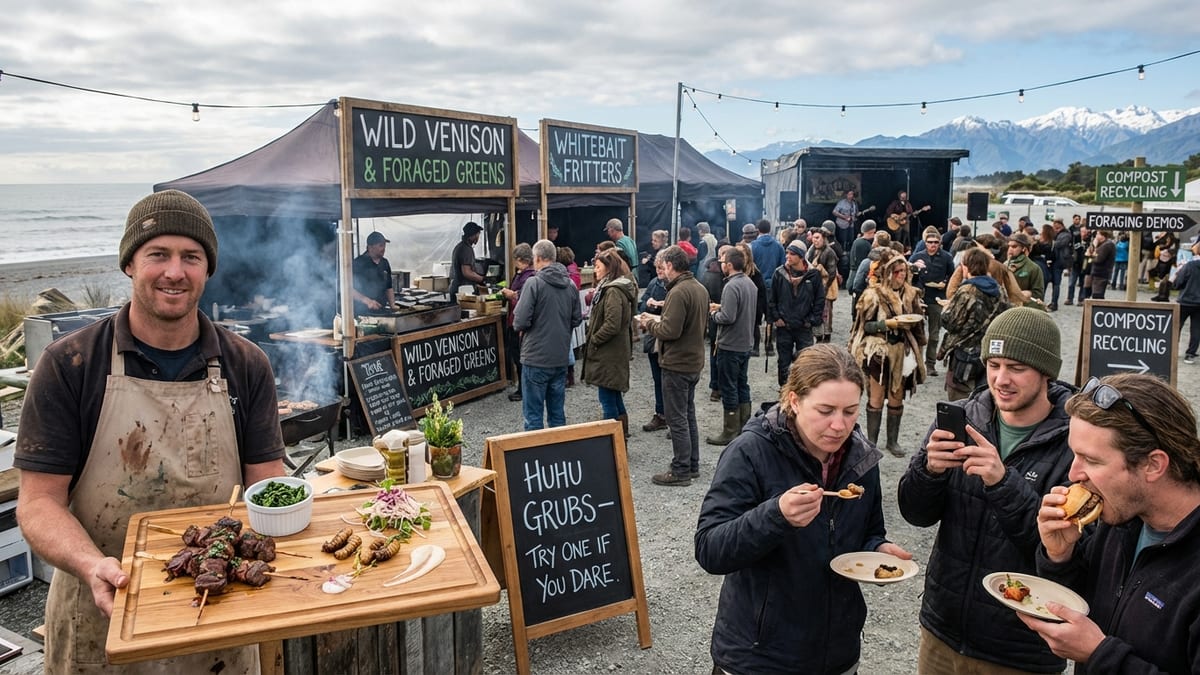
The festival’s menu reads like a cross between a natural history field guide and a dare list. Among the most talked-about items are huhu grubs, the creamy larvae of a native beetle, often cooked on site after being pulled from split logs. Local vendors serve sheep testicles, dubbed “mountain oysters,” next to wild pork, venison and foraged greens. Past editions have featured dishes incorporating everything from garden snails to unusual offal cuts and coastal plants.
Yet the culinary experience is not simply about shock value. The best stalls take pride in technique and flavor balance, marinating wild meat for tenderness, pairing sharp native herbs with rich sauces, or smoking fish with locally sourced woods to layer in complexity. Visitors who might initially queue up as a joke often return for second helpings. That alchemy, combining bravado with serious cooking, is what many chefs cite when they call Hokitika one of the most inventive food gatherings on the planet.
At a time when global gastronomy talks endlessly about sustainability and nose-to-tail eating, the festival’s ethos of minimal waste and whole-animal usage feels remarkably contemporary. These are principles Hokitika has quietly practiced for more than 30 years, long before they became culinary buzzwords.
From Wild Stunt to Culinary Laboratory
Over time, Wildfoods has evolved from what some dismissed as a novelty event into a de facto open-air test kitchen. The presence of high-profile New Zealand chefs, along with visiting culinary personalities, has helped slowly shift the narrative from “bizarre foods” to “radical terroir.” Cooking demonstrations, judging panels and informal collaborations between local cooks and guest chefs have become core parts of the weekend.
Some chefs use the festival as an opportunity to rethink familiar ingredients. Venison, long associated with rugged pub fare, appears as delicate tartares and slow-smoked ribs. Whitebait, often simply fried in fritters, may be reimagined in light tempuras or folded into custards. Others lean into the sense of spectacle, pairing items such as grubs with fine-dining techniques, setting them atop micro-herbs or serving them in tasting menus that mix the challenging with the comforting.
This experimental environment encourages risk-taking among stallholders as well. A local home cook might arrive with a single dish the first year, then return season after season with refined versions influenced by festival feedback. Some have parlayed Wildfoods success into permanent products or restaurant features, turning what began as one-off curiosities into viable business ideas.
The result is a feedback loop: the festival pushes boundaries, audiences respond, and both visitors and locals recalibrate what they consider “good food.” It is this capacity to reshape culinary expectations, rather than simply entertain, that has led some commentators to describe Hokitika Wildfoods as one of the most forward-thinking food festivals anywhere.
Crowds, Culture and Controlled Chaos
For all its culinary inventiveness, Hokitika Wildfoods is also a social phenomenon. Costumes are encouraged, and for many attendees dressing up in “feral fashion” has become as important as what they eat. On festival day, the town fills with groups in homemade outfits riffing on everything from native birds to kitchen utensils, adding a carnivalesque layer to the tasting experience.
Live music, often leaning heavily on New Zealand bands, plays across the site throughout the day. In the evenings, the celebration spills into local pubs, where visitors trade tasting notes and compare their most daring bites. A fireworks display has traditionally capped the event, underscoring that this is as much a community festival as a culinary one.
In its early 2000s heyday, popularity came with growing pains, including rowdy off-site gatherings and concerns from local authorities about public order. In response, organizers worked with police and community groups to cap ticket numbers, introduce alcohol controls and refine crowd management. The current format reflects those lessons: it is big enough to feel electric, but carefully contained to keep the focus on food and culture rather than excessive partying.
That balance of energy and order is another way Hokitika quietly outperforms more famous counterparts. Visitors get the excitement of a major event without the logistical grind or anonymous sprawl that can plague bigger, more commercial food festivals.
Why Global Travelers Still Overlook It
Given its distinctive character and longevity, Hokitika Wildfoods might be expected to top lists of must-visit culinary events. Instead, it often sits in the shadow of larger, more heavily marketed gatherings such as Taste of London, Melbourne Food & Wine Festival or the restaurant-studded weeks in cities like Singapore and New York.
One reason is geography. The West Coast of New Zealand, while spectacular, is far from major population centers. International travelers may visit the country’s vineyards in Marlborough or the restaurant scenes of Auckland and Wellington, but relatively few plan their itineraries specifically around Hokitika in March. Those who do often stumble upon the event through local word of mouth rather than glossy global campaigns.
The festival’s own communications lean more toward community engagement than international branding. Marketing budgets are modest, and organizers have historically prioritized regional attendance and manageability over aggressive expansion. In an age of social media spectacle, Wildfoods is more likely to appear in personal travel blogs and niche culinary publications than in mainstream global roundups.
Ironically, that low profile may be part of what makes the festival so compelling. Without the pressure to play to a global television audience or conform to sponsor requirements, Hokitika has been free to pursue an idiosyncratic path. It answers first to locals and regular visitors, and only second to external expectations. For discerning food travelers, that authenticity can be more valuable than name recognitions.
The Economic and Cultural Stakes for Hokitika
For Hokitika itself, Wildfoods is far more than a weekend of adventurous eating. The festival reliably injects tourism revenue into local accommodation, hospitality and retail businesses at a shoulder season time of year. Hotels and guesthouses typically book out months in advance, and small operators from tour guides to taxi services feel the impact.
Economic impact assessments over the years have highlighted not just direct spending on tickets and food, but wider benefits including return visits from festival-goers who later come back to explore the region’s glaciers, rainforests and beaches. For a town whose traditional industries such as mining and forestry have fluctuated, this kind of visitor-driven income is significant.
Culturally, the event acts as a powerful focal point. It keeps local food traditions alive by providing an annual stage to share them, and it encourages younger residents to value skills such as foraging, preserving and whole-animal butchery. The presence of renowned chefs and media also helps place Hokitika on the broader New Zealand culinary map, countering the perception that the country’s most interesting food is confined to its major cities.
At the same time, there is ongoing debate in the community about how far to lean into the festival’s more extreme offerings, and how to communicate its ethos to a changing public. Some in Hokitika would like to see an even greater emphasis on native ingredients, environmental education and regenerative practices, building on the event’s already strong sustainability narrative. Others caution against smoothing out the wild edge that drew attention in the first place.
How to Experience the World’s Best Little-Known Culinary Festival
For travelers intrigued by Hokitika Wildfoods, planning ahead is essential. The festival is typically held on a Saturday in early March, chosen to coincide with historically drier weather on the West Coast. Tickets often sell out, and accommodation in and around Hokitika can be scarce if bookings are left too late.
Most international visitors fly into Christchurch or Queenstown, then make the journey overland by car, campervan or bus, turning the festival into part of a broader South Island itinerary. The route itself, passing alpine passes, braided rivers and dense rainforest, is frequently cited as one of the most scenic drives in the country, adding to the sense of pilgrimage.
Once on site, the most rewarding approach is to sample widely and stay open-minded. Seasoned attendees recommend starting the day early, when queues are shorter and stallholders have time to talk through their creations. Many visitors balance daring bites with more familiar dishes: tasting a single huhu grub or unusual offal skewer before settling into a plate of expertly prepared venison or local seafood.
Comfortable shoes, weatherproof layers and a willingness to embrace unpredictability all help. So does a focus on conversation. Some of the festival’s most memorable moments come not from the food itself, but from the stories behind it: a hunter explaining how they source wild game responsibly, a forager sharing tips on coastal plants, or a chef outlining how a one-day experiment could shape their restaurant menu for months to come.
FAQ
Q1. What exactly is the Hokitika Wildfoods Festival?
The Hokitika Wildfoods Festival is an annual food event held in early March in Hokitika, on New Zealand’s South Island West Coast, showcasing unconventional local ingredients, wild game and experimental dishes alongside more familiar regional specialties.
Q2. Why do some people call it the world’s best culinary festival?
Supporters point to its singular combination of bold, often wild ingredients, genuine community involvement, serious cooking and small-scale, authentic atmosphere, which together deliver an experience many find more memorable and innovative than much larger, heavily commercialized food festivals.
Q3. Is the festival only about extreme or “gross-out” foods?
No. While unusual items such as grubs and offal draw headlines, the majority of stalls serve thoughtfully prepared dishes featuring local seafood, venison, pork, preserved produce and baked goods, with many options suitable for curious but less adventurous eaters.
Q4. When does the festival take place each year?
The festival is traditionally scheduled for a Saturday in early March, timed to take advantage of relatively settled late-summer weather on the West Coast. Exact dates are announced in advance so travelers can plan around them.
Q5. How difficult is it to get to Hokitika?
Hokitika is remote but reachable via domestic flights to regional airports and scenic road journeys from larger hubs such as Christchurch and Queenstown. Most visitors combine the trip with wider exploration of South Island landscapes, including glaciers and coastal national parks.
Q6. Do I need to buy tickets in advance?
Yes. Ticket numbers are capped to keep the event manageable, and they often sell out ahead of time. Booking festival entry and accommodation well in advance is strongly recommended, especially for international travelers.
Q7. Is the festival suitable for families?
Many families attend, drawn by the festive atmosphere, costumes and music. Parents typically curate what younger visitors taste, steering them toward milder foods while adults sample the more challenging dishes. As with any large event, supervising children in crowds is important.
Q8. What should I wear and bring?
Comfortable footwear, layers for changeable coastal weather and a waterproof jacket are advisable. Reusable water bottles, sunscreen and a small day pack for purchases and extra clothing also help, and many visitors add a costume element or quirky accessory to join the playful spirit.
Q9. Are there vegetarian or less adventurous options?
Yes. While wild meats are prominent, there are usually vegetarian dishes, baked goods, preserves and sweets on offer, as well as more conventional meat and seafood preparations for those who prefer to bypass the more provocative items.
Q10. How does the festival impact the local community?
The festival delivers a significant economic boost to Hokitika’s hospitality and tourism sectors, supports local producers and small businesses, and reinforces regional food traditions. It has also sparked wider interest in foraging, sustainable hunting and nose-to-tail cooking among both residents and visitors.