

More news on this day
In the middle of Bolivia’s Salar de Uyuni, the world’s largest salt flat, an abandoned hotel built entirely from salt blocks still draws visitors to its otherworldly, wind‑scarred halls.
Get the latest news straight to your inbox!
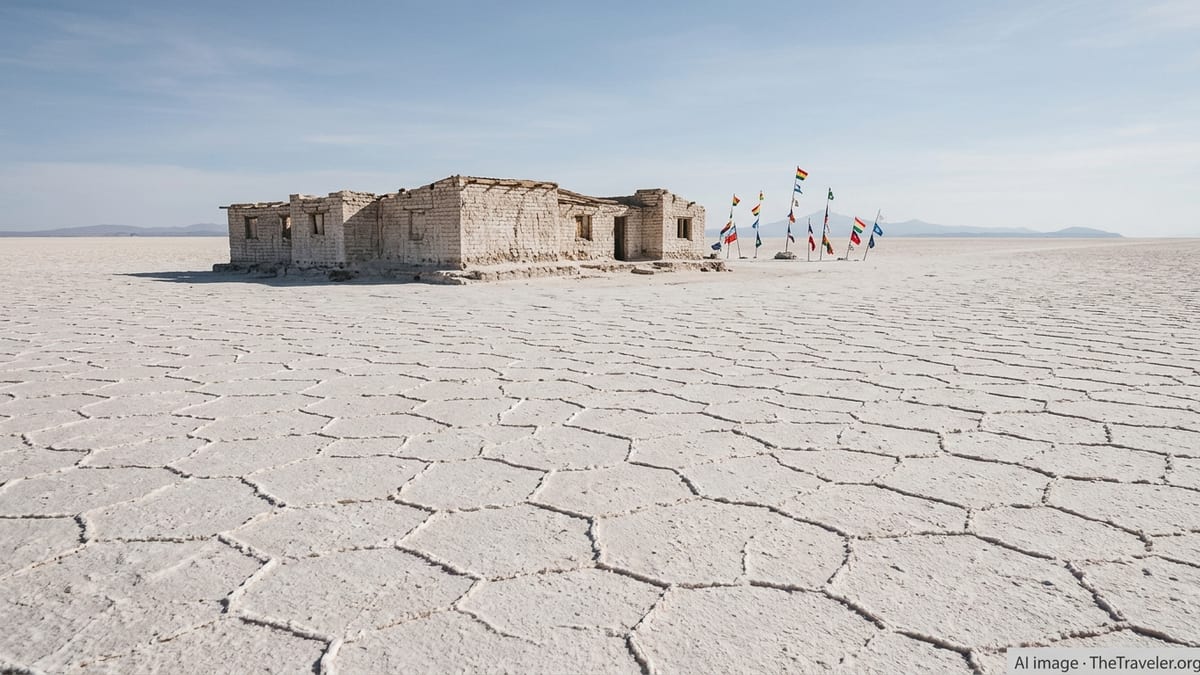
A pioneering salt hotel turned silent landmark
Playa Blanca, also known as Hotel de Sal Playa Blanca, was among the first hotels in the world to be constructed almost entirely from salt, from its walls and floors to beds and tables. Publicly available information traces its construction to the early 1990s, when tourism in the Salar de Uyuni was beginning to expand and basic infrastructure on the high Andean plateau was limited.
Positioned out on the salar itself rather than on the shoreline, the structure offered a rare chance for travelers to sleep in the middle of the vast white expanse. Tour operators promoted the novelty of its salt architecture and its isolation, with the building appearing to float on a sea of crystalline hexagonal tiles during the dry season and, at times, on a mirror of shallow water during the rainy months.
Over time, however, the challenges of running a hotel in such a remote, fragile environment became increasingly apparent. Reports indicate that Playa Blanca struggled with sanitation and waste management, issues complicated by its location far from established services and by a steady increase in visitor numbers. By the early 2000s, environmental concerns and regulatory pressure converged, and the hotel ceased operating in its original form.
From accommodation to ghostly attraction
Today, Playa Blanca is generally described in travel coverage and tour descriptions as deactivated or functioning only as a basic refuge and photo stop, rather than as a full-service hotel. Many tours crossing the Salar de Uyuni pause at the site so visitors can walk through the salt-block rooms, examine the grainy white walls, and experience the striking contrast between the bright exterior and the dim, echoing interior.
The building’s abandoned character has become part of its appeal. Inside, furniture sculpted from salt appears worn and pitted, while the floor crunches underfoot. Some sections are used for simple dining during day tours, particularly at lunchtime stops, but the overall impression is of a place frozen between past utility and present spectacle.
Outside, the hotel is framed by other manmade markers of the salar’s tourism boom. Immediately nearby is a cluster of brightly colored flags, often referred to as the Plaza de las Banderas, where travelers leave national banners and symbols of football clubs or cities. A salt-carved monument referencing the Dakar Rally, commemorating the international race’s route across the flats in the 2010s, adds another layer to the site’s hybrid identity as both ghost hotel and open-air museum of contemporary adventure travel.
Environmental lessons on a fragile salt desert
The story of Playa Blanca mirrors broader debates over how to manage tourism in one of Bolivia’s most iconic landscapes. Early development on the salar prioritized novelty and remoteness, with structures like this hotel placed directly on the salt crust. Over time, the environmental impact of concentrated visitor traffic, waste disposal, and vehicle access in such a delicate setting became harder to ignore.
According to historical summaries of the area, concerns over pollution from early salt hotels contributed to a shift in policy that favored dismantling or repurposing structures in the salar’s interior. Newer salt hotels were subsequently developed on firmer ground at the edge of the flats, closer to settlements such as Colchani and Uyuni town, where electricity, water, and waste systems could be managed with fewer risks to the environment.
Playa Blanca’s current status as an effectively abandoned site visited mainly by day tours highlights the tensions between access and conservation. Its eroding walls and scarred floors offer visitors a tangible reminder that the salar’s apparently endless white surface is, in reality, highly vulnerable to careless development and unmanaged mass tourism.
Modern salt hotels rise on the salar’s edge
While Playa Blanca has slipped into a ghostly half-life in the middle of the salar, a new generation of salt hotels has grown along its margins. Publicly available listings and hotel descriptions point to properties such as Palacio de Sal and other salt-built lodgings near Colchani and along the eastern shore, which now anchor most overnight stays associated with the salt flats.
These modern properties typically draw attention for their architectural flair and for amenities ranging from heated rooms to spas, while still using salt blocks for walls, floors, and furnishings. Many emphasize compliance with environmental regulations, including improved wastewater treatment, controlled vehicle access, and cooperation with local communities. The result is a stark contrast with the improvised infrastructure that once defined Playa Blanca’s heyday.
For travelers, the shift means that the experience of sleeping surrounded by salt usually takes place off the salar’s central crust, with Playa Blanca serving instead as a daytime excursion stop. Guides often weave the hotel’s history into broader narratives about the region’s changing tourism model, lithium exploration in the wider area, and the delicate balance between economic opportunity and ecosystem protection.
Visiting the ghost hotel on today’s tours
Most visitors reach Playa Blanca as part of organized one-day or multi-day tours departing from Uyuni or, less commonly, from the Chilean town of San Pedro de Atacama. Itineraries typically include stops at salt-harvesting operations near the edge of the flats, shallow waterholes known as ojos del salar, and the vast open plain used for perspective photographs, before pausing at the hotel and the surrounding flag plaza.
Depending on the season, Playa Blanca can appear in very different guises. During the dry months, usually the middle of the year, the building rises from a hard, blinding-white surface under intensely clear skies. In the rainy season, often between January and March, shallow water may transform the surrounding salt into a reflective sheet, giving the impression that the ghost hotel floats above the clouds. Tour companies frequently highlight these contrasts in their promotional material.
Travel information published in recent months indicates that visits to Playa Blanca are typically brief and focused on photos, rest breaks, and a look inside the aging structure. Overnight stays, when offered at all, tend to be limited and basic compared with the more established salt hotels on the salar’s rim. For many travelers, this fleeting encounter is enough: a walk through a decaying salt labyrinth at nearly 3,700 meters above sea level, framed by silence and an endless white horizon.