

More news on this day
Deep beneath the jungles of central Vietnam, Son Doong stretches for kilometers through the limestone of Phong Nha Ke Bang National Park, a surreal underground world so vast that parts of the cavern are wide and tall enough for a Boeing 747 to fly through without its wings touching either side.
Get the latest news straight to your inbox!
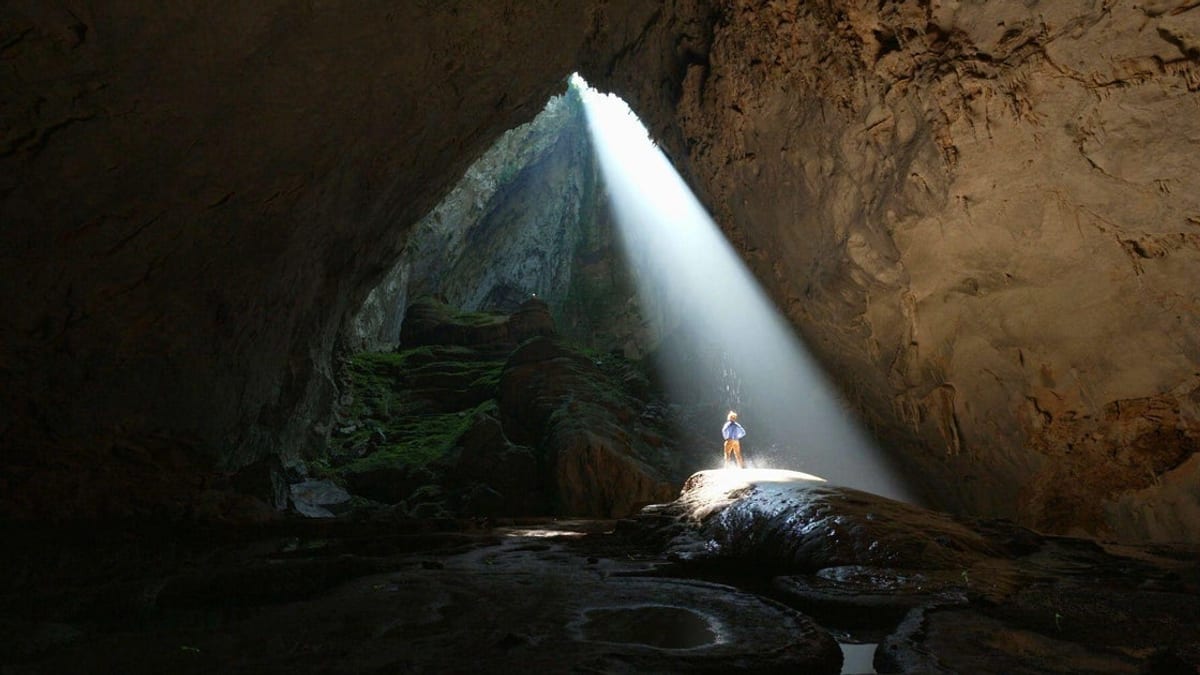
Image by CBS News
A subterranean giant reshaping Vietnam’s adventure map
First surveyed in detail in 2009 after being located by local hunter Ho Khanh, Hang Son Doong has since been recognized in multiple scientific and travel reports as the world’s largest known cave passage by volume. Laser measurements cited in recent geological studies indicate that some of its chambers reach around 200 meters in height and 150 meters in width, giving it a capacity comparable to an entire city block of skyscrapers.
The cave lies within Phong Nha Ke Bang National Park in Quang Binh province, a UNESCO World Heritage site near the border with Laos. The park already held several cave records before Son Doong’s emergence on the global stage, but the scale of this system has transformed the region’s profile from a niche caving destination into a flagship site for international adventure travel.
Published coverage by outlets including National Geographic and Live Science has helped turn Son Doong into a visual icon of extreme landscapes. Drone footage and 360 degree virtual tours have shown viewers around the world how daylight pours through collapsed ceilings, revealing forests, rivers and fog banks that form an alien looking ecosystem far below the surface.
The Boeing 747 comparison, repeated in guidebooks and promotional materials, has become shorthand for describing Son Doong’s magnitude. Travel and science writers note that some passages could accommodate a wide body jet, while other sections are large enough to fit dozens of Great Pyramids of Giza stacked together in the dark.
A six day journey through jungles, rivers and underground skylights
Son Doong is not a cave that visitors can see in a single afternoon. Publicly available itineraries show that the standard expedition runs for six days and typically covers about 17 kilometers on foot, with trekkers hiking through jungle, wading rivers and scrambling over boulder fields before reaching the main chambers.
The route usually begins with a trek through the forests of Phong Nha Ke Bang and an overnight at nearby Hang En, itself one of the world’s largest caves. From there, small groups descend into Son Doong via steep rocky slopes, guided along an underground river that threads through vaulted galleries and echoing tunnels.
Inside, two massive dolines, or sinkholes, have opened the cave roof to the sky, creating conditions for self contained jungles that thrive in pockets of light and mist. Travelers report that these “underground rainforests” are among the journey’s most striking sights, where ferns, trees and vines rise from sediment dunes beneath shafts of sun.
Further in, explorers encounter towering stalagmites, some measured at up to 70 meters high, and an area known informally as the “Great Wall of Vietnam,” where a ridge of calcite formations blocks the way like a frozen wave. Multi night camps on sandy beaches beside the subterranean river create a rare experience of sleeping inside a space large enough to swallow city blocks.
Strict limits, soaring demand and sold out seasons
Despite the cave’s huge size, access remains tightly controlled. Information released by the licensed operator and provincial authorities indicates that only around 1,000 visitors are allowed to enter Son Doong each year, a cap designed to protect the fragile environment and manage safety in one of the world’s most complex cave expeditions.
Recent Vietnamese media reports state that tours are fully booked through at least the end of 2027, with waiting lists extending beyond that. Data compiled by local outlets and the operator show that more than 7,500 travelers have completed the expedition over the past decade, representing visitors from more than 70 countries.
For the surrounding communities, Son Doong has become a significant economic engine. Public figures shared by provincial tourism departments suggest that revenues from the expedition and associated services have reached hundreds of billions of dong, with a portion paid as conservation and forest protection fees. Dozens of residents of the Phong Nha area now work as porters, safety assistants, cooks and support staff for the tours.
Travel magazines in the United States, Europe and Asia have increasingly highlighted Son Doong in lists of top adventure experiences. A feature by Travel + Leisure in 2025 described the cave as both the world’s largest and one of its most visually surreal, reinforcing the perception that successfully joining an expedition here has become a bucket list achievement for well prepared trekkers.
Conservation at the core of the Son Doong experience
Tourism in Son Doong operates under a narrow seasonal window. Public information from the operator indicates that expeditions typically run from January to August, pausing during Vietnam’s rainy months when river levels rise and access becomes more hazardous. This seasonal approach also gives parts of the cave ecosystem months of respite from human presence.
Reports on the cave’s management describe detailed conservation protocols that include small group sizes, strict waste removal policies and limits on where visitors can walk or camp. Everything taken into the cave is brought back out, from food packaging to human waste, in an effort to keep the environment as pristine as possible.
International conservation organizations that have visited the region have pointed to Son Doong as an example of how carefully managed adventure tourism can support both local livelihoods and protected area funding. By concentrating high value, low volume expeditions in a single operator model, planners aim to reduce the pressure that mass tourism can place on fragile karst landscapes.
At the same time, researchers and guides emphasize that Son Doong is still a living cave system subject to natural changes. Sections remain off limits to travelers to preserve speleothems, rare fauna and scientific study sites, reinforcing the message that visitors are guests in a still evolving geological world.
Planning a once in a lifetime descent
For travelers hoping to experience Son Doong, the combination of strict caps and long lead times means preparation is essential. Booking information shared by the operator and travel agencies suggests that places often sell out years in advance, with prospective visitors encouraged to register interest as soon as new seasons are announced.
The expedition is marketed as demanding but achievable for fit hikers. Public guidelines recommend that participants be able to run several kilometers in under half an hour and be comfortable carrying a daypack over uneven, slippery terrain for multiple days. Training in advance is advised, particularly for those unaccustomed to tropical heat and humidity.
Costs reflect both the logistical complexity and conservation model. Widely circulated figures place the price of the multi day tour in the several thousand dollar range per person, covering guiding, safety teams, equipment, permits, meals and accommodation before and after the trek in the Phong Nha area. For many, the high cost and physical challenge are offset by the rarity of stepping into a cave where an airliner could theoretically pass overhead.
As Vietnam continues to promote Quang Binh province as a hub for adventure tourism through 2030 and beyond, Son Doong remains the headline act. With its jungles under rock, rivers in permanent twilight and caverns on the scale of aviation hangars, the cave offers a singular journey into the heart of one of the most extraordinary underground landscapes on Earth.