


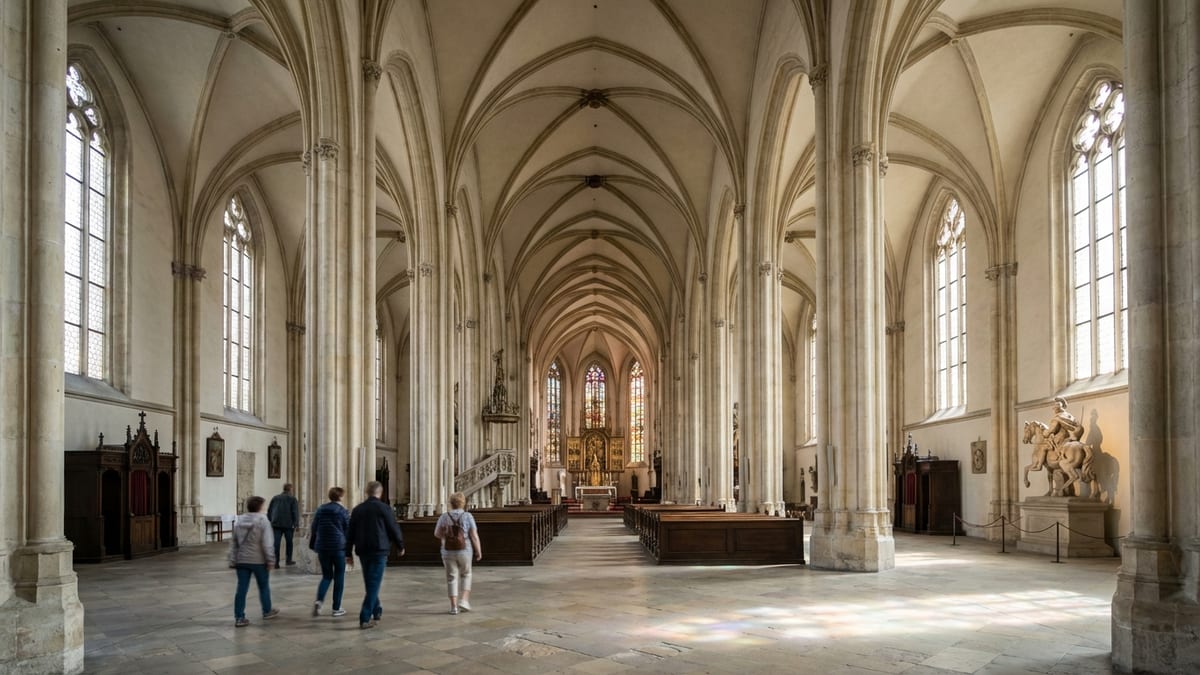
St Martin’s Cathedral in Bratislava is one of those rare churches where the weight of history and the elegance of Gothic architecture meet in a single, concentrated space. Step inside and the noise of the city falls away, replaced by a high, ribbed stone canopy, filtered light from stained glass, and the quiet echo of a sanctuary that once witnessed royal coronations. For travelers interested in architecture, sacred art, or the story of Slovakia’s capital, the Gothic interior of this cathedral is a compelling destination in its own right.
Entering the Gothic Hall: First Impressions of the Interior
The moment you step through the main entrance, St Martin’s reveals itself as a classic Central European Gothic hall church. Instead of a dramatically taller central nave, the three aisles are almost the same height, creating a broad, unified interior that feels more like a great stone hall than a basilica. Vaults sweep across the full width of the space, resting on a measured rhythm of clustered pillars, and the eye is naturally drawn to the distant chancel where the high altar and stained glass form a luminous focal point.
The scale of the interior surprises many first-time visitors. St Martin’s is nearly 70 meters long and more than 22 meters wide, with a nave rising around 16 meters. This is not an oversized cathedral by Western European standards, yet the proportions and the hall design give it an unexpected sense of openness. The columns are set to maximize visibility, so you can stand almost anywhere and enjoy a clear view toward the choir, the chancel vaults, and the main liturgical axis.
The overall color palette is restrained: pale stone, softened by the patina of centuries, offset by darker wooden furnishings and the deeper tones of the stained glass. This subtlety is part of the building’s Gothic character. Ornamental details exist in capitals, window tracery, and side chapels, but they rarely overwhelm the architecture itself. The result is a space that feels contemplative, yet firmly grounded in the medieval world that created it.
Gothic Structure and Vaulting: Reading the Stone
St Martin’s began as a Romanesque church before evolving into the Gothic cathedral seen today. Much of its internal drama comes from the late Gothic reconstruction of the nave and eastern chancel, completed by the late 15th century under the guidance of master builders connected to Vienna. Their work turned a modest parish building into a sophisticated hall church suitable for a royal coronation site, with a consistent Gothic vocabulary running from west to east.
The nave vaults are key to this transformation. Look upward and you will see rib vaults that spring from engaged shafts along the pillars, crossing the ceiling in a pattern of pointed intersections. These ribs are not just structural; they visually emphasize the vertical thrust of the architecture and organize the space into discrete bays. At the intersection joints, carved bosses add a decorative highlight, some bearing heraldic symbols or vegetal motifs linked to the patrons and civic elite of medieval Pressburg, as Bratislava was then known.
In the chancel, where the clergy once gathered for the liturgy and where the high altar stands, the Gothic language becomes even more elaborate. The polygonal east end is framed by tall, pointed windows set between buttresses outside, while inside, the vaulting appears more refined, with complex rib patterns and a greater sense of height. This was intentional: the chancel was designed to outshine the earlier nave and to signal the enhanced prestige of the church when the city became a coronation center for the Kingdom of Hungary.
As you move through the aisles, pay attention to the subtle changes in profile and detail that reveal the building’s long construction period. Some arches are slightly different in curvature or moulding, hinting at evolving styles and workshops. Together, these nuances give the interior its layered, lived-in character, reminding visitors that Gothic cathedrals were not instantaneous creations but multi-generational projects.
Side Chapels and Sacred Corners: Gothic and Baroque in Dialogue
One of the most rewarding ways to explore St Martin’s interior is to walk slowly along the side aisles, where chapels open like small theaters of devotion. The cathedral has four principal chapels: the canons’ chapel, the Gothic chapel of Sophia of Bavaria, the chapel of St Anne, and the Baroque chapel of St John the Merciful. Each has its own architectural language and historical associations, revealing how the interior evolved as both a liturgical and memorial space.
The Gothic chapel of Sophia of Bavaria, widow of King Wenceslas IV, is especially atmospheric. Tucked along the northern side, it preserves late medieval features that complement the main structure. Here the stonework feels more intimate, the vaulting lower, and the decorative details more focused on the tombs and epitaphs that marked it as an aristocratic burial space. The chapel of St Anne, also Gothic in origin, contributes to this northern cluster of medieval devotions, its vaults and wall surfaces bearing traces of earlier polychromy and furnishings.
In contrast, the Baroque chapel of St John the Merciful introduces a different visual language. Added in the 18th century, it features more sculptural decoration, and its focal point was designed by the renowned Austrian sculptor Georg Raphael Donner. Although the wider cathedral was later returned to a more pronounced Gothic appearance, this chapel retains its Baroque identity, creating a vivid dialogue between stylistic periods inside the same building.
The canons’ chapel, used historically by the cathedral chapter, reinforces the status of St Martin’s as an ecclesiastical center rather than a mere parish church. These side spaces highlight that, despite later restorations aiming to “purify” the Gothic character of the interior, the cathedral remains a palimpsest of periods and tastes. For visitors, they provide sheltered corners to pause, study the details, and appreciate how centuries of worship and patronage have layered meaning into the walls.
The High Altar, Sculpture and Stained Glass
At the heart of the Gothic interior stands the high altar and the chancel ensemble, which together draw the visitor’s eye as the ultimate focal point of the building. The current arrangement reflects both historical continuity and modern liturgical adaptation, but its spirit remains deeply Gothic. The tall east windows act almost like luminous panels, flooding the sanctuary with colored light when the sun strikes the stained glass. Scenes from the life of Christ, Marian imagery, and saintly figures appear in the glass, framed by delicate stone tracery.
Sculpture plays a crucial role in giving the cathedral interior its personality. Among the most famous works is Donner’s early 18th-century group of St Martin on horseback sharing his cloak with a beggar. Originally created for the main altar, this ensemble now stands in the side nave as a free-standing work, offering visitors a close view of Donner’s expressive treatment of drapery, anatomy, and movement. Though Baroque in date, the subject matter ties directly to the cathedral’s dedication and to the medieval cult of St Martin, creating a thematic bridge with the Gothic architecture.
Elsewhere in the church, Gothic and Neo-Gothic altarpieces, crucifixes, and statues punctuate the space. Many of the furnishings were replaced or reworked in the 19th century, when a wave of historicist restoration sought to strengthen the Gothic character of the interior after earlier Baroque modifications. While art historians sometimes debate the purity of these interventions, most visitors experience them as part of a harmonious ensemble that respects the lines and atmosphere of the late medieval cathedral.
Music also shapes the contemporary experience of the interior. A large modern organ, installed in the early 21st century with thousands of pipes and dozens of registers, fills the hall church with sound during liturgies and concerts. Hearing a recital in the nave, with the notes resonating beneath the vaults, offers another way to appreciate how the Gothic architecture was conceived to amplify both sight and sound in a sacred setting.
Royal Coronations and Crypts: History Beneath the Vaults
The Gothic interior of St Martin’s cannot be separated from its long role as a coronation church. Between the mid-16th century and 1830, when Bratislava served as a key city of the Hungarian kingdom, ten kings, one queen, and seven royal consorts of the Habsburg dynasty were crowned here. Inside the nave, imagine platforms, banners, and canopies filling the space, with nobles packed into the aisles and the chancel transformed into a stage for royal ritual. The scale and clarity of the hall church design were ideal for such ceremonies, allowing both clergy and civic elites to witness the event.
Traces of this royal past remain woven into the cathedral. Heraldic symbols in stained glass and stone, references to coronation regalia, and memorial tablets to prominent figures of the kingdom all contribute to an interior that is equal parts church and state sanctuary. The gilded replica of the Hungarian Crown that crowns the 85 meter tower outside is a reminder of this history, but inside the more subtle markers invite careful looking and informed imagination.
Below the Gothic floor, the story continues in the crypts. Around ninety burial sites lie beneath the cathedral, many dating from the period when Pressburg was a political and ecclesiastical hub. While not all areas are accessible to the casual visitor, their presence underscores that St Martin’s functioned not only as a place for coronations but also as a favored burial church for bishops, clergy, and members of the political elite. The Gothic structure above, with its stable supports and robust vaulting, provided a secure shelter for these subterranean spaces.
Today, the cathedral continues to host re-enactments and commemorative events that recall its coronation past. Stepping into the nave during these occasions, with period costumes and music echoing through the hall, can give modern visitors a sense of how the Gothic interior once functioned as a ceremonial theater of power as well as a house of worship.
Lighting, Atmosphere and Practical Visiting Details
Part of what makes St Martin’s interior so memorable is the quality of its light. Because the building is integrated into the former city walls and hemmed in by streets and nearby structures, daylight filters in laterally more than from great western windows. This side lighting accentuates the ribs, capitals, and tracery of the aisles and chapels, casting soft shadows that change with the time of day. On bright afternoons, shafts of color from the stained glass fall across the stone floor; on overcast mornings, the interior takes on a cool, evenly lit calm.
Artificial lighting is kept relatively discreet, which helps preserve the authenticity of the Gothic atmosphere. Spotlights highlight altars and sculptures, but large sections of the vaulting remain in natural semi-shadow, encouraging visitors to look slowly and adjust their vision as they move. Photography is generally possible, but using the eyes first and the camera second tends to be more rewarding here, especially when pausing beneath the central bays of the nave or in the chancel.
From a practical standpoint, St Martin’s is an active Roman Catholic cathedral, with regular services alongside its role as a major tourist attraction. Typical opening hours run from morning to late afternoon or early evening on weekdays and Saturdays, with more limited visiting hours on Sundays to respect liturgies. There is no heavy security atmosphere; entry is straightforward, though visitors are expected to dress modestly, keep voices low, and avoid walking around during Mass.
Because the interior is not overly vast, most travelers can explore it thoroughly in 30 to 45 minutes, but architecture and history enthusiasts may linger longer, tracing each bay of the vaults, examining the chapels, and studying the art. Benches in the nave and side aisles offer places to sit and absorb the space, and it is worth taking a few minutes simply to be still in the center of the hall, letting the proportions and details gradually reveal themselves.
Restoration, Preservation and the Cathedral Today
Like many historic Gothic churches, St Martin’s has endured fires, structural challenges and changing tastes. A lightning strike in the early 19th century forced the rebuilding of the tower helmet, spurring a larger Neo-Gothic restoration of the western façade. In the 18th century the interior had already been refitted in Baroque style, only to be steered back toward a more Gothic appearance in the 19th century, when medieval elements were selectively revived and later additions removed or toned down.
More recent decades have focused less on stylistic reworking and more on conservation. Systematic restoration campaigns began in the late 20th century, addressing structural issues, weathered stone, facade plaster, and roof coverings. A gold-plated replica of the Hungarian crown on the tower was restored to its former brilliance, while careful masonry and conservation work has stabilized the chancel and nave. Inside, projects have improved lighting, restored chapels, and integrated modern facilities as discreetly as possible.
Despite its restored beauty, the cathedral faces ongoing challenges. Heavy traffic on nearby bridge ramps and roads has been noted as a source of vibration and pollution, affecting both the stone fabric and the visitor atmosphere. Preservationists and city planners must balance modern infrastructure with the needs of a medieval monument that functions as a living place of worship and a national symbol.
For visitors today, these efforts mean that the Gothic interior is in better condition than it has been in generations. Cleaned stone, stabilized vaults and refreshed stained glass allow the original architectural vision to come through clearly. When you stand beneath the nave vaulting or in the chancel looking east, it is easier than ever to imagine the church as it might have appeared at the end of the 15th century, when newly completed, or during the high age of coronations that followed.
The Takeaway
Inside St Martin’s Cathedral, Bratislava reveals itself not just as a charming Central European capital, but as a former royal city whose identity was forged beneath Gothic vaults. The hall church interior brings together the ambition of medieval patrons, the ceremony of Habsburg coronations, the devotion of generations of worshippers, and the patient work of modern conservators. It is a space where architecture, history and faith are inseparable.
For travelers, the cathedral is both a highlight of Bratislava’s Old Town and a rewarding study in Gothic design. The unified height of the three-aisled nave, the sculpted vaults of the chancel, the contrasting chapels and the quietly eloquent side altars all invite closer inspection. Yet even without specialist knowledge, visitors feel the power of its proportions and the dignity of its light-filled stone hall.
Whether you enter for a quick look between other sights or stay for a concert or service, the interior of St Martin’s leaves a lasting impression. It stands as a reminder that, in a compact cityscape dominated by a hilltop castle and riverside modernity, some of Bratislava’s most compelling stories are still told in Gothic stone, beneath a crown-topped tower that has watched over the city for centuries.
FAQ
Q1: Where is St Martin’s Cathedral located within Bratislava?
St Martin’s Cathedral stands at the western edge of Bratislava’s Old Town, close to the base of Bratislava Castle and near the approach to the main bridge over the Danube. It is easily reached on foot from the city’s historic streets and main squares.
Q2: What makes the interior of St Martin’s Cathedral Gothic?
The interior is characterized by a three-aisled hall plan with pointed arches, rib vaults, clustered pillars and tall traceried windows. These elements, along with the late medieval chancel and Gothic side chapels, define the building’s architectural style.
Q3: How long does it take to visit the interior of the cathedral?
Most visitors spend about 30 to 45 minutes inside, which is enough time to walk the nave, explore the chapels and study the main artworks. Architecture enthusiasts or those attending a service or concert may choose to stay longer.
Q4: Are there any notable artworks to look for inside?
Yes. The most famous is Georg Raphael Donner’s sculptural group of St Martin on horseback sharing his cloak with a beggar, now displayed in a side nave. Visitors should also pay attention to the stained glass in the chancel and the furnishings and altars in the chapels.
Q5: Can visitors see the royal coronation-related features inside?
While the coronation ceremonies themselves are long past, visitors can see heraldic symbols, memorials and spatial arrangements that reflect the cathedral’s role as a coronation church. Re-enactments held annually help bring this history to life, though they are not daily events.
Q6: Is there an entrance fee to visit the interior?
The cathedral has traditionally been open to visitors either free of charge or for a modest voluntary contribution, with occasional fees for special exhibitions or guided tours. It is advisable to check current conditions on site or with local tourist information before visiting.
Q7: Are there any rules for photography inside the cathedral?
Photography for personal use is generally allowed, but visitors are expected to be discreet, avoid flash during services and respect posted signs or staff instructions. Tripods and professional equipment may require special permission.
Q8: Is the cathedral accessible for visitors with limited mobility?
Access to the main nave is relatively straightforward, but some chapels, steps and uneven stone floors can pose challenges. Recent projects have aimed to improve accessibility, yet not all historic areas can be fully adapted, so visitors with mobility needs may wish to plan ahead.
Q9: When is the best time of day to appreciate the Gothic interior?
Late morning and early afternoon often provide the most dramatic natural lighting, as sunlight filters through the stained glass and side windows. Visiting outside of major services also allows more freedom to move around quietly and study the architecture.
Q10: Can I attend a Mass or concert at St Martin’s Cathedral?
Yes. Regular Catholic Masses are held throughout the week, and concerts or organ recitals are periodically scheduled, especially during festivals and special occasions. Joining a liturgy or musical event is an atmospheric way to experience the cathedral’s Gothic interior in use.