

More news on this day
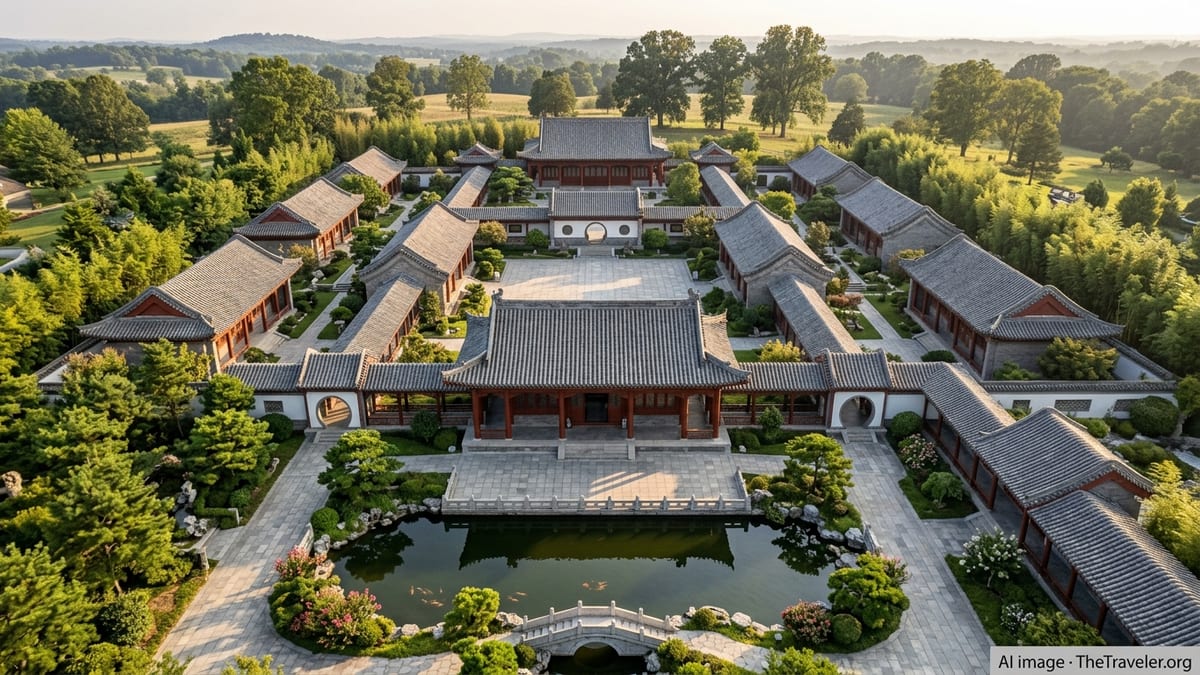
A sprawling U.S. property known as Taishan Estate has arrived on the market for around $23 million, inviting potential buyers into a meticulously crafted world of ancient Chinese architecture, landscaped courtyards and cultural symbolism rarely seen in North American luxury real estate.
Get the latest news straight to your inbox!
A Palace-Inspired Retreat Reimagines Ancient China
Taishan Estate takes its name and inspiration from Mount Tai, one of China’s most revered sacred peaks, long associated with imperial worship and longevity. The estate’s design borrows heavily from traditional northern Chinese palace and temple layouts, adapting them to a contemporary residential setting while preserving a strong sense of ceremonial grandeur.
Publicly available listing information describes a multi-structure compound arranged around enclosed courtyards, with axial pathways, pavilions and gateways echoing the planning principles of historic Chinese imperial sites. Rooflines rise in sweeping, tiered profiles, with deep eaves, ornamental brackets and ridge decorations that recall classical palace architecture without directly copying any single monument.
At an asking price in the vicinity of $23 million, the property positions itself at the very top of the local market, comparable in ambition to other global trophy homes that mimic European chateaus or modernist glass pavilions. What sets Taishan Estate apart is its immersive narrative: it is not simply a mansion with Asian-influenced décor, but a residence conceived from the ground up as an evocation of a traditional Chinese compound.
From the entry sequence onward, the emphasis is on procession, symmetry and framed views. Visitors move through gates and forecourts before arriving at the main hall, a circulation pattern that mirrors the hierarchical spaces of historic Chinese residences where thresholds marked shifts in privacy, status and ritual function.
Courtyards, Water and Gardens Shape a Cultural Landscape
Landscaping at Taishan Estate is central to its appeal, drawing on classical Chinese garden traditions in which rocks, water, trees and pavilions are composed like a living scroll painting. Listing photos and descriptions highlight a series of walled courtyards and outdoor rooms, each designed to feel self-contained yet interconnected, allowing residents to experience the property as a sequence of unfolding scenes.
Water features play a key role, with ponds, rills or reflecting pools positioned to capture sky and architecture in their surfaces. Bridges and stepping stones introduce movement and sound, while planted edges blur the line between built space and nature. The overall effect is intended to echo historic literati gardens, where scholars once retreated to write poetry and paint landscapes in seclusion.
Rockeries and carefully placed boulders reference the scholar’s stones prized in Ming and Qing dynasty collections. These sculptural elements, combined with mature trees and bamboo groves, generate depth and layered sightlines within a relatively controlled footprint. Garden structures such as open-sided pavilions and covered walkways offer shaded vantage points toward the main residence and the surrounding grounds.
At night, discreet exterior lighting emphasizes rooflines, gateways and garden silhouettes rather than raw brightness. The result is a low-key atmosphere that remains usable for entertaining, yet retains the moody, contemplative character associated with historic temple precincts and courtyard homes.
Interior Design Blends Traditional Motifs with Modern Luxury
Inside, Taishan Estate continues the thematic journey, combining traditional Chinese motifs with contemporary comforts expected at the $23 million level. Public descriptions point to grand reception halls with double-height ceilings, exposed timber trusses and carved screens that allude to historic palace interiors while accommodating modern furniture and lighting.
Wood plays a dominant role, from coffered ceilings and latticework to intricately detailed door panels. Darker stained timbers are often contrasted against pale stone or plaster walls, creating a restrained, gallery-like backdrop for art and antiques. Decorative elements such as fretwork, cloud patterns and stylized lotus designs appear in railings, window frames and ceiling borders, adding subtle layers of cultural reference.
The bedroom suites and private lounges introduce softer, more contemporary lines, with expansive glazing in select areas to open views toward gardens and distant landscape. Yet even here, the design leans on traditional materials like stone, wood and bronze rather than overtly glossy finishes, preserving the overall historic mood of the compound.
Behind the scenes, the property incorporates the full set of modern amenities associated with top-tier estates: a professional-grade kitchen for catering, temperature-controlled storage for wine or art, spa-style wellness facilities and smart-home infrastructure. The integration is deliberately discreet, allowing residents to inhabit a space that feels timeless while still meeting current expectations for technology and comfort.
A Niche Trophy for Global Buyers Seeking Cultural Immersion
The arrival of Taishan Estate on the market highlights a broader trend in international luxury real estate toward themed trophy properties that deliver not only square footage, but also a strong sense of story. In this case, the narrative is steeped in Chinese cultural history, appealing to buyers who value heritage architecture or who wish to express personal or family connections to China through their primary or secondary residence.
In recent years, agents and analysts have pointed to growing demand among global high net worth individuals for homes that express a specific cultural or architectural identity, from Tuscan farmhouses in the United States to Japanese-inspired pavilions on European lakefronts. Taishan Estate fits squarely within this trajectory, but with a focus on traditional Chinese design that remains comparatively rare at this scale in North America.
At a price point around $23 million, the estate competes with coastal compounds, contemporary glass villas and historic European-style mansions. Its differentiator is the depth of its cultural immersion, which could resonate with collectors of Asian art, cross-border entrepreneurs or families who divide their time between North America and major Chinese cities.
Market observers note that such highly customized properties can require longer marketing periods, since the pool of potential buyers is smaller and more specific. However, when a match is found, themed estates often command premium valuations because they cannot be easily replicated and would be difficult to reconstruct under current planning, cost and craftsmanship constraints.
Positioning Taishan Estate Within Global Luxury Travel and Lifestyle
Although conceived as a private residence, Taishan Estate also intersects with the realm of high-end travel and experiential hospitality. The compound’s layout, guest accommodations and entertainment spaces resemble those of boutique resort retreats that offer curated cultural experiences alongside seclusion and security.
For affluent travelers accustomed to staying in palace hotels, ryokan-style inns or historic riads, a property like Taishan Estate offers the possibility of bringing that level of atmosphere into everyday life. The estate’s architecture and gardens suggest potential for multigenerational gatherings, private cultural events or artist residencies that blur the boundaries between home and destination.
Industry watchers suggest that if acquired by an investor rather than an owner-occupier, a property of this type could be repositioned in the future as an invitation-only retreat, small-scale cultural venue or film location, subject to local regulations. Its distinctive design and self-contained layout are well suited to hosting immersive stays focused on wellness, calligraphy, tea culture or other aspects of Chinese tradition.
Whether used as a personal sanctuary or a discreet venue for high-profile guests, Taishan Estate underscores how global luxury real estate increasingly draws on deep cultural narratives. Its arrival on the market at approximately $23 million invites not only a buyer, but also an audience of travelers and architecture enthusiasts eager to see how faithfully ancient China can be evoked within a contemporary North American landscape.