

More news on this day
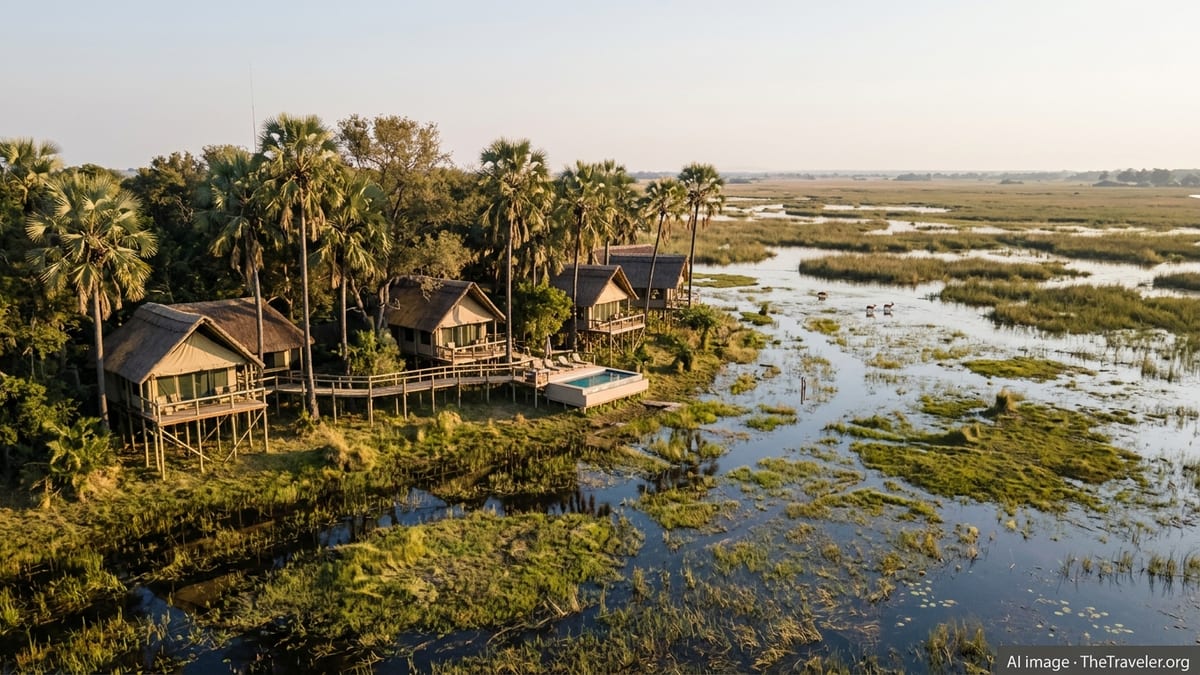
One of Botswana’s most secluded safari hideaways, Kwetsani Camp in the Okavango Delta, has been reimagined as a contemporary, low-impact retreat that combines elevated treehouse-style luxury with a stronger focus on renewable energy, conservation and quiet immersion in the floodplains below.
Get the latest news straight to your inbox!
A Remote Island Camp, Redesigned for Seclusion and Space
Kwetsani Camp sits on an elongated, palm-fringed island in the private Jao Reserve in the northwestern Okavango Delta, a setting that has long made it one of the region’s more remote properties. Recent updates, detailed in new brochures and trade fact sheets, highlight how the camp’s design has been refined to emphasize its treehouse concept and expansive views over surrounding floodplains and channels.
The camp remains deliberately small, with just five tented “treehouse” suites raised on wooden decks and linked to the main areas by elevated walkways. Public descriptions indicate that suites are now more open-plan, with large mesh windows and private verandas intended to maximize airflow and wildlife viewing rather than rely heavily on mechanical cooling. The intimate scale continues to position Kwetsani for travelers seeking privacy rather than a larger resort environment.
Common spaces, including a thatched lounge, dining areas and pool deck, retain a classic safari style but with lighter, more contemporary finishes and calmer, neutral palettes. The reimagining appears focused on subtle reconfiguration and refresh rather than a complete rebuild, aligning the camp with newer Delta openings while preserving its original character as a quiet, treetop refuge.
Solar Power and a Lighter Eco Footprint
Kwetsani has operated for several years under a hybrid solar and generator system, but current property descriptions from Wilderness and specialist tour operators now foreground its solar-powered operations as a core part of the offering. Updated information indicates that inverters and battery storage support 24-hour electricity in guest tents and main areas, while generators run in back-of-house spaces and are generally switched off when guests return from activities.
Thermodynamic solar geysers provide hot water, and charging points for cameras and mobile devices are powered via the camp’s inverter network. This shift toward more prominent solar infrastructure follows a broader trend in the Okavango, where high-end camps are increasingly marketed on their ability to minimize fuel use and noise in sensitive wildlife areas.
Kwetsani’s operators position the camp within a larger conservation ambition that includes research partnerships and commitments to expand protected acreage across their portfolio by 2030. While the exact share of Kwetsani’s power now delivered by solar versus back-up generation is not broken out in public documents, the camp is consistently described as operating with a light footprint, supported by water-saving fixtures and careful waste management in line with Delta regulations.
Treehouse Suites, Views and In-Camp Comforts
The reimagined Kwetsani places strong emphasis on elevated living spaces that look out over open plains, reed beds and seasonal waterways. Each of the five suites is raised on a deck, with interiors described as “treehouse-style” and furnished with large beds draped in mosquito netting, indoor and outdoor seating, and en suite bathrooms with hot showers.
Materials lean toward timber and thatch, with soft furnishings in muted tones that echo the surrounding papyrus and palm landscape. Newer marketing images and copy suggest that décor has been streamlined, with fewer heavy textiles and more natural textures to keep interiors cool in the hot months and to reduce visual intrusion on the environment.
The main area includes a small swimming pool overlooking the floodplain, as well as bar and lounge corners designed for relaxed downtime between activities. Reports from specialist travel companies note that dining remains flexible, with meals often served on the deck under the trees or out in the open when conditions allow, reinforcing the camp’s low-key, nature-forward atmosphere.
Safari Activities Shaped by Seasonal Water Levels
As with other parts of the Jao Reserve, the experience at Kwetsani is closely tied to the Okavango’s shifting flood patterns. Product updates released in late 2024 indicate that low water levels have restricted boat-based activities in recent seasons, although there has remained sufficient water to offer traditional mokoro excursions in nearby channels.
Guests typically combine game drives by open 4x4 vehicle with mokoro outings and, when levels permit, motorboat trips deeper into the floodplains. The private nature of the concession means vehicles can leave established tracks where appropriate, which often translates into extended sightings of predators such as lions and leopards, as well as large herds of red lechwe and other antelope adapted to the wetland environment.
Walking safaris may also be offered when conditions are suitable, giving guests a closer look at smaller details like tracks, feathers and floodplain flora. Travelers planning visits in coming seasons are being advised by tour operators to pay close attention to up-to-date water forecasts and recent field reports, as Delta hydrology has been more variable in recent years.
Access, Ownership Changes and Booking Considerations
Kwetsani is accessed via light aircraft from Maun to the Jao airstrip, followed by a game drive transfer of around 30 minutes, depending on sightings along the way. The logistics remain broadly consistent with other remote Delta camps, requiring guests to use scheduled charter flights arranged through tour operators or the camp’s central reservations.
In the background, the Jao Reserve has been the focus of a legal and commercial dispute between Wilderness and the local leaseholders over sales and marketing arrangements. Travel trade coverage from late 2025 and 2026 notes a move toward the Jao Collection brand handling more of the direct marketing for camps in the concession, even as existing bookings made through Wilderness continue to be honored.
For travelers, this evolving structure primarily affects who manages reservations and how the camp is branded in brochures, rather than the on-the-ground experience. Prospective guests are being encouraged by specialist agents to check which entity is handling their booking and to reconfirm transfer arrangements, cancellation terms and any changes to activity offerings ahead of travel, particularly as the reimagined Kwetsani positions itself as a high-end, eco-sensitive choice in a fast-evolving Delta safari landscape.