


I walked into Tuol Sleng Genocide Museum in Phnom Penh with my stomach already tight. I knew it had been a school turned into Security Prison 21 under the Khmer Rouge, and I knew that most of the people who entered never left alive.
Still, the reality of the place, room by room, was different from what I had imagined. It was at once quieter, more ordinary, and more horrifying than any documentary had prepared me for.
Practicalities Before You Step Inside
I visited on a hot weekday mid-morning, arriving a little after 9 am. The museum is open daily from 8 am to 5 pm, and tickets were straightforward to buy at the entrance. As a foreign adult I paid 5 US dollars for admission, plus another 5 dollars for the audio guide. Cambodians can enter free of charge, which felt appropriate for a site that is as much a national wound as a tourist attraction.
There were no queues when I arrived, but I noticed that by around 11 am the courtyard had become noticeably busier. Tour buses pulled up, and large groups swelled around the entrance and along the ground-floor corridors. If I went again, I would try to be at the gate right at 8 am, both to avoid the midday heat and to experience the rooms with a bit more silence and space.
The dress code is conservative, and in this context I was grateful for it. Shoulders and knees should be covered, and it is not a place for flashy outfits or loud behavior. Photography for personal, non-commercial use is allowed, but pointing a camera at everything felt deeply uncomfortable. I took only a handful of photos in less graphic spaces and kept my phone in my bag most of the time. It is not enforced as strictly as I expected, and some visitors were posing in ways that felt inappropriate. This lack of monitoring was one of the first little frictions for me, and it stayed in the back of my mind throughout the visit.
If you do nothing else to prepare, I strongly recommend paying for the audio guide at the entrance. You get a headset and a small device with numbered stops, available in multiple languages. There are also human guides (donation based), but they were already engaged with groups when I arrived. The audio guide pace is slow and reflective rather than rushed, and without it I think I would have walked through the rooms understanding the horror in only the vaguest sense.
First Impressions in the Courtyard
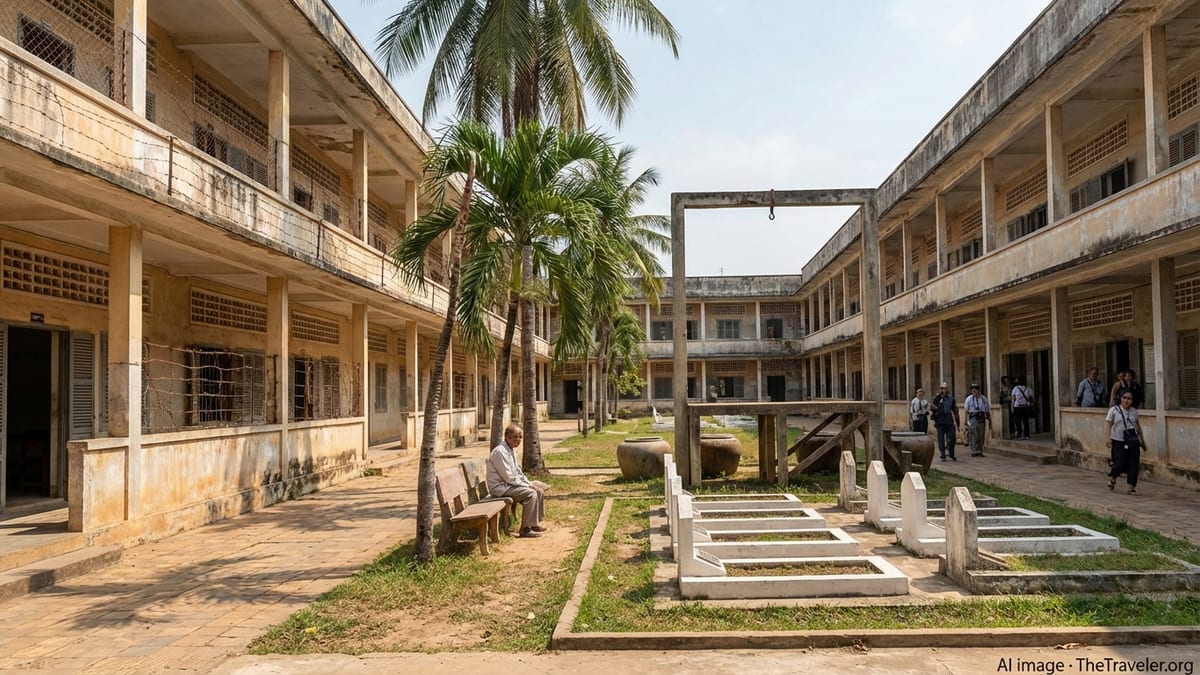
Stepping past the entrance, I found myself in an open courtyard surrounded by four long, rectangular concrete buildings. It still looks very much like a high school. There are palm trees, a few benches, and in the middle, tidy white concrete graves marking the last 14 bodies found in the prison when the Vietnamese army entered Phnom Penh in 1979. A simple gallows structure stands nearby, once used as part of a torture method involving near-drowning in water jars.
My first reaction was almost disorienting. Under the bright Cambodian sun, with a faint breeze and the sound of distant traffic, the compound looked unassuming. Children were not running around, but it was not the bleak, dark, decaying fortress my mind had conjured up. If anything, the ordinariness made it more unsettling. It took me a few minutes to adjust my expectations from cinematic horror to the blunt reality of a former school re-purposed into a machine of cruelty.
The audio guide begins here, in this courtyard, giving context to what S-21 was and how it functioned. It also warns gently about the graphic nature of some rooms ahead and makes it clear that I could skip any part I did not feel ready to see. That tone of consent was something I appreciated. I did not feel pushed to “consume” trauma; I felt invited to bear witness as far as I was able. Still, I quickly realized this was going to be a draining experience, one that benefits from moving slowly and taking breaks in the shade.
Building A: The Interrogation Rooms and Rusting Beds
I started in Building A, nearest to the main entrance. The ground-floor rooms here are some of the most difficult spaces in the museum. Each large classroom was turned into an interrogation and torture room, and today they are nearly empty. There is usually only a single metal bedframe, some rusted shackles or an iron bar, and on the wall a black-and-white photograph showing how the Vietnamese found the room in 1979: the same bed, the same position, but with a mutilated body still chained in place.
It is a simple curatorial choice, but it hit me harder than any elaborate exhibit might have. There is no glass case to mediate what you see, no dramatic lighting. I found myself standing a few steps from these beds, looking back and forth between the metal frame and the photo. I could not stay in each room for very long. The audio guide describes torture methods used here, and between that calm voice in my ear and the images on the wall, the atmosphere became almost suffocating.
One frustration I had here was the crowding. Despite signs asking for silence and respect, some groups moved through very quickly, chatting or whispering to each other, and at times I felt pushed along by the flow of bodies. There was no staff presence inside the rooms to manage behavior, so it depended entirely on the mindfulness of visitors. I found myself repeatedly stepping aside to let others pass, trying to reclaim a tiny bubble of quiet to actually absorb what I was seeing.
On the upper floors of Building A, there are larger communal cells and more exhibits, including background information about the Khmer Rouge and the transformation of the school into S-21. Here the interpretive panels are dense and text-heavy. As someone who likes context, I appreciated the detail, but I watched plenty of visitors glance at a few sentences and move on. The museum is clearly stronger emotionally than it is educationally in this building. You have to be willing to stand and read, or rely heavily on the audio guide, to get a full understanding of the administrative system behind the brutality.
Building B: Faces on the Walls
From Building A I crossed back through the courtyard to Building B, where the small cells have been removed to create gallery spaces. Here the rooms are lined, almost floor to ceiling, with black-and-white photographs taken of prisoners when they arrived at S-21. Thousands of faces stare out from the walls: men, women, teenagers, children, people in uniforms, people in ordinary clothes. Every expression is different, from confusion to fear to stunned emptiness.
This was where the visit became less abstract for me. It is one thing to hear about “up to 20,000 prisoners” and quite another to be physically surrounded by their portraits. I found myself focusing on individual details: a crooked collar, a scar, a child’s hand gripping a sleeve. Most labels are minimal, often just a number. You get very little biographical information in these rooms, which is both powerful and frustrating. Part of me wanted to know their stories, but another part recognized that the anonymity mirrors what was done to them.
The audio guide walks you through selected panels, explaining how the Khmer Rouge meticulously documented its victims and how these archives later became crucial evidence in war crimes trials. I appreciated that this section does not simply display horror but also acknowledges the role of these images in the search for truth and justice. That said, there is little attempt to contextualize who the prisoners were beyond broad categories. A separate section or interactive display with more individual testimonies would have made this part even more meaningful.
The atmosphere in Building B was noticeably quieter than in Building A, perhaps because the faces demand a different kind of attention. Still, I noticed an uncomfortable dynamic around photography. Some visitors were snapping close-ups of portraits, and a few were even posing against the walls. There were no visible staff to gently intervene. Personally, I do not think this kind of behavior belongs in a memorial space, and the lack of active stewardship here was one of the low points of my visit. It would take very little from the museum to set a clearer tone.
Building C: Narrow Cells and Claustrophobic Silence
Building C is the one that the museum has chosen to preserve largely as it was during the Khmer Rouge period. Here, classrooms were subdivided into tiny individual cells using rough brickwork on the ground floor and wooden partitions above. Each cell is about 0.8 meters by 2 meters, just enough for a person to lie down. Some have small square openings in the doors through which guards would observe or pass food.
Walking down the corridor, I found myself hesitating before looking into each cell. There is almost nothing inside, sometimes just a rusted chain or a stain on the floor, but the dimensions alone are oppressive. The audio guide describes how prisoners were shackled, forbidden to speak or move, and how disease spread quickly in the cramped, unsanitary conditions. Here the absence of elaborate interpretation works. The building is the exhibit. The silence in this block was heavier, and most visitors moved through more slowly.
That said, there are moments where the line between preservation and deterioration feels blurred. Some of the brickwork looks fragile, and parts of the building show their age in ways that seem less like intentional conservation and more like a lack of resources. I do not say this as a criticism of the museum’s intent, more as an observation. Tuol Sleng has become a UNESCO-listed site, and yet it still feels underfunded in places. Information panels mention ongoing conservation, but the reality in Building C is that you are walking through a structure straining under both time and memory.
On the upper floors, the cells give way to larger communal rooms where prisoners were shackled in rows to long iron bars. The original barbed wire still covers some of the outer corridors, added not to prevent escape but to stop prisoners from throwing themselves to their deaths. Looking through that grid of rusted wire toward the bright courtyard, I felt a kind of emotional whiplash. The museum does not dramatize this contrast; it simply presents it, and it is enough.
Building D: Tools, Testimony, and the Weight of Evidence
By the time I reached Building D, I was already emotionally tired. This block contains a mix of torture instruments, documentation, and more interpretive exhibits, including paintings by Vann Nath, one of the very few survivors of S-21. His paintings depict specific torture scenes and daily life in the prison: prisoners being beaten, dunked headfirst into water jars, hung from the gallows, or forced to eat lizards and insects.
These paintings are not subtle, and they are not meant to be. After the stark emptiness of Building A and the anonymous faces of Building B, Vann Nath’s work gives the horror a narrative form. The audio guide layers his testimony over the images, and this combination was one of the most powerful parts of the visit. Instead of imagining abstract cruelty, I could see it through the eyes of someone who endured it. It is still mediated, of course, but it feels closer to a voice than an artifact.
Other rooms in Building D display shackles, chains, and written “confessions” extracted under torture. I found this section intellectually important but emotionally flatter than I expected. The documents are mostly behind glass with typed translations on panels, and the amount of text can be overwhelming if your energy is low by this point. It is undeniably valuable evidence, but as a visitor I struggled to connect with it after the sensory intensity of the earlier buildings.
One thing I appreciated, though, was the museum’s attempt to address the legal aftermath. There are panels about the Extraordinary Chambers in the Courts of Cambodia (the Khmer Rouge Tribunal) and the trials of key figures. It is not an in-depth legal analysis, but it anchors the site in a longer story of accountability rather than leaving visitors with the impression that the perpetrators simply vanished into history. Still, I would have welcomed more about how Cambodians today grapple with this legacy, beyond the basic facts of the trials.
Special Rooms, Survivor Testimonies, and Emotional Overload
Beyond the four main buildings, the museum has developed several additional spaces over the years: a movie room, a visitor room with digital archives, an activity room for students, and the White Lotus Room for reflection. On the day I visited, a film screening about S-21 and the Khmer Rouge period was scheduled in the early afternoon, but I did not stay for it. After more than two hours in the main buildings, I simply did not have the emotional stamina left for another intense narrative.
I did step briefly into the visitor room, which has air conditioning and touchscreen access to digitized archives. It is a useful space if you want to delve deeper into the documents, search the names of victims, or watch educational videos. In practice, most visitors seemed to treat it as a place to cool down and sit for a moment, and I cannot blame them. The museum provides the tools to go further, but the emotional cost of using them is high.
On weekdays there is also a survivor testimony session in the afternoon, where survivors or family members share their stories in person. I missed this by a couple of hours, but in a way I was relieved. The site itself had already pushed me close to my limits. If I returned, I might plan specifically around one of these sessions, giving it a dedicated time slot instead of tacking it onto the end of an already heavy visit.
Overall, I left with mixed feelings about how the museum manages the visitor experience beyond the exhibits. On the one hand, the audio guide is thoughtful, the signage is clear, and there are spaces to sit and reflect. On the other hand, staff presence is minimal inside the buildings, which means that inappropriate behavior often goes unchecked, and the emotional pacing is left entirely to the individual. This is not necessarily a flaw, but it does mean that sensitive visitors may find themselves overwhelmed without much external guidance.
Expectations Versus Reality
Before coming to Tuol Sleng, I had read many accounts describing it as one of the most harrowing places in Cambodia, often mentioned together with the Killing Fields at Choeung Ek. I expected something almost theatrical in its horror, a place designed to shock. The reality is more complex. The horror here is not theatrical at all. It is bureaucratic, repetitive, and stubbornly ordinary. It unfolds in classrooms, along tiled corridors, under fluorescent light.
I had also imagined that the museum would feel polished, given its international importance and UNESCO connections. In truth, Tuol Sleng still has a raw, almost provisional quality. Exhibits have been upgraded over time, but the site has not been over-curated. Some panels show their age, translations are occasionally clumsy, and a few rooms feel like they have been left in limbo between preservation and decay. If you are expecting a slick, modern museum experience, you may find this disjointed.
Yet that roughness is part of what makes Tuol Sleng powerful. The imperfections remind you that this is not a neutral institution built from scratch to tell a story. It is the story itself, weathering in real time. The cracks in the walls and the aging photographs are not design elements; they are the material remains of a system that tried to erase people and instead left overwhelming traces.
If I were to repeat the visit, I would do a few things differently. I would arrive at opening time to avoid the densest crowds. I would consider splitting Tuol Sleng and the Killing Fields across two days instead of compressing both into one emotional marathon. And I would build in time at the end of the day to do something gentle and grounding, rather than rushing straight into another tourist activity. This is not a site you simply tick off and move on from.
The Takeaway
Tuol Sleng Genocide Museum is not a pleasant place to visit, and it should not be. It is emotionally exhausting, visually disturbing, and morally confronting. Some rooms will stay with me for a long time, especially the interrogation chambers in Building A and the endless faces in Building B. I did not “enjoy” my time there in any conventional sense, and at moments I felt angry at other visitors, frustrated by the lack of staff engagement, and overwhelmed by the sheer volume of suffering compressed into those walls.
Yet I am still glad I went. The visit gave weight and specificity to a chapter of history that often floats past in textbooks as a paragraph about “the Khmer Rouge era.” Standing in those rooms, looking into the eyes of people who disappeared, I had to confront not only what happened in Cambodia but also how easily such systems can grow from fear, ideology, and dehumanization. The museum does not provide easy lessons or neat closure. What it offers is the chance to bear witness, however briefly and imperfectly.
I would recommend Tuol Sleng to travelers who are willing to engage with Cambodia as more than a backdrop for beaches and temples. If you are the sort of person who believes travel should sometimes make you uncomfortable, who is prepared to listen rather than just look, then this museum is worth your time. It is particularly important if you plan to visit the Killing Fields, since the two sites together form a fuller picture of how the Khmer Rouge system functioned from arrest to execution.
However, I would not push this experience on everyone. If you are traveling with very young children, or if you are currently dealing with severe trauma of your own, this may not be the right place or moment. If you decide to come, do so with intention: dress respectfully, move slowly, use the audio guide, and give yourself permission to skip rooms that feel like too much. The museum does not need you to see every exhibit; it needs you to treat what you do see with seriousness. In that sense, Tuol Sleng is worth it for those who can approach it with humility, patience, and a willingness to leave with more questions than answers.
FAQ
Q1: How long should I plan for a visit to Tuol Sleng Genocide Museum?
I found that about two to three hours was a realistic minimum, especially if you use the audio guide and move through all four main buildings. If you want to watch the documentary film, explore the digital archives, or attend a survivor testimony session, you could easily spend half a day. Anything less than two hours will likely feel rushed and superficial.
Q2: Is the audio guide really necessary, or can I just read the signs?
I strongly recommend the audio guide. The signs alone give you basic context, but the audio adds personal stories, historical background, and sensitive guidance through the more graphic areas. It also lets you control your own pace. Without it, I think my visit would have been much more confusing and less meaningful.
Q3: Can children visit, and is it appropriate for them?
Children are allowed, but in my view this site is only suitable for older, emotionally mature teenagers. Many rooms contain graphic photos and detailed descriptions of torture. Even adults can find it overwhelming. If you choose to bring a teen, be prepared to talk with them afterwards and to skip certain rooms if necessary.
Q4: What should I wear when visiting Tuol Sleng?
Dress modestly and respectfully. That means shoulders and knees covered, no low-cut tops, and nothing too tight or flashy. It is also practical to wear light, breathable fabrics because the buildings can get very hot and stuffy, especially late in the morning and early afternoon.
Q5: Is it okay to take photos inside the museum?
Photography for personal, non-commercial use is officially allowed, but I would urge caution. Some spaces, particularly the torture rooms and the walls of victim portraits, feel inappropriate for casual photography. I took only a few wide shots in less graphic areas and avoided close-ups of faces. It is worth asking yourself whether your photos are about remembrance or simply about collecting images.
Q6: Should I visit Tuol Sleng and the Killing Fields on the same day?
Many people do both on the same day, and logistically it is possible. However, based on my experience, it makes for a very heavy and emotionally draining day. If you have the time, I would split them across two days so you can process what you have seen instead of stacking one traumatic site immediately on top of another.
Q7: Are guided tours with a human guide better than using the audio guide?
It depends on your style. Human guides can add a personal touch, answer questions, and sometimes share their own or their family’s experiences. The downside is that you move at the group’s pace and may not have as much quiet reflection time. I was happy with the audio guide because it gave me space to pause and step away when needed, but if I returned, I might try a guided tour for a different perspective.
Q8: Is the museum accessible for people with mobility issues?
The courtyard and some ground-floor rooms are relatively accessible, but many exhibits are on upper floors reached only by stairs, and the old school buildings were not originally designed with accessibility in mind. Corridors can be narrow, and floors uneven. If mobility is a concern, it is worth knowing that you may not be able to see every room, though you can still experience a significant portion of the site.
Q9: How emotionally intense is the visit, and how can I prepare?
The visit is very intense. You will see graphic images, hear detailed accounts of torture, and stand in the actual cells and interrogation rooms used by the Khmer Rouge. I found it helpful to eat beforehand, stay hydrated, and give myself permission to step outside for air when needed. Planning some quiet time afterwards, instead of plunging straight into other sightseeing, also made a difference.
Q10: Is Tuol Sleng Genocide Museum worth visiting if I am only briefly in Phnom Penh?
If you have limited time and are trying to choose between attractions, I would still place Tuol Sleng near the top of the list, as long as you feel ready for a difficult experience. It offers an essential understanding of Cambodia’s recent history that reshapes how you see the rest of the country. If you prefer lighter, more leisurely travel and have only a few hours in the city, you might decide to skip it, but for anyone seeking a deeper connection to Cambodia beyond its scenic highlights, it is worth making room for.