

More news on this day
In the heart of China’s central plains, Zhengzhou’s emerging Snow King Park is rapidly becoming a symbol of how indoor ice and snow attractions can redefine urban tourism, extend travel seasons, and reposition once transit focused cities as destination hubs in their own right.
Get the latest news straight to your inbox!
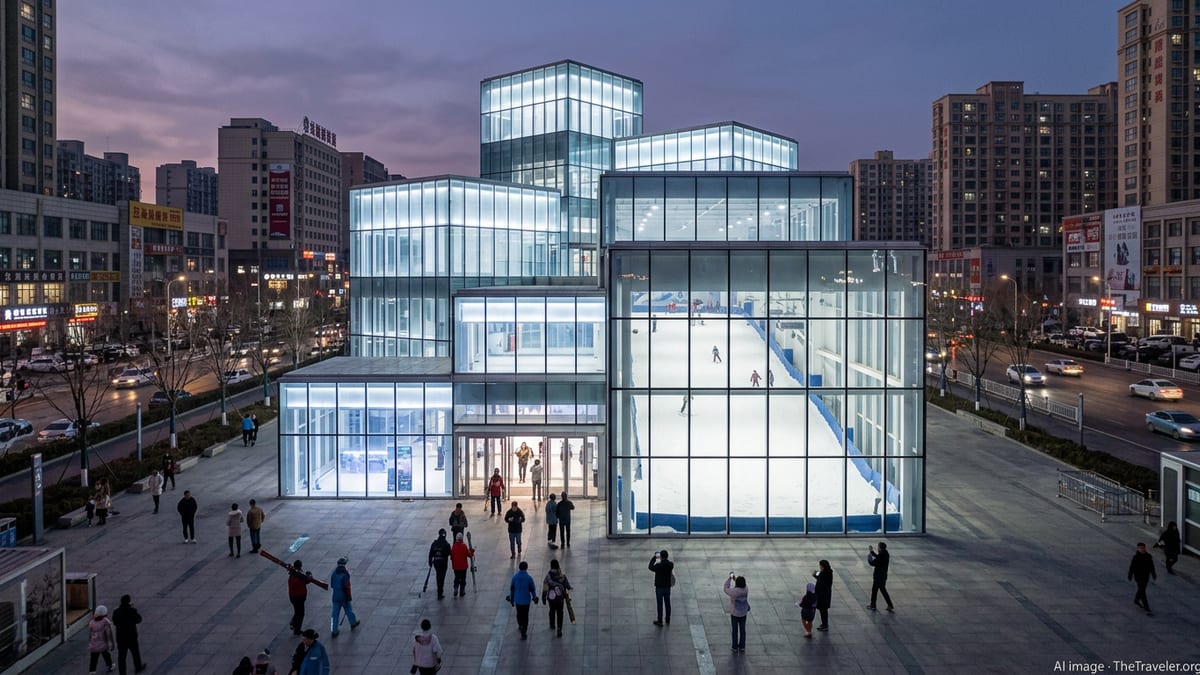
A Futuristic “Ice Cube” Landmark for the Central Plains
Snow King Park sits within the Zhongyuan Cultural Touristic City in Zhengzhou, a vast leisure and commercial complex that has drawn attention for its striking stacked “ice cube” architecture. Publicly available design information describes a cluster of staggered glass volumes, wrapped in printed glass and steel that creates a translucent, frosted facade. The effect is that of a shimmering block of ice rising from the city’s dense urban fabric, instantly recognizable on Zhengzhou’s fast changing skyline.
Architecture and design coverage indicates that the scheme is dedicated to winter sports and indoor recreation, with the future ski slope and snow attractions integrated into the geometric tower. Rather than hiding the snow facilities in a windowless box on the urban fringe, planners have placed Snow King Park at the visual and geographic center of a mixed use district, signaling the city’s ambition to make ice and snow tourism a defining part of its identity.
This positioning matters. For decades, China’s signature winter attractions were clustered far to the north in Harbin, Jilin, and Xinjiang. By anchoring a major snow themed complex in Henan Province, nearly 1,000 kilometers south of traditional ice tourism strongholds, Zhengzhou is helping shift the mental map of where winter can be experienced in China.
Snow King Park’s role as an architectural statement also dovetails with Zhengzhou’s broader effort to move beyond its reputation as a rail and logistics crossroads. The ice cube tower gives the city a new visual calling card, one designed to photograph well on social media and in travel marketing, and that alone is a powerful advantage in a crowded domestic tourism landscape.
Indoor Snow, Year Round Demand
While full technical specifications of Snow King Park have not yet been widely disclosed, planning descriptions emphasize a four season indoor snow environment built around an all weather ski slope. The project follows a national wave of large scale snow domes, from Shanghai’s vast L+SNOW complex to record setting facilities in Shenzhen, but it fills a critical geographic gap in central China, where winters are cold enough to feel seasonal yet inconsistent for natural snow tourism.
The logic is clear. By decoupling winter sports from actual winter, indoor parks can operate 365 days a year, stabilizing visitor flows and revenue for both operators and surrounding businesses. Industry reports on China’s indoor ski boom describe consistent temperatures kept several degrees below freezing, controlled snow quality, and bundled rental services that remove barriers to entry for first time skiers and snowboarders.
Snow King Park appears set to replicate that formula for Zhengzhou. Families can plan a snow day in July, schools can schedule organized outings during shoulder seasons, and residents who might never travel to distant mountain resorts gain an accessible introduction to skiing and snow play. In tourism terms, that transforms snow from a niche, climate dependent product into a reliable urban attraction.
For Zhengzhou’s hotels, restaurants, and retail streets, the potential upside is substantial. A steady stream of domestic visitors drawn by Snow King Park in traditionally quiet months could help flatten seasonal dips, a trend already documented around other major indoor ski complexes in eastern and southern China.
Leveraging China’s Ice and Snow Momentum
Snow King Park is also emerging at a favorable moment for China’s wider ice and snow economy. Since the Beijing 2022 Winter Olympics, national level campaigns to get “300 million people on ice and snow” have sparked rapid growth in both outdoor resorts and indoor facilities. Media reports on the 2025 to 2026 ski season describe strong demand across established northern destinations and newly opened city based domes.
Within this context, Zhengzhou’s project is not an isolated experiment but part of a diversified network of snow experiences. Travelers may pair a trip to a flagship northern resort with a shorter urban break in Zhengzhou, while regional visitors from neighboring provinces can opt for a weekend at Snow King Park rather than a long haul flight north. This layered hierarchy of winter products, from Olympic scale slopes to mall adjacent snow hills, allows China to capture a wider range of budgets and skill levels.
Available policy documents on Henan’s cultural tourism strategy highlight a push to upgrade “ice and snow plus” offerings, combining winter sports with folk culture, night time leisure, and conferences. Snow King Park fits neatly into that template. Beyond its slope, the complex is expected to host entertainment zones, food and beverage areas, and retail, encouraging visitors to spend full days and evenings on site rather than treating skiing as a quick, single activity.
By embedding Snow King Park in a broader cultural tourism district, planners also align with national trends toward mixed use “cultural and tourism cities,” which seek to integrate sports, shopping, performances, and themed accommodations. This holistic approach is increasingly seen as key to lifting per visitor spending and encouraging repeat trips.
A New Model for Second Tier City Tourism
Perhaps most significantly, Snow King Park underscores how second tier and inland cities are experimenting with bold, single anchor attractions to reposition themselves in China’s competitive domestic tourism market. Zhengzhou, better known historically for rail yards and grain markets than for leisure, is aiming to pivot toward a more diversified service and experience economy.
The choice of an indoor snow park as a flagship is strategic. Unlike a summer only water park or an open air amusement zone, a climate controlled winter complex can generate relatively predictable demand, even during heat waves, smog episodes, or off peak school calendars. For municipal planners wrestling with how to make new cultural districts viable beyond a few holiday peaks, this kind of weather proof anchor is especially attractive.
Snow King Park also differentiates Zhengzhou from a wave of coastal theme park projects linked to international brands. By focusing on winter sports and a distinctive ice cube architectural language rather than imported characters, the city is betting on a more locally relevant story that still feels aspirational to visitors from across central China.
If early patterns seen around other indoor snow hubs hold, the park could catalyze new small businesses nearby, from gear shops and specialty cafes to youth training camps and travel agencies offering bundled hotel and park access. That ecosystem effect is part of what makes Snow King Park a potential game changer rather than just another large entertainment box.
What It Signals for the Future of Travel in China
As construction advances and more details of Snow King Park become visible, the project is being closely watched by tourism analysts as a test case for how deeply indoor winter attractions can reshape travel behavior in regions without established snow traditions. The signals so far point to a future where the distinction between “northern winter” and “southern off season” becomes less rigid, replaced by a network of artificial snow hubs embedded in major population centers.
For travelers, that means more flexibility. A family in Wuhan or Xi’an can consider a weekend in Zhengzhou for reliable snow rather than booking long rail journeys to Heilongjiang. For destination managers, it presents both opportunities and challenges, from managing energy consumption and environmental impacts to ensuring that indoor attractions complement rather than cannibalize interest in natural mountain landscapes.
What sets Snow King Park apart is not only its scale and striking glass cube form but also its location in a historically transit oriented, inland metropolis. If the project succeeds in drawing sustained visitor numbers and reshaping Zhengzhou’s image, it will offer a powerful blueprint for how other second tier cities across China can use carefully designed, year round snow attractions to punch above their weight in the national tourism hierarchy.