

California is one of the easiest places in the United States to stay online, but the range of options can be confusing for visitors. From short city breaks in San Francisco and Los Angeles to long road trips through national parks and the Pacific Coast Highway, the right mobile and WiFi setup can save you stress and money. This guide explains how to get reliable internet in California using SIM cards, eSIM and WiFi, with up to date insights for 2026.
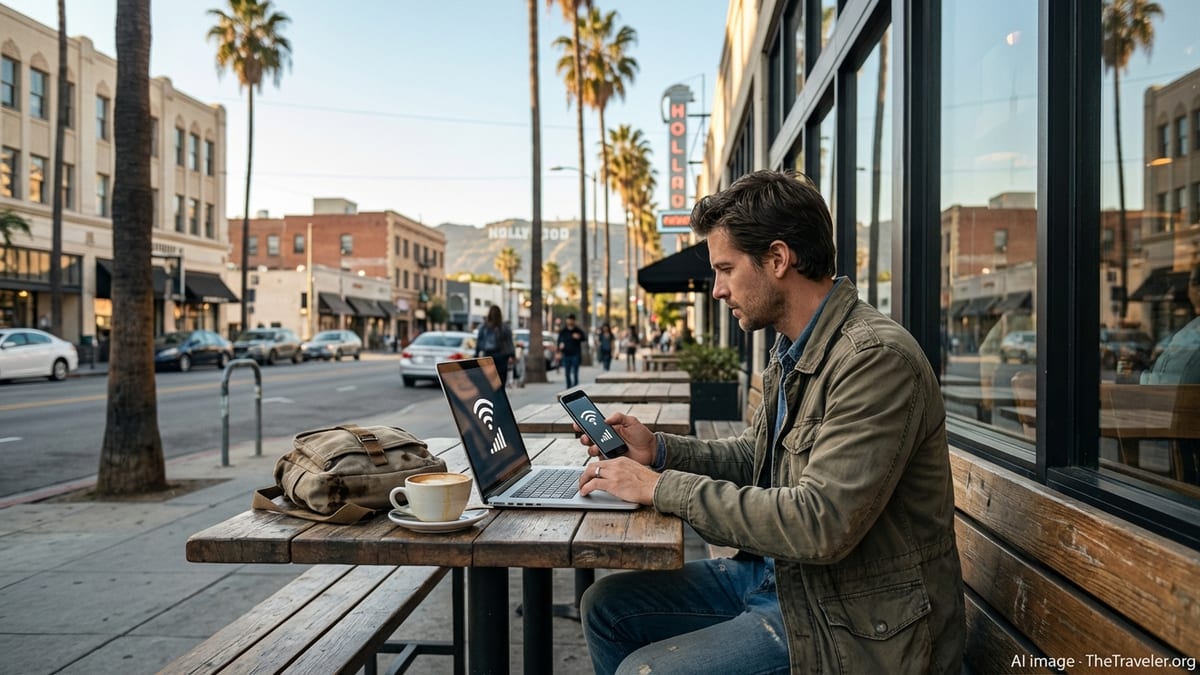
How Mobile Networks Work in California
California has some of the strongest mobile infrastructure in the United States, especially in major metro areas such as Los Angeles, San Francisco, San Diego and the Silicon Valley corridor. Most visitors experience fast 4G or 5G data in cities, airports and along main highways. Coverage is more variable in mountain regions, deserts and deep inside national parks, where signals can drop to older technologies or disappear entirely. Planning around these gaps is essential if you rely on navigation or work while you travel.
Three large national operators dominate mobile service across California: AT&T, Verizon and T Mobile. Independent testing and specialist connectivity guides consistently show that T Mobile often leads for 5G speeds in dense urban areas, while AT&T and Verizon typically provide stronger coverage along intercity highways and in rural zones. For a typical visitor using a mainstream tourist eSIM that rides on one of these networks, real world download speeds in California’s big cities can often reach well over one hundred megabits per second on 5G, while 4G is commonly fast enough for streaming and video calls.
Outside the metro cores, expectations should be more cautious. In wine country, along sections of the Pacific Coast Highway, and in vast parks such as Yosemite or Joshua Tree, you may see a mix of 4G, slower data or occasional dead zones. In practice that means maps and messaging usually work near towns and main roads, but you should not rely on cloud services deep on a trail or remote campground. Download offline maps and key documents before you drive into remote areas, no matter which carrier or plan you choose.
Most travel focused eSIM providers and prepaid brands partner with at least one of the big three networks, and some can switch between two or even all three. That improves your odds of staying connected as you move around the state, though there is still no provider that can guarantee a strong signal at every viewpoint or scenic stop. Think of mobile data in California as excellent in cities, good on major roads and patchy in true wilderness.
eSIM Options for Visitors to California
For many international visitors in 2026, an eSIM is the easiest way to get online in California. An eSIM is a digital SIM profile that you install by scanning a QR code, without needing to handle a physical card. Once active, it connects you to a local US network at rates that are often significantly cheaper than traditional roaming from your home carrier. Leading travel connectivity platforms now offer dedicated United States or North America eSIMs that work seamlessly in California.
Recent buyer guides from specialist connectivity sites highlight several recurring names when recommending eSIMs for the United States. Brands such as Airalo, Nomad, Ubigi, Yesim, GoMoWorld, Holafly and others sell US specific plans that typically range from a few gigabytes for a week to larger data bundles for a month or more. A number of these providers offer plans that connect to the same underlying networks used by residents, with some able to access more than one network so that your phone can fall back to the strongest available signal in a given area.
Pricing for US focused eSIMs tends to be much lower than pay per day roaming from many overseas carriers. As of late 2025 and early 2026, short stay packages for around a week with modest data can often be found in the range that many travellers describe as reasonable compared with roaming charges that sometimes approach the cost of a budget hotel night per week. For longer trips, 30 day eSIMs with larger data allowances remain popular with digital nomads and road trippers, who value predictable costs more than absolute rock bottom pricing.
Activation is usually straightforward. In most cases you buy the plan online before departure, receive a QR code by email or in the provider app, and install it under the mobile network settings on your phone. Many travellers prefer to activate the eSIM on arrival at their first California airport or hotel, but it is wise to download the QR code and instructions in advance so you are not dependent on airport WiFi to complete setup. Keep your original SIM active for receiving calls or texts from home if needed, and set the eSIM as the primary data line.
Physical SIM Cards and Prepaid Plans in California
While eSIMs have become the default choice for many visitors, physical SIM cards are still widely available across California and can be a good fit if your phone does not support eSIM or you prefer a more traditional setup. You can purchase prepaid SIMs from major carriers such as AT&T, Verizon and T Mobile at their branded stores in shopping malls and city centers, as well as from big box electronics retailers and some supermarkets. In tourist heavy areas, staff are generally familiar with activating plans for international visitors.
Prepaid plans from the major carriers in 2026 often include unlimited domestic calls and texts within the United States, with data allowances that range from modest caps to unlimited data subject to speed management after heavy use. Periodic promotional deals appear where, for example, two prepaid lines with unlimited data are priced competitively for travellers or families who need multiple connections. These offers tend to change seasonally, so it is best to think in general terms and confirm exact inclusions and prices just before you buy.
Beyond the big three carriers, mobile virtual network operators known as MVNOs also sell physical SIMs and eSIMs that use the same underlying networks. Brands such as US Mobile, Mint Mobile, Visible, Tello and others regularly attract visitors because they combine competitive pricing with access to one or more nationwide networks. Some MVNOs allow you to switch between different host networks under a single plan, which can help maintain coverage as you move around California. The trade off is that customer support and store presence may be more limited, with much of the setup handled online.
Airport kiosks in Los Angeles, San Francisco and other major gateways occasionally sell tourist SIM bundles, but selection can be narrower and prices slightly higher than in the city. If you are comfortable finding a store or ordering online on your first day, you may have more options. For travellers who prefer to land with everything ready, pre ordering a physical SIM from a reputable provider and having it shipped ahead of time can still be an option, although shipping times and availability vary by country.
Coverage Realities: Cities, Coastlines and National Parks
California’s size and varied geography mean that your internet experience will change dramatically as you move between regions. In the major cities, including Los Angeles, San Francisco, San Diego, Sacramento and Oakland, 5G coverage is now widespread with typical real world speeds that are easily sufficient for video calls, high definition streaming and heavy app use. Independent testing referenced by connectivity guides suggests that T Mobile frequently leads on 5G availability in urban centers, while AT&T performs strongly for a mix of speed and coverage, and Verizon retains strengths in certain suburbs and business districts.
Along the coast, from San Diego through Orange County, Los Angeles, Santa Barbara and up toward the Central Coast and the Bay Area, coverage is generally solid on at least one of the major networks. Popular beach towns, wine regions and freeway corridors usually see 4G or 5G with adequate performance. However, as you follow more remote stretches of the Pacific Coast Highway, particularly north of San Francisco or on less travelled coastal backroads, expect patches of weak signal or total dropouts regardless of provider. Many Californians who regularly drive these routes keep offline music and maps for that reason.
Inland, the pattern is similar. The Central Valley and intercity routes like Interstate 5 and Highway 99 are well covered, but once you head east into the Sierra Nevada or south into desert regions such as Death Valley or Anza Borrego, mobile data becomes less predictable. Connectivity guides for US travel emphasise that even the strongest networks sometimes fall back to slower speeds in these remote zones, and that short dead spots are not unusual between small towns. A multi network travel eSIM can improve your chances of finding a working signal, but it does not eliminate the underlying geography.
National parks and protected areas require special planning. Places such as Yosemite, Sequoia and Kings Canyon, Joshua Tree, Lassen Volcanic and the northern redwood parks all have significant areas with no signal. Visitor centers and some lodges may offer WiFi, but mobile coverage on trails and scenic drives often drops out. Before entering these parks, download offline maps, confirm accommodation details and share your itinerary with someone at home. Treat any mobile coverage you find inside parks as a bonus rather than a guarantee, no matter which SIM or eSIM you use.
Public WiFi: Airports, Cafes and Accommodation
Public WiFi is widespread in California, and many travellers successfully combine WiFi with a modest mobile data plan to keep costs down. Major airports such as Los Angeles International, San Francisco International, Oakland, San Diego and Sacramento provide free terminal wide WiFi. Speeds are often good enough for email, messaging and even video calls during less busy times, although congestion can slow connections during holiday peaks or large convention weeks.
Hotels in California almost always offer WiFi, usually included in the room rate or charged as part of a resort or destination fee. Budget motels on highway routes commonly advertise free WiFi, though performance varies widely. In city centers, co working spaces and business hotels typically provide faster, more reliable connections suitable for remote work. If stable video conferencing is critical, it is worth reading recent guest reviews that mention WiFi or contacting the property directly to ask about average speeds and whether wired connections are available in rooms or meeting spaces.
Cafes, coffee chains and casual restaurants are another important part of the connectivity picture. Well known coffee brands, fast food outlets and many independent cafes across California offer WiFi for customers, sometimes with a simple landing page and time limits but often with no formal restriction beyond making a purchase. Libraries in cities and smaller towns almost always provide free public WiFi, and are a good backup if you need a quiet place with relatively stable connectivity for a few hours.
Despite this abundance of WiFi, travellers should be cautious when using open networks. Avoid accessing sensitive accounts or entering payment details on unsecured hotspots where possible, use a reputable VPN if you have one, and enable two factor authentication on key services before your trip. Public WiFi should complement, not replace, a reliable mobile option for navigation and urgent tasks, especially when driving in unfamiliar areas.
Managing Costs and Data Usage
Roaming into the United States on a foreign SIM is still relatively expensive in 2026. Many European and international carriers classify the US as a premium zone and charge either flat daily fees or per megabyte rates that can add up quickly when using maps, ride hailing apps and social media. Travel connectivity blogs continue to highlight cases where heavy use on standard roaming plans can push costs into uncomfortable territory within a week. Using a local California compatible SIM or eSIM is usually a safer and more predictable approach.
Once you have chosen a local plan, managing your own data usage becomes the main lever to keep costs in check. Streaming high definition video on mobile data, constant social media scrolling and large cloud backup uploads can consume gigabytes surprisingly quickly. By contrast, navigation apps such as Google Maps or Apple Maps tend to use far less data when routes are preloaded and satellite imagery is disabled. Messaging apps are generally light on data unless you send many photos and videos without WiFi.
Practical tactics include downloading offline maps for the regions you will visit, saving playlists and shows for offline playback before long drives, setting cloud photo backup to operate only on WiFi where possible, and turning on data saver modes in social and streaming apps. When travelling as a couple or group, sharing a single generous data plan via hotspot can be more economical than buying separate small plans for each person, as long as you monitor combined usage.
Many eSIM and prepaid providers offer apps that show near real time data consumption. These are valuable tools to avoid surprises. Check your usage every few days, especially early in the trip, to understand your patterns. If you realise you are consistently using more data than expected, it is often cheaper to buy a larger bundle or move to a plan with a higher allowance than to pay out of allowance fees or emergency top ups at the last minute.
Practical Setup Tips for a Smooth Arrival
A little preparation before landing in California makes a big difference to your first 24 hours. If using an eSIM, confirm that your phone is unlocked and supports eSIM functionality, then purchase your chosen plan a few days before departure. Download the provider’s app, store the QR code offline and read through the setup instructions. On arrival, connect briefly to airport WiFi if needed to finalise activation and then switch mobile data to the eSIM while keeping your home SIM active for incoming text messages if necessary.
Travellers who prefer a physical SIM should identify likely purchase locations along their arrival route. If you are flying into Los Angeles or San Francisco and staying in the city, it may be more comfortable to visit a carrier or electronics store near your hotel where you can sit down and ask questions. Bring your passport, as some retailers may request identification when activating a SIM. Explain that you are a short term visitor and ask staff to show you prepaid options without long term contracts.
Once your service is active, test it before leaving the store or airport. Confirm that data browsing works, that you can place a local call and that your messaging apps are registering the correct number if you intend to use it for verification. If you are renting a car, open your navigation app and load the route to your accommodation while still on a strong connection. This ensures you are not troubleshooting connectivity issues while trying to drive out of an unfamiliar airport at night.
Finally, consider your backup options. It can be useful to screenshot hotel details and key addresses, store offline copies of boarding passes and car rental confirmations, and share your initial itinerary with a trusted contact. While California’s connectivity is generally excellent, treating mobile data as one layer within a broader preparation plan leads to a far more relaxed start to your trip.
The Takeaway
Staying connected in California in 2026 is straightforward if you understand the main building blocks: strong but uneven mobile coverage across a vast state, increasingly flexible eSIM and prepaid options, and abundant but sometimes unreliable public WiFi. For most visitors, a travel focused eSIM on a major US network offers the best mix of convenience, speed and predictable pricing, especially when combined with sensible data management and offline preparation.
Physical SIM cards and traditional prepaid plans remain a solid alternative, particularly for those with older phones or travellers who appreciate in person support at a carrier store. Meanwhile, WiFi in airports, hotels, cafes and libraries fills in the gaps for heavier tasks such as large downloads, long video calls or cloud backups. None of these solutions is perfect on its own, but together they provide a resilient connectivity toolkit for almost any California itinerary.
The most important step is to align your choice with your travel style. City based visitors who rarely leave Los Angeles or San Francisco can prioritise fast 5G and generous data for streaming and social media. Road trippers and hikers should focus on broad coverage, offline maps and realistic expectations about dead zones. Business travellers might value stability and support over absolute lowest price. With a clear sense of your needs and the information in this guide, you can arrive in California ready to enjoy its landscapes and cities without worrying about how you will get online.
FAQ
Q1. Do I really need a local SIM or eSIM for California, or is roaming enough?
For short visits, some travellers use roaming from their home carrier, but costs can rise quickly. A local US compatible SIM or eSIM usually provides better value and more predictable pricing, especially if you rely on maps, ride hailing and social media.
Q2. Which network is best for coverage across California?
There is no single best network everywhere. T Mobile often performs strongly for 5G speeds in cities, while AT&T and Verizon are generally considered strong on highways and in rural zones. Multi network eSIMs and MVNOs that can use more than one underlying carrier offer added flexibility.
Q3. Can I buy and activate an eSIM before I arrive in California?
Yes, most travel eSIM providers allow you to purchase and install the eSIM profile before departure, then activate it on your arrival date. Always save the QR code and instructions offline so you are not dependent on airport WiFi to complete setup.
Q4. Are airport SIM card kiosks in Los Angeles and San Francisco good value?
Airport kiosks are convenient if you want immediate connectivity, but their selection is often limited and prices can be slightly higher than options in the city or online. If you are comfortable using hotel WiFi or an eSIM on day one, you may find better deals away from the terminal.
Q5. How reliable is public WiFi in California hotels and cafes?
Most hotels, cafes and public libraries provide free WiFi, and in large cities it is usually adequate for email, browsing and calls. However, speeds and reliability vary by property, so for critical work you should not rely solely on public WiFi and should maintain a mobile data backup.
Q6. Will my phone work with US networks in California?
Most recent smartphones from major brands support the frequency bands used by US carriers, particularly if purchased in the last few years. The key requirement is that your device is unlocked so it can accept a different SIM or eSIM. If you are unsure, check compatibility with your chosen provider before travel.
Q7. Is 5G widely available in California for visitors?
Yes, 5G is now common in major Californian cities and many suburbs, and most travel focused eSIMs and prepaid plans can access it on compatible phones. In rural areas and national parks coverage still often relies on 4G or slower technologies, so do not expect 5G everywhere.
Q8. How much mobile data do I need for a one week trip?
Usage varies by person, but many travellers find that around 5 to 10 gigabytes is sufficient for a week of maps, messaging, social media and occasional streaming when combined with hotel and cafe WiFi. Heavy video streaming or hotspot use for laptops will require a larger allowance.
Q9. Is it safe to use public WiFi in California?
Public WiFi in California is widely used, but any open network carries some security risk. Avoid accessing banking services or entering sensitive passwords on unsecured hotspots, enable two factor authentication where possible and use a trusted VPN if you plan to work or handle confidential information.
Q10. Can I share my data with other travellers using a hotspot?
Most US prepaid and eSIM plans allow hotspot use, but some unlimited or discounted offers may cap hotspot speeds or data. Check the plan details carefully. Sharing a single generous plan by hotspot can be cost effective for small groups if everyone is mindful of overall usage.