

Staying connected in Hawaii is easier than ever, but the way you get online can dramatically affect your costs and your experience once you leave Honolulu’s city streets for remote beaches, rainforests, or volcanic landscapes. Whether you are a first-time visitor planning a week in Waikiki or a digital nomad splitting time between islands, understanding how SIM cards, eSIM options, and mobile coverage really work in Hawaii will help you avoid bill shock and stay online when it matters most.
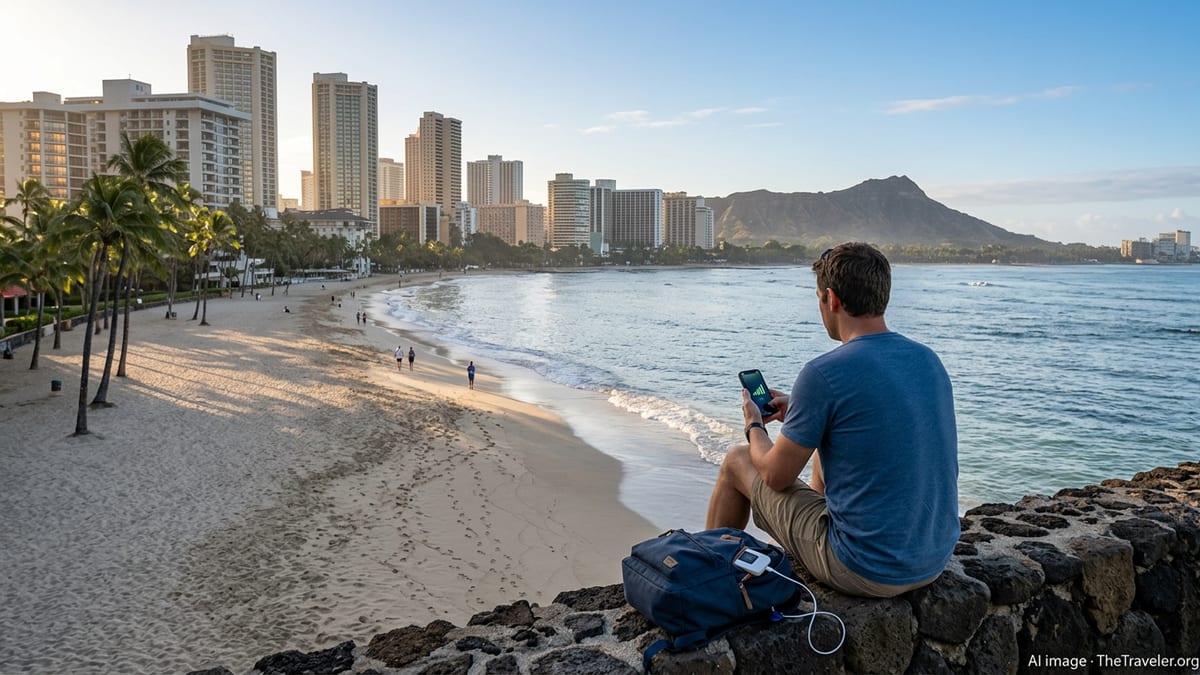
How Mobile Networks Work Across the Hawaiian Islands
Hawaii’s mobile infrastructure is part of the wider United States network ecosystem, so the same national carriers dominate: AT&T, T-Mobile, and Verizon, along with a long list of smaller virtual operators that ride on those networks. Coverage and speeds, however, do not mirror what you might be used to on the mainland. Topography, distance between islands, and a relatively small population spread over a large oceanic area mean that signal quality can vary sharply over just a few kilometers.
On the most visited islands, Oahu, Maui, Kauai, and Hawaii Island (the Big Island), you will find solid 4G LTE coverage in and around major towns, resort areas, and highways. Honolulu and its surrounding suburbs are particularly well served, with dense sites and broad 5G footprints from T-Mobile and low-band 5G overlays from AT&T and Verizon. Once you venture toward remote valleys, windward coasts, and interior highlands, service becomes much less predictable, regardless of carrier.
Recent crowd-sourced coverage maps and federal broadband data suggest that overall LTE availability in Hawaii is high, but 5G coverage is uneven. T-Mobile has invested heavily in wide-area 5G across the islands, while AT&T and Verizon are still more reliant on LTE and low-band 5G in many locations. For visitors, that translates into fairly consistent connectivity for basic tasks, but not always the blazing-fast 5G speeds you might see advertised on the mainland.
Because each island has its own geography and infrastructure constraints, coverage can feel almost hyper-local. A particular resort on Maui might have excellent T-Mobile speeds but only middling AT&T performance, while a small community on the Big Island might favor Verizon or AT&T. Checking updated coverage maps and, if possible, asking recent visitors or local hosts about their experience on a specific part of an island is often more useful than nationwide carrier marketing claims.
Physical SIM Cards in Hawaii: What Visitors Can Expect
Physical SIM cards are still widely used across the United States, and Hawaii is no exception, although many newer phones support eSIM and some prepaid brands now lean toward digital-only activation. If you prefer a traditional plastic SIM, your main options are buying from the big carriers’ retail stores, picking up a prepaid SIM through a reseller, or ordering online for delivery to your hotel or vacation rental.
Honolulu’s Daniel K. Inouye International Airport typically offers limited on-site SIM options in its international arrivals area, with occasional kiosks or counters focused on T-Mobile-branded prepaid services. Hours and stock can vary and are not guaranteed late at night, so travelers arriving on evening flights should not rely entirely on the airport for SIM purchases. It is often safer to plan a stop at a carrier store in Honolulu or to arrange a SIM or eSIM before takeoff.
In tourist corridors such as Waikiki, Kahului on Maui, Lihue on Kauai, and Kona and Hilo on the Big Island, you will find branded AT&T, T-Mobile, and Verizon stores in shopping centers alongside big-box electronics retailers that sell prepaid SIMs. These outlets can activate short-term plans with domestic data, voice, and texts that work not only across Hawaii but throughout the mainland United States. Pricing is comparable to the rest of the country, and short-duration tourist-specific SIMs are less common than in parts of Asia or Europe.
When buying a physical SIM card in Hawaii, you will generally need an unlocked device that supports the US LTE and 5G bands used by your chosen carrier. Staff in corporate carrier stores are usually familiar with common international phone models, but it is wise to confirm that your device is unlocked before departure and to bring documentation or screenshots showing your model number and band support. Once a US prepaid SIM is inserted and activated, it will normally override your home number for calls and texts, which can complicate two-factor authentication or banking alerts unless you use apps that rely on data instead of SMS.
eSIM Options: The Easiest Way to Get Online Fast
For many travelers, eSIM has become the simplest and most flexible way to stay connected in Hawaii. A growing number of international eSIM providers sell Hawaii and United States regional plans that can be purchased and installed before your trip. After you pay online, you usually receive a QR code by email within minutes. Scanning the code adds a secondary data profile to your phone, which you can then activate upon landing.
Travel eSIM plans for Hawaii commonly include short-duration data packages ranging from a few gigabytes valid for a week to larger bundles that work for 30 days or more. Some brands also offer “unlimited” options, which in practice often mean high-speed data capped at a certain amount per day, followed by slower but still usable speeds once you hit the daily threshold. Because these products piggyback on AT&T, T-Mobile, or multi-carrier roaming agreements, performance on the ground is similar to buying a domestic prepaid SIM for data use.
One major advantage of eSIM is the ability to keep your home SIM active for calls and verification codes while using the eSIM solely for data. On most modern smartphones, you can select which line handles data and which receives calls. This dual-line setup is particularly useful if you need to remain reachable on your primary number for work, or if you want to keep banking and messaging services tied to your home country SIM without paying expensive roaming data fees.
Because eSIM is digital, you avoid searching for a store, navigating language barriers, or dealing with physical packaging. For Hawaii specifically, where many travelers land after long trans-Pacific flights and then connect to inter-island services, being online immediately can simplify everything from ride-hailing and navigation to contacting an accommodation host. The main requirement is that your device supports eSIM and is unlocked; older or budget models may lack eSIM capability, and some carrier-locked phones from abroad restrict adding foreign eSIM profiles.
Comparing AT&T, T-Mobile, Verizon, and MVNO Coverage
Understanding how the main US carriers perform in Hawaii will help you choose the right SIM or eSIM product. While exact coverage percentages evolve over time, recent mapping and user reports paint a fairly consistent picture: T-Mobile stands out for wide 5G coverage and strong performance in many urban and resort areas, AT&T offers solid statewide reach with dependable LTE and low-band 5G, and Verizon remains a robust choice for voice and LTE but with more limited higher-speed 5G capacity in parts of the islands.
T-Mobile’s network in Hawaii benefits from extensive mid-band spectrum that supports higher-speed 5G across large areas, particularly on Oahu and in populated parts of Maui and the Big Island. Travelers using eSIM products that rely on T-Mobile or affiliated networks often report fast downloads and responsive apps in cities, along major highways, and around popular beaches. However, like any network, T-Mobile can struggle in certain remote or mountainous pockets, and indoor coverage may vary in older concrete buildings or deep inside large resorts.
AT&T, by contrast, often leans on strong low-band LTE and 5G coverage that reaches well into rural and semi-rural areas, including stretches of coastline and interior roads. Speeds in those zones may be modest compared with mid-band 5G, but the connection is often more consistent than competitors where towers are sparse. For visitors planning long drives, hiking in less touristed regions, or staying on the outskirts of towns, AT&T-backed SIMs and eSIMs can offer a useful balance between reach and reliability.
Verizon’s footprint in Hawaii is anchored in established LTE coverage with added low-band 5G in some districts. In practice, that means dependable connectivity for voice calls, messaging, and routine browsing in most populated zones, but fewer locations with the very high 5G speeds advertised elsewhere in the United States. For travelers whose priority is strong signal for calls rather than maximum data throughput, Verizon-based options remain viable. Many discount brands and international eSIM providers rely on more than one network, dynamically steering traffic between them, which can soften the differences for casual users.
Island-by-Island Realities: Where Coverage Shines and Drops
Oahu, home to Honolulu and Waikiki, is the best-served island in Hawaii from a mobile perspective. All three major carriers maintain dense site grids across the Honolulu metropolitan area, the popular south shore beaches, and key suburban communities stretching toward the west and east. Visitors can typically count on fast data for video streaming, social media, and real-time navigation across most of the island’s main roads. Some windward valleys and less developed coastal pockets may see weaker signals, but these tend to be the exception rather than the norm.
Maui’s coverage pattern is more complex. Resort centers such as Lahaina, Kihei, and Wailea, along with Kahului and the airport area, enjoy solid LTE and 5G service from multiple carriers. Connectivity along the main highways that loop around the island is generally adequate, though certain stretches, particularly near more rugged coastline or high elevation points, can suffer from spotty coverage. Iconic drives like the Road to Hana are known for long dead zones where networks of all types may drop out entirely, so offline maps and pre-downloaded content are essential.
On Kauai, coverage is concentrated around Lihue, Kapaa, Princeville, and the south shore resort areas. Once you move into the island’s dramatic interior mountains, canyons, and hiking regions, mobile signals become scarce, regardless of carrier. The same is true along more isolated coastal areas, where conservation priorities and challenging terrain limit tower placement. Travelers who are relying on connected navigation or communication during outdoor adventures should plan for extended periods without service.
The Big Island’s size and varied landscape create a patchwork of connectivity. Kailua-Kona, Hilo, and major resort complexes along the Kohala Coast have relatively strong coverage from the main carriers, but long stretches of highway between them pass through rural and volcanic terrain where signals fade or disappear. On the island’s south and interior routes, it is common to see data speeds drop or calls fall back to older technologies. For safety, visitors should not assume that emergency calls will always go through in these remote sections, and should prepare accordingly with offline maps, printed directions, and clear check-in plans.
Practical Tips for Getting Online Affordably in Hawaii
If you have an unlocked phone and plan to use a US-based SIM or eSIM, the most cost-effective strategy is usually to choose a plan that covers both Hawaii and any time you may spend on the mainland, rather than a “Hawaii-only” option. Many prepaid products provide unlimited domestic calls and texts plus a fixed data allowance or unlimited data with speed management after a certain threshold. Because Hawaii is part of the US domestic footprint for major carriers, you will not face roaming charges when moving between the islands and the continental states on the same plan.
Before departure, confirm whether your existing home operator offers reasonably priced roaming packages that include the United States. For light users who only need occasional messaging and maps, a flat daily roaming rate can be simpler than switching to a local provider. Heavy data users, however, almost always save money by purchasing a US or global eSIM dedicated to data. Many travelers pair a low-cost home roaming package for calls and SMS with a generous local data eSIM to get the best of both worlds.
Once in Hawaii, take advantage of Wi-Fi where available. Hotels, vacation rentals, and many cafes and restaurants on the main islands provide free or low-cost Wi-Fi, which can offload large downloads, backups, and software updates from your mobile plan. Keep in mind that public Wi-Fi security can be inconsistent, so avoid sensitive transactions on unsecured networks or consider using a reputable VPN if you must handle banking or confidential work while connected.
Finally, remember that battery management and offline preparation matter as much as your choice of network. Long road trips and full days outdoors can quickly drain your phone, particularly if it is constantly searching for a signal in marginal coverage zones. Carry a power bank, download offline maps and key reservation details, and save important contact numbers so you can access them even when connectivity dips. These simple steps can turn a patchy-signal day into a manageable inconvenience rather than a stressful emergency.
Staying Connected for Work, Navigation, and Safety
For remote workers and digital nomads, Hawaii’s connectivity can range from excellent to challenging, depending on where you base yourself. Urban Honolulu and many resort-focused areas offer speeds and reliability sufficient for video conferencing, large file transfers, and cloud-based work tools, particularly on T-Mobile and AT&T-backed connections. Some co-working spaces and business-oriented hotels provide dedicated high-speed broadband that reduces reliance on mobile networks altogether.
Outside of those hubs, expectations should be tempered. Rural parts of the islands, scenic coastal villages, and upcountry agricultural zones may deliver only moderate LTE speeds or intermittently weak signals during peak hours. If your work is highly time-sensitive or bandwidth-intensive, it is wise to test connections in your chosen neighborhood before committing to a long stay. Keeping a backup data option, such as a second eSIM on a different carrier, can also provide redundancy if one network underperforms during crucial meetings or deadlines.
For navigation and everyday travel logistics, mobile internet in Hawaii is generally good enough, provided you plan ahead. Road conditions, traffic updates, and weather alerts are readily accessible in most populated zones, but familiar scenic routes, such as narrow coastal drives and remote hiking trailheads, often fall into coverage gaps. Downloading offline maps for each island you plan to visit, and storing key locations like accommodations, hospitals, gas stations, and evacuation routes, helps ensure you are not left guessing when service drops.
From a safety perspective, it is important to remember that relying solely on your phone in remote natural environments is risky. Coastal flooding, sudden weather changes, and trail hazards are real concerns, especially on the Big Island and Kauai. Local authorities encourage visitors to check official advisories before heading into remote regions and to inform someone of their itinerary. Mobile coverage, while improving, is not yet comprehensive enough to serve as a single line of defense in an emergency.
The Takeaway
Internet access in Hawaii is shaped by a mix of modern 5G buildouts, island geography, and the realities of maintaining infrastructure in the middle of the Pacific. Travelers who understand that mix will enjoy a much smoother trip than those who assume “US coverage” automatically equals fast and flawless connectivity everywhere. In practice, you can expect strong service in Honolulu and other major tourist centers, solid but sometimes slower coverage in smaller towns and along key highways, and genuine dead zones in remote coastal and mountain regions.
For most visitors, the smartest approach is to arrive with an unlocked, eSIM-capable phone, install a reputable travel eSIM or plan to pick up a local prepaid SIM, and prepare offline backups for maps and essential information. Choosing a carrier that aligns with your itinerary, pairing mobile data with Wi-Fi where possible, and carrying a backup power source will keep you connected for what matters most, from boarding passes and restaurant bookings to sharing sunset photos with friends back home.
Ultimately, Hawaii rewards travelers who embrace both connectivity and disconnection. With the right SIM, eSIM, and coverage expectations, you can stay online when you need to plan or work, yet still step away from the screen to appreciate the islands’ natural beauty. A little preparation ensures that when the bars on your phone inevitably drop in a remote valley or along a wild stretch of coast, it feels like part of the adventure rather than an unwelcome surprise.
FAQ
Q1. Do I need a local SIM card or eSIM to use my phone in Hawaii?
It depends on your home plan and usage. Many visitors can roam on their existing plan, but a local SIM or eSIM is usually cheaper for heavy data use.
Q2. Which mobile carrier has the best coverage in Hawaii?
There is no single best carrier everywhere. T-Mobile often leads for wide 5G coverage, while AT&T and Verizon provide strong LTE and dependable service in many areas.
Q3. Is 5G widely available on the Hawaiian islands?
5G is common in urban and resort areas, especially on Oahu, but it is far from universal. Many rural and remote zones still rely on LTE or have limited service.
Q4. Can I buy a SIM card at Honolulu’s airport?
Limited prepaid SIM options are sometimes available in the international arrivals area, but hours and stock vary, so it is wise to have a backup plan.
Q5. How do travel eSIMs for Hawaii work?
You buy a plan online, receive a QR code, scan it to install a data profile on your phone, and then activate it when you land in Hawaii.
Q6. Will my unlocked phone from abroad work with US networks in Hawaii?
Most recent unlocked smartphones work fine, but you should verify that your device supports US LTE and 5G bands used by major carriers.
Q7. Is mobile internet in Hawaii fast enough for remote work?
In Honolulu and major resort areas, speeds are usually sufficient for video calls and cloud tools. In rural locations, performance can be inconsistent.
Q8. Are there long stretches without coverage on scenic drives?
Yes. Routes such as the Road to Hana and remote coastal or mountain roads on several islands have extended dead zones, regardless of carrier.
Q9. What is the cheapest way to stay connected in Hawaii?
For light users, a roaming add-on from your home carrier may suffice. Heavy data users typically save money with a local prepaid SIM or travel eSIM.
Q10. Can I rely on my phone for emergency calls in remote areas?
Not completely. While emergency services may work outside your carrier’s normal coverage, some remote regions have no usable signal at all, so you should plan accordingly.