

Staying online in Mexico has become far easier in recent years, but also a bit more complex behind the scenes. Powerful 4G networks, growing 5G coverage and a wave of travel eSIM providers give visitors plenty of options, yet new identification rules and a shifting telecom landscape mean it pays to understand how mobile connectivity really works before you land. Whether you are heading for Mexico City’s cafes, Yucatan’s beaches or remote mountain pueblos, choosing the right SIM or eSIM can make the difference between smooth navigation and frustrating dead zones.
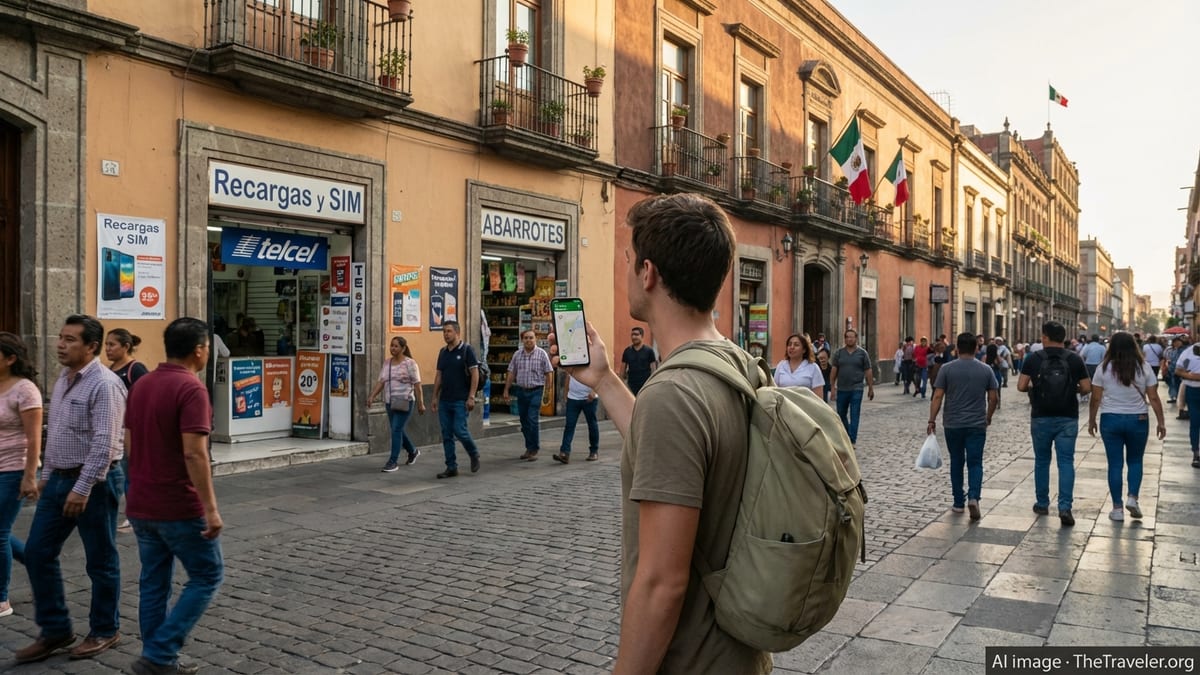
The Mobile Landscape in Mexico Today
Mexico’s mobile market is dominated by a handful of big players and a growing number of smaller virtual brands. Telcel remains the largest operator by a wide margin, with a majority share of active mobile lines nationwide. AT&T Mexico sits in second place with a far smaller but still significant portion of the market. Movistar, historically the third major network, has been transitioning away from its own infrastructure and is in the process of exiting the country, leaving its customers to be absorbed by other providers or operate through wholesale agreements. Alongside these giants are dozens of mobile virtual network operators that rent capacity from the big networks and sell it under their own brands, often with aggressive prices and simple app-based management.
For travelers, the important takeaway is that, although you will see many brand names in kiosks and supermarkets, they mostly rely on either Telcel’s or AT&T’s underlying networks. That means coverage quality is closely tied to those two operators, even if the SIM packaging carries another logo. In practice, Telcel tends to offer the broadest geographic reach, especially in rural areas and on highways, while AT&T often performs strongly in major cities and along industrial corridors. Independent testing in early 2025 found that all major operators provide at least fair 4G or 5G coverage for most users in areas where people commonly use their phones, but performance can still vary block by block in dense urban environments and drop sharply in remote zones.
Mexico’s 5G rollout is still a work in progress. As of late 2024, only Telcel and AT&T had deployed commercial 5G networks, focusing on Mexico City, Monterrey, Guadalajara and a growing list of large and mid-sized cities. While 5G is becoming more visible in city centers, the majority of the country remains on 4G and 3G. For most visitors this is not a problem, since 4G speeds are usually sufficient for maps, messaging, ride-hailing and streaming in standard quality, but it is worth knowing that peak 5G performance is still limited to specific neighborhoods and venues.
New 2026 Rules: ID and Phone Line Registration
A major change for anyone using a Mexican phone number, including short-term visitors, is the introduction of nationwide line registration rules in 2026. As of January 9, 2026, Mexican law requires that every mobile line, whether it uses a physical SIM or an eSIM, be verifiably associated with an individual or legal entity. That includes prepaid and postpaid plans, local residents and foreign travelers, and even numbers that are mostly used for data rather than voice. Anonymous pay-as-you-go lines are being phased out in favor of registered, traceable accounts.
Under the new framework, users must link their Mexican mobile number to official identification. For citizens and residents, that generally means a national ID or tax identifier. For foreign visitors, operators are expected to request a passport and may record additional details such as address or contact information in Mexico. The law sets June 30, 2026, as a key deadline, after which any Mexican number that is not properly registered is subject to suspension. Service on a suspended line is restricted, typically allowing only emergency calls until registration is completed. Once the user provides the required ID, full service can be restored.
For travelers, this has two main implications. First, you should expect to show your passport when purchasing a local SIM or activating a local eSIM in Mexico from 2026 onward, even for short stays. Second, if you have a Mexican number from a previous trip and want to keep it active, you may need to complete a registration process online or in person before mid-2026. The exact procedures differ by operator, but most large carriers provide digital self-service options as well as in-store assistance. While these rules add a layer of formality, they are unlikely to be a major obstacle for typical visitors, provided you carry valid ID and allow a little extra time when setting up service.
Coverage: Where Mexico’s Networks Work Best
From a traveler’s perspective, coverage in Mexico is a mix of excellent, good enough and occasionally nonexistent, depending on where you go. Large metropolitan areas such as Mexico City, Guadalajara and Monterrey typically enjoy strong 4G coverage and, increasingly, pockets of 5G on Telcel and AT&T. Tourist hubs like Cancun, Playa del Carmen, Tulum, Puerto Vallarta, Los Cabos and Oaxaca city are also generally well served, since they are commercially important and see high seasonal traffic. In these places, you can usually expect reliable data for maps and ride-hailing, and acceptable speeds for video calls as long as you have a modern smartphone and a plan that supports high-speed data.
Outside the main corridors, conditions vary more. Along major highways and bus routes, Telcel coverage is often better than its competitors, which can be crucial if you rely on navigation during a self-drive road trip. In interior states and mountainous regions, both Telcel and AT&T may fall back to 3G or lose service entirely in small stretches between towns. Coastal drives on the Pacific and Gulf sides can show similar patterns, with strong coverage near regional centers and patchy service in sparsely populated stretches. Travelers who plan to spend significant time in rural villages, highland hiking areas or off-the-beaten-path archaeological sites should anticipate spots with little or no signal, regardless of provider.
Performance is also influenced by Mexico’s challenging spectrum costs and regulatory shifts. High fees for frequency use have limited the pace at which some operators expand their 5G networks, leading them to prioritize profitable urban zones over lower-density areas. Although regulators have experimented with incentives for broader coverage, the practical reality for travelers is that 4G remains the workhorse in most of the country, and 5G is a pleasant surprise rather than something to rely on. When choosing a SIM or eSIM plan, prioritize the footprint of the underlying network over any marketing promise of 5G, especially if your itinerary includes road trips or smaller towns.
Physical SIM Cards: Buying and Using Them in Mexico
For many visitors, a traditional prepaid SIM card remains the simplest way to get online in Mexico, especially if you arrive with an unlocked phone that accepts physical cards. SIMs are widely sold at official carrier stores, electronics shops, convenience chains and some supermarket kiosks. In airports, you will often find branded counters or vending stands offering tourist-oriented packages. These tend to be more expensive than buying in town, but they can be convenient if you want connectivity as soon as you clear customs. Telcel, AT&T and various virtual brands typically offer starter packs that include a small data allowance and a local number, which you can then top up as needed.
Plan structures for prepaid SIMs are usually straightforward. You purchase a starter kit, then choose a bundle that combines data, domestic calls, texts and often unlimited use of popular social and messaging apps. Validity periods can range from a few days to a month or more, with the option to extend by adding credit. Many plans allow domestic roaming across Mexico at no extra cost, meaning your number will work nationwide as long as the underlying network has coverage. International calling and roaming back to your home country may be available, but the rates are frequently less attractive than using internet-based calling through apps like WhatsApp or Signal.
The main practical requirements are an unlocked phone and, under the new 2026 rules, a willingness to present ID. At point of sale, staff may ask to see your passport and record some details to attach the line to your name. Activation is usually quick, often completed within minutes through an automated call or SMS, and some stores will help you configure APN settings and test data on the spot. If you purchase from a small kiosk that does not offer technical support, it is worth checking that your phone shows a local network connection and that mobile data works before walking away.
eSIMs: Flexible Options for Connected Travelers
eSIM technology has transformed how many travelers connect in Mexico, particularly those with newer smartphones that support multiple digital profiles. Instead of swapping physical cards, you can now purchase an eSIM plan online before your trip, scan a QR code and have service activate automatically when you arrive. A growing ecosystem of international travel eSIM providers offers Mexico-specific data plans that ride on the networks of major local carriers. These options are especially popular among frequent travelers, remote workers, and digital nomads who move through multiple countries and want to avoid visiting stores or dealing with physical SIM logistics.
Most travel eSIMs aimed at visitors to Mexico are data-only. They provide a local data connection but no traditional voice minutes or SMS. Instead, you make calls and send messages through internet-based apps, which is adequate for many travelers who rely on messaging and video calls. Data allowances range from small packages suitable for a few days of navigation and messaging to larger bundles and sometimes unlimited plans designed for longer stays. Some providers also offer regional Latin American or global packages that cover Mexico alongside neighboring countries, useful if you are combining Mexico with a broader trip.
A newer development is the emergence of global eSIM plans that include both data and a phone number, allowing conventional calls and text messages while roaming across dozens or even hundreds of countries, including Mexico. These subscription-style plans can be attractive for frequent travelers who want a single recurring service instead of buying separate local eSIMs for each destination. However, they are usually priced higher than country-specific data-only offers, and travelers whose primary need is affordable local data will often find better value with focused Mexico plans that tap directly into Telcel or AT&T’s networks.
Choosing Between a Local SIM, Roaming and Travel eSIMs
Deciding how to stay connected in Mexico comes down to balancing price, convenience and your specific itinerary. If you are visiting for only a few days, your home carrier’s roaming add-on might be acceptable, especially if it offers a fixed daily fee and you prefer not to change any settings. The downside is that roaming costs often mount quickly, and in some cases the speeds or data caps are less competitive than what you can obtain locally. For longer trips, remote work stays or data-heavy use such as tethering a laptop, many travelers find that a Mexican SIM or a travel eSIM offers far better value.
A local prepaid SIM card is generally the most cost-effective solution if you do not mind a short stop at a carrier store and your phone has a free SIM slot. This route gives you a local number, strong integration with domestic networks and straightforward top-ups using cash or cards. It can be particularly attractive if you plan to make or receive calls from local businesses, such as hotels, guides or delivery services that prefer traditional phone numbers. On the other hand, it does require handling a physical card, potentially saving your home SIM somewhere safe and, under the 2026 rules, sharing your ID information with a Mexican operator.
Travel eSIMs excel in convenience. You can choose and pay for a plan while you are still at home, install it over Wi Fi and have it activate the moment your plane lands and your device sees a Mexican network. If your phone supports Dual SIM or dual eSIM, you can keep your home line active for authentication codes and essential calls while routing data through the Mexican eSIM. For itineraries that include both major cities and remote areas, look carefully at which underlying network your eSIM uses, because coverage quality will hinge on that detail rather than the brand selling the plan. A data-only eSIM combined with internet-based calling is sufficient for most visitors whose communications revolve around apps rather than traditional voice.
Practical Tips for Staying Online Across Mexico
Regardless of which option you choose, a few practical habits can improve your connectivity experience in Mexico. First, check that your phone is fully unlocked before leaving home, especially if it was purchased through a carrier on a contract. Locked devices may refuse to accept foreign SIMs or eSIM profiles, leaving you dependent on roaming. Second, update your device’s software and confirm that it supports the relevant bands used in Mexico, which in practice means most recent-model phones work well, but very old or niche devices may struggle with certain 4G frequencies.
Once in Mexico, pay attention to how your phone behaves in areas with patchy coverage. In rural regions or between towns, your device may cycle aggressively between 4G, 3G and no service, which can drain battery quickly. Manually forcing your phone to use 4G or even 3G only can sometimes provide a more stable experience and reduce power consumption. When you know you will spend several hours traveling through sparse coverage areas, download offline maps for your route and any city you plan to explore. This ensures you can navigate even if the signal drops or data speeds become unusably slow.
Finally, remember that public Wi Fi still plays a useful supporting role. Hotels, many restaurants and some long distance bus terminals provide complimentary or paid Wi Fi networks, which can help you conserve mobile data during heavy tasks such as software updates, large file transfers or high-resolution streaming. Security standards vary, so it is wise to avoid sensitive activities like online banking on unsecured networks or to use a trusted VPN if you must handle private data. Combining a modest mobile data plan with strategic use of Wi Fi often strikes a good balance between cost and comfort, particularly on longer journeys.
The Takeaway
Mexico offers visitors a solid and steadily improving mobile connectivity environment, with strong 4G coverage in cities and tourist corridors and expanding 5G service in select urban areas. Behind the scenes, the market is dominated by Telcel and AT&T, with a shifting cast of virtual operators and the gradual exit of Movistar. For travelers, this translates into a choice between physical SIMs, increasingly popular eSIM solutions and home carrier roaming, each with its own balance of cost and convenience.
New 2026 registration rules mean that every Mexican number, whether attached to a SIM or an eSIM, must be tied to a verified identity, so visitors should be ready to show a passport when activating local service. In most cases the process is quick and routine, and it is a small trade-off for affordable data and a local number that works across the country. With a bit of planning, an unlocked modern phone and realistic expectations about rural coverage, you can stay comfortably connected from Mexico’s colonial cities to its surf beaches and highland pueblos, using the mix of SIM, eSIM and Wi Fi that best suits the way you travel.
FAQ
Q1. Do I need to show ID to buy a SIM card in Mexico in 2026?
Yes. Under Mexico’s new rules, all mobile lines, including prepaid SIMs and eSIMs, must be registered to an individual or business, so you should expect to present a valid passport or other official ID when activating service.
Q2. Which mobile network has the best coverage for travelers?
Coverage varies by region, but Telcel generally offers the broadest nationwide footprint, especially in rural areas and along highways, while AT&T often performs strongly in major cities and industrial corridors.
Q3. Is 5G widely available in Mexico?
5G is available in parts of large cities and some popular urban areas, primarily through Telcel and AT&T, but most of the country still relies on 4G and 3G, so you should not plan your trip around 5G access.
Q4. Can I rely on a data-only eSIM instead of a physical SIM card?
Yes, many travelers successfully use data-only eSIMs that connect to local networks and handle calls and messages through apps. This is often the most convenient option if your phone supports eSIM and you are comfortable using internet-based communication.
Q5. Will my foreign phone work with Mexican SIM cards?
Most modern unlocked smartphones work seamlessly with Mexican networks, but you should confirm that your device is unlocked and supports common 4G bands used in Mexico before you travel.
Q6. Is it cheaper to use a local SIM than to roam with my home carrier?
In many cases, a local prepaid SIM or eSIM offers better value than international roaming, especially for longer stays or heavy data use. Roaming add-ons can be convenient for short trips, but costs often add up quickly.
Q7. How good is coverage in rural and remote areas?
Coverage in rural and remote regions is more limited. Telcel typically offers the best reach outside cities, but even its network may have gaps in mountains, jungles and sparsely populated coastal stretches, so you should expect occasional dead zones.
Q8. Can I keep my home number active while using a Mexican eSIM?
If your phone supports multiple SIM profiles, you can keep your home number active for calls and verification codes while using a Mexican eSIM for data, which is a popular approach among frequent travelers.
Q9. Do travel eSIMs in Mexico include a local phone number?
Most travel-focused eSIMs for Mexico are data-only and do not provide a Mexican number, though some newer global plans offer a phone number for calls and texts. If you specifically need a local number, a traditional Mexican SIM or a plan that explicitly includes one is usually the better choice.
Q10. What can I do if my signal is weak or drops frequently?
If your signal is unstable, try switching your phone to 4G or 3G only, move closer to open areas or higher ground and use offline maps as a backup. In persistently poor coverage zones, connecting to reliable Wi Fi in hotels or cafes is often the most practical solution.