

More news on this day
A magnitude 4.3 earthquake near Ioannina in the Epirus region of northwestern Greece has rattled residents and visitors, prompting structural inspections and renewed attention to the area’s seismic risk as monitoring agencies continue to track aftershocks and possible impacts on transport, tourism and essential services.
Get the latest news straight to your inbox!
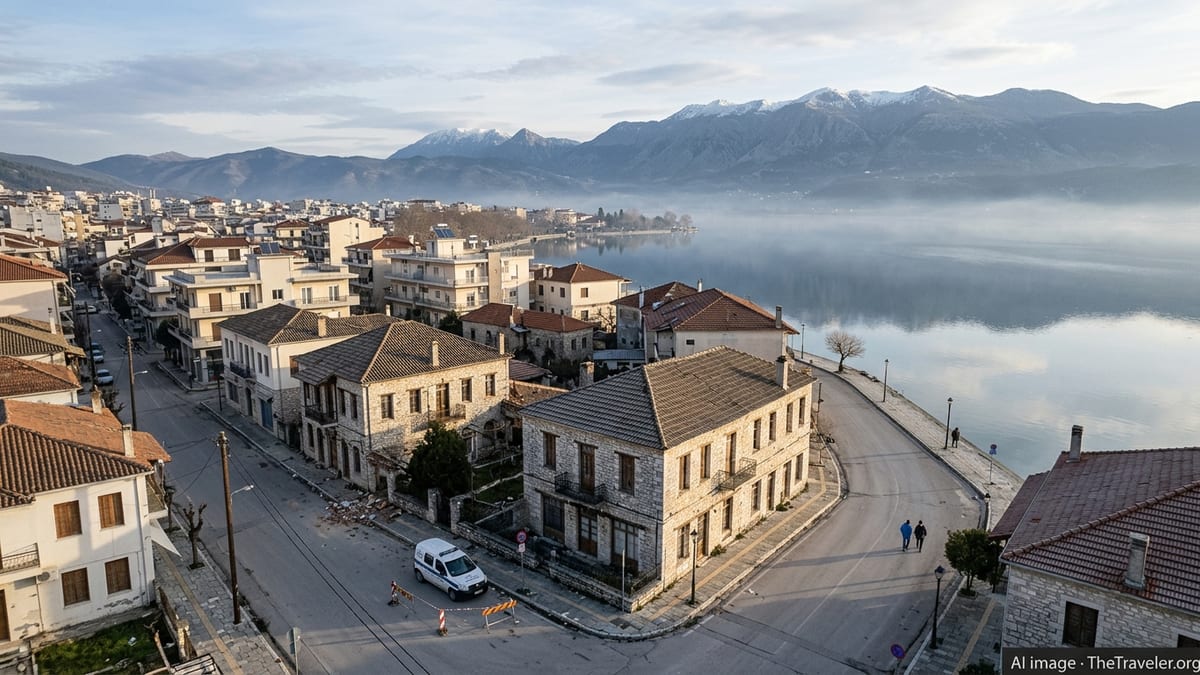
Shallow Quake Jolts Epirus Near Rodotopi and Ioannina
Publicly available regional monitoring data describe the event as a shallow magnitude 4.3 earthquake with an epicenter in the Greece–Albania border region near Rodotopi, northwest of the city of Ioannina. Seismic portals indicate that the main shock occurred in the late evening at a depth of around 10 kilometers, a profile consistent with the active crustal faulting that characterizes much of mainland Greece.
Event summaries from European and international seismic networks show that shaking was felt across a broad swath of Epirus, including Ioannina and surrounding towns such as Anatoli, Eleousa and Katsikas, and in parts of neighboring Albania. Felt reports describe a short, sharp jolt accompanied in some areas by a low rumble, typical of moderate, shallow inland earthquakes in this part of the Hellenic region.
Preliminary intensity assessments classify the shaking as light to moderate in urban centers, sufficient to startle people, rattle windows and set hanging objects swaying. In several districts near the epicenter, residents reportedly moved briefly into open spaces as a precaution before gradually returning indoors once the situation appeared to stabilize.
The epicentral area north and northwest of Ioannina has a documented history of small to moderate earthquakes linked to complex fault systems along the Greece–Albania border. Seismological overviews point to gradual strain accumulation in this broader corridor, which from time to time releases energy in sequences of minor and occasionally stronger tremors.
Damage Inspections and Ongoing Safety Checks
Initial information from regional news coverage and civil-protection bulletins suggests that the 4.3 quake did not cause widespread, severe damage. However, municipal crews, engineers and technical services in Epirus have been carrying out visual inspections of public buildings, older residential blocks and key infrastructure to identify any localized structural issues.
Local reports from the Ioannina area mention minor non-structural damage in some buildings, including cracked plaster, fallen masonry fragments and dislodged tiles, particularly in older stone houses and village structures closer to the epicenter. Several shop owners and hoteliers in the city center have also reported checking for hairline cracks and securing interior fixtures after the tremor.
Transport infrastructure, including main regional roads, the bypass around Ioannina and key routes toward the Albanian border and the Ionian coast, has remained largely operational, according to publicly accessible traffic and road-condition updates. No major disruptions to electricity or telecommunications have been widely reported, though brief power fluctuations were noted in some neighborhoods immediately after the quake.
In rural communities around Rodotopi and other epicentral villages, attention has focused on older masonry buildings, small churches and retaining walls along hillside roads, which are considered more vulnerable to even moderate shaking. Local authorities and technical staff in these areas are continuing to monitor slopes and roadside embankments for signs of small rockfalls or instability, especially after overnight rainfall.
Seismic Swarm Raises Questions About Aftershocks
Seismological catalogs for northwestern Greece show that the 4.3 event follows a pattern of heightened microseismic activity in the broader Ioannina and Greece–Albania border region, with several smaller quakes reported in recent months near Perama, Kardamitsia and other settlements. Analysts describe this behavior as typical of a local seismic swarm, with clusters of small to moderate earthquakes occurring along nearby faults.
Regional seismic services have recorded multiple aftershocks and related small tremors following the main 4.3 shock. Most of these have been below magnitude 4 and only lightly felt, if at all, by the general population. Nonetheless, local media coverage notes that some residents have reported a sense of persistent, low-level shaking over recent days, particularly at night.
Greek and European earthquake bulletins emphasize that aftershocks are common following an event of this size, though the majority are significantly weaker than the main shock. Travel advisories issued by various information portals recommend that visitors to Epirus remain aware of the potential for additional tremors but stress that daily life and tourism activities continue largely uninterrupted across the region.
Academic studies on Greek seismicity underline that Epirus, like much of the country, is subject to ongoing tectonic deformation related to the broader collision of the African and Eurasian plates. In practical terms, this means that sequences of small earthquakes and occasional moderate tremors are a familiar, if unsettling, component of life in northwestern Greece, and emergency planning frameworks are built around that reality.
Implications for Travelers and the Local Tourism Economy
Ioannina is a growing city-break and nature getaway destination, known for its lakeside promenade, Ottoman-era architecture and access to the dramatic Zagori villages and Vikos Gorge. The latest tremor arrived as hotels and guesthouses were preparing for the spring tourism period, prompting quick checks of accommodation facilities and public spaces.
Travel-related reporting suggests that major tourism attractions, including the historic center of Ioannina, Lake Pamvotis waterfront and key gateways toward Zagori and the Pindus mountains, remain open. Many hotels and guesthouses have taken the opportunity to review emergency procedures, confirm evacuation routes and ensure that furniture and equipment are secured against future shaking.
For visitors currently in Epirus or planning trips in the coming weeks, widely shared safety advice highlights a few key steps: familiarize oneself with emergency exits, avoid placing heavy objects on high shelves and know the basic “drop, cover, hold on” response recommended by international disaster-preparedness organizations. Travelers are also encouraged to follow updates from national and regional civil-protection agencies for the most current information.
Tourism operators in the region are keen to emphasize that moderate earthquakes are not unusual in Greece and that robust building codes, especially for newer structures, aim to mitigate serious damage. While some travelers may feel uneasy after reading about seismic activity, on-the-ground accounts indicate that daily routines in Ioannina resumed quickly, with cafes, shops and lakeside promenades returning to their usual rhythms shortly after the tremor.
Long-Term Preparedness in a Historically Active Region
Seismic-hazard maps and historical records show that Epirus and the wider Ionian and mainland Greece corridor have experienced notable earthquakes over past decades, including stronger events that affected communities further south and offshore. In response, national and regional planning frameworks have gradually integrated stricter building regulations, public-awareness campaigns and regular emergency drills in schools and public institutions.
Recent research on Greek seismicity, including analyses of swarms in the Aegean and Ionian regions, underlines the importance of dense monitoring networks and rapid data sharing among observatories. The Ioannina event is feeding into this broader scientific effort, with waveform data and felt reports contributing to updated models of how stress is distributed and released along the complex fault systems of northwestern Greece.
For residents and property owners in and around Ioannina, the latest quake serves as a reminder to review personal preparedness: securing interior furnishings, understanding safe spots inside homes and workplaces, and maintaining basic emergency supplies. Public information campaigns regularly stress that such low-cost measures can make a significant difference in comfort and safety during short, unexpected tremors.
As seismic instruments continue to record aftershocks and scientists refine their understanding of the Rodotopi and Greece–Albania border faults, the 4.3 earthquake near Ioannina is being treated as another data point in a long-running story of life in one of Europe’s most seismically active countries, where preparedness and awareness remain central to both everyday life and the visitor experience.