

More news on this day
As airspace closures linked to the Iran conflict continue to disrupt flight paths across the Middle East and beyond, hundreds of thousands of travelers are discovering that standard travel insurance may offer far less protection than they expected.
Get the latest news straight to your inbox!
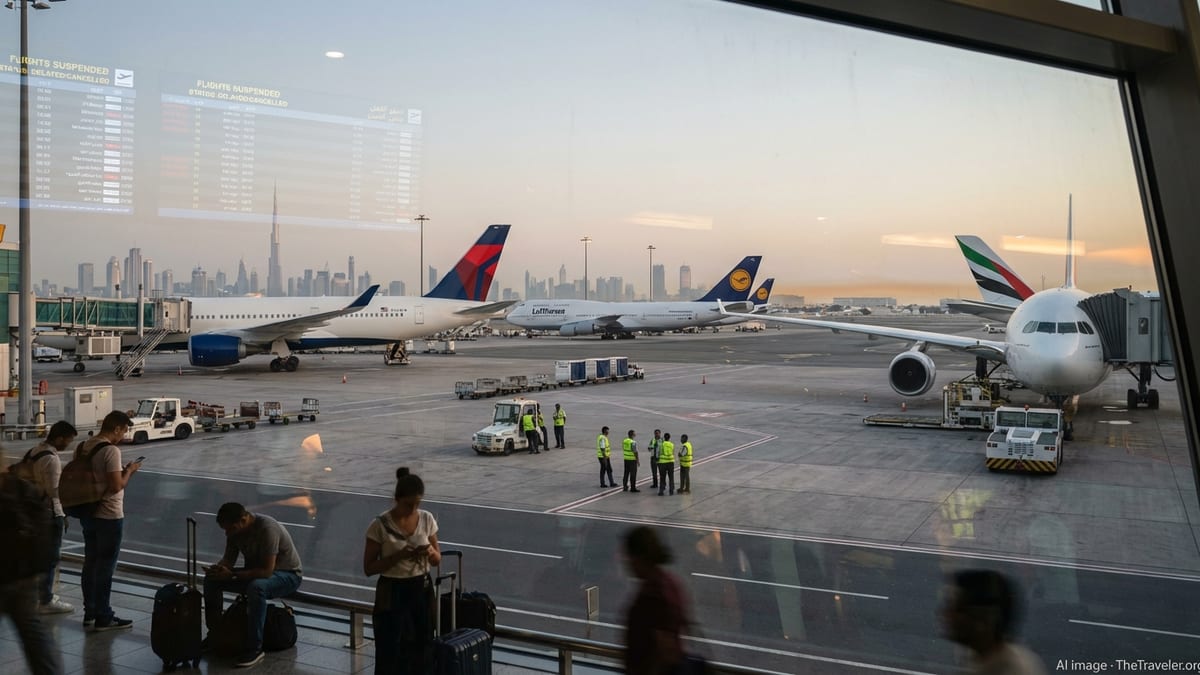
Conflict-driven flight cancellations widen across the region
Since late February 2026, military action involving Iran, the United States and Israel has triggered rolling airspace closures across parts of the Middle East, forcing airlines to cancel or reroute thousands of flights. Reports from regional and international outlets describe temporary shutdowns or severe restrictions in the skies above Iran, Israel, Jordan, Qatar and several Gulf states, along with the suspension of commercial operations at major hubs.
Tracking data and industry coverage indicate that Iranian airspace has remained effectively closed for most foreign carriers, while airports in the United Arab Emirates, Qatar and neighboring countries have faced waves of disruption as routes are reconfigured. Some Gulf airports are operating on a reduced or emergency schedule, with carriers using alternative hubs such as Muscat to keep long-haul networks running.
Global airlines from Europe, Asia and North America have responded by suspending direct services to Iran and nearby destinations or by diverting flights around the affected airspace, often adding hours to journey times. For passengers, the result has been last‑minute cancellations, missed connections and unexpected stopovers, frequently with limited advance notice.
Airlines have issued a patchwork of waivers that allow free date changes, partial refunds or rerouting within set time windows. These measures have helped some travelers avoid extra costs, but they sit alongside policy exclusions and strict conditions that leave others with sizeable out‑of‑pocket expenses.
War exclusions leave gaps in many travel insurance policies
The turmoil has thrown a spotlight on how travel insurance responds to conflict. Publicly available policy documents from major insurers show that standard trip cancellation and interruption cover often excludes losses that arise directly or indirectly from war, invasion or military action. In practice, this can mean that disruption linked to the Iran conflict falls outside the core protections many travelers rely on.
Industry briefings and consumer advocacy reports note that even when terrorism is listed as a covered reason for canceling a trip, active warfare and broader geopolitical hostilities are frequently carved out. Some policies also distinguish between isolated terror incidents and sustained military campaigns, limiting coverage once a situation escalates into open conflict or when formal travel warnings are in place.
Travel insurance trade bodies in Europe and other regions have issued guidance reminding customers that airlines and tour operators are typically the first port of call for refunds when flights are canceled for safety reasons. Insurance is more likely to respond to secondary costs, such as additional accommodation or new tickets, and only where the conditions of the policy are clearly met.
Specialist products that include “war risk” or enhanced political risk cover do exist, but they are usually marketed to corporate travelers, journalists or those heading to high‑risk destinations. Analysts say these products tend to carry higher premiums and stricter underwriting, reflecting the scale and unpredictability of potential claims in an active conflict zone.
When your insurer may still help
Despite the widespread presence of war exclusions, some travelers are finding that limited protections remain available, depending on the timing of purchase and the specifics of their journey. Insurance advisers point out that policies bought before a conflict becomes a known event sometimes preserve certain benefits, especially if the trip was already underway when fighting escalated.
Several major providers have publicly pledged to extend cover at no extra cost for customers stranded abroad whose policies were in force before the Iran conflict flared. In practice, this can include continued medical cover, emergency assistance and, in some cases, modest support for additional accommodation while travelers wait for replacement flights arranged by airlines.
Trip interruption benefits may also apply if a traveler is forced to cut a journey short for a covered reason unrelated to the fighting, such as illness or a family emergency, but is unable to return home on their original routing because of airspace closures. In such scenarios, insurers may contribute toward alternative transport up to the policy limit, although each claim is assessed against detailed wording that can be difficult for policyholders to interpret.
Optional add‑ons that focus on terrorism or “disruption” risk can provide broader cancellation and curtailment rights if official travel advice changes or if a terror incident directly affects booked accommodation or transport. However, these riders often exclude travel to countries where government advisories already warn against all or all but essential travel, which currently includes Iran in many jurisdictions.
Airline obligations vs insurance: who pays for what?
Confusion over who should bear the cost of disrupted trips has intensified as the Iran conflict continues. Consumer groups emphasize that airlines remain responsible for providing refunds or rebooking when they cancel flights, regardless of whether passengers hold travel insurance. Under European Union and United Kingdom regulations, for example, carriers must offer a choice between a refund and rerouting when services are canceled.
At the same time, aviation law specialists highlight that armed conflict and government‑ordered airspace closures are widely treated as “extraordinary circumstances.” This classification reduces or removes airlines’ obligation to pay additional statutory compensation for delays and cancellations, even though they must still assist with rerouting and care such as meals and accommodation in some cases.
Insurance is generally designed to sit on top of these airline duties, filling gaps rather than duplicating what carriers must already provide. In the current crisis, that has meant many claims for replacement tickets on different airlines, upgrades to avoid affected hubs or extended hotel stays while waiting for a new departure have been rejected, with insurers pointing to war exclusions and policy language that requires travelers to exhaust airline remedies first.
Travel law commentators note that the alignment of airline rules, consumer protection statutes and private insurance contracts creates a complex landscape. Passengers whose flights touch multiple jurisdictions, or involve non‑European carriers operating to or from EU and UK airports, can find that their rights differ substantially from one leg of a journey to another.
How travelers can protect future trips
The current wave of Iran‑linked disruption is prompting calls for clearer communication from both insurers and airlines about what is, and is not, covered in situations of war and political instability. Consumer advocates argue that many customers do not realize the breadth of standard war exclusions until they read a claim denial, often after incurring significant expenses.
Advisory groups recommend that travelers heading to or overflying volatile regions review the fine print of any policy before purchase, paying close attention to sections on war, terrorism, civil unrest and changes in government travel advice. Comparing standard products with those that offer supplemental disruption or terrorism cover can highlight the trade‑off between higher premiums and more flexible cancellation options.
Analysts also suggest that itinerary choices matter. Opting for routings that avoid conflict‑adjacent airspace where possible, booking through airlines with established hub capacity outside the Gulf, and keeping connections with a single carrier or alliance can all reduce exposure to cascading cancellations. Flexible tickets and airline‑issued waivers, while often more expensive upfront, may provide more reliable protection than relying solely on insurance in a fast‑moving conflict.
For now, the Iran conflict is serving as a stress test for the global travel insurance industry and for passenger rights frameworks that were largely written with weather, strikes and technical failures in mind rather than prolonged regional warfare. As the situation evolves, travelers planning routes through or around the Middle East are being urged by consumer bodies to assume that many war‑related disruptions will fall outside the safety net of standard travel insurance.