

More news on this day
Global aviation networks are facing severe disruption as the escalating conflict involving Iran triggers widespread airspace closures and flight cancellations across the Middle East, leaving thousands of passengers stranded and sparking concerns about how long the shock to international travel will last.
Get the latest news straight to your inbox!
Routes Rerouted and Grounded Across the Region
Published coverage from broadcasters and news agencies indicates that major carriers across Europe, the Gulf and North America have rapidly scaled back operations in and around Iranian and adjacent airspace. Multiple airlines have suspended services to destinations such as Tehran, Tel Aviv, Beirut and major Iraqi cities, or diverted flights onto longer paths to avoid potential conflict zones.
Reports describe aircraft already en route being turned back to their points of origin or redirected over alternative corridors through Turkey, the Caucasus and the Arabian Peninsula. Aviation tracking platforms show a sharp reduction in traffic over Iran and neighboring states compared with typical patterns for this time of year, underscoring how quickly commercial schedules have been upended.
These measures follow military activity and heightened tension that have raised risk thresholds for civil aviation. Publicly available information from regulators and airline statements shows that some authorities have issued explicit restrictions on flying over parts of the Middle East, while others have advised carriers to conduct their own risk assessments and adjust operations accordingly.
The result is a patchwork of suspensions, diversions and schedule cuts that is rippling through the wider global network, affecting travelers with no original plans to transit the region but whose itineraries depend on key Gulf and European hubs.
Thousands Stranded as Disruption Spreads
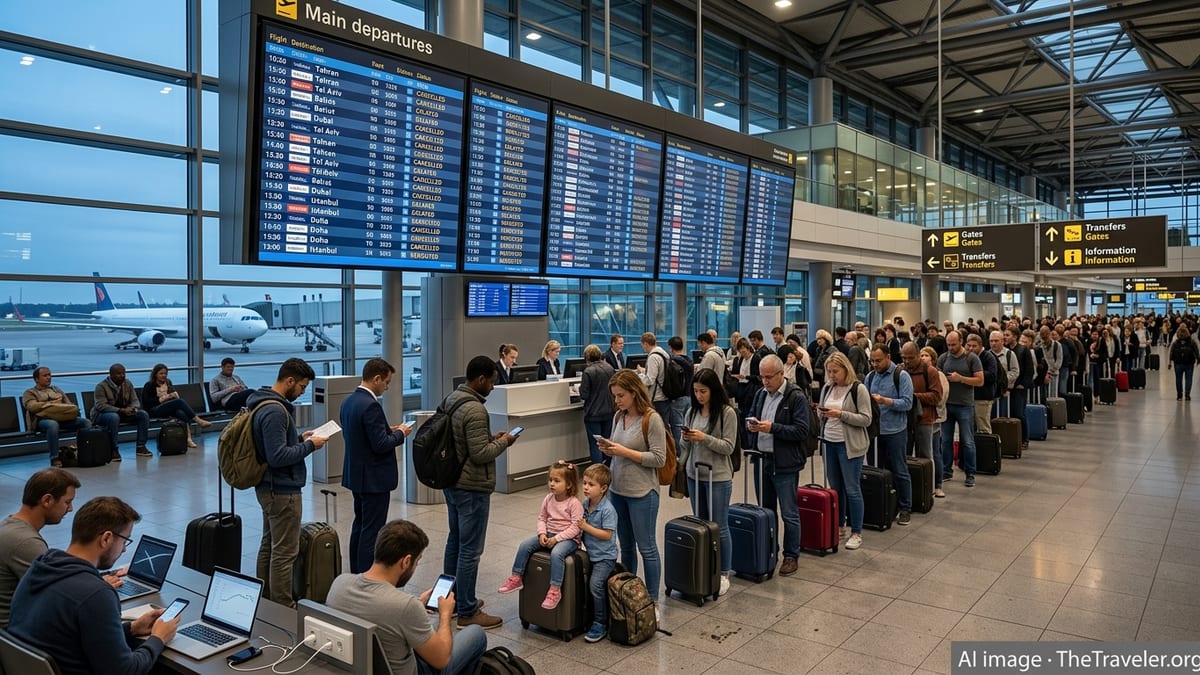
Airports serving as traditional transit points between Europe, Asia and Africa are experiencing scenes of uncertainty as passengers face rolling delays and last minute cancellations. Coverage from international news outlets describes crowded terminals, long rebooking queues and travelers struggling to secure replacement flights as inventory on alternative routes tightens.
With some carriers suspending specific city pairs for days or weeks, travelers bound for destinations such as India, Southeast Asia and East Africa are being forced onto indirect routings that add many hours to journey times. In some cases, passengers are being routed via North America or southern Europe to avoid any overflight of the most sensitive airspace.
Consumer advocates note that rebooking challenges are compounded by the complexity of modern itineraries, where trips often involve multiple carriers and alliance partners. When one segment fails due to a sudden airspace closure, entire journeys can collapse, leaving passengers reliant on limited staff at overburdened service desks to reconstruct travel plans.
Social media posts and local news reporting highlight cases of families stranded overnight or longer, sometimes far from home and without clarity on when routes will resume at scale. Travel insurers and credit card providers are beginning to receive an uptick in claims inquiries as travelers seek compensation or emergency assistance.
Airlines Balance Safety, Cost and Network Integrity
According to publicly available statements and industry analysis, airline decisions are being driven first by safety considerations and compliance with any formal restrictions from national and regional aviation authorities. Carriers are also weighing the operational and financial impact of longer routings, increased fuel burn and crew duty-time limitations.
Rerouting widebody aircraft around Iranian and adjacent airspace can add significant distance to long haul services, in some cases requiring payload restrictions or technical stops. Analysts note that these factors raise operating costs at a time when fuel prices and broader economic uncertainty are already pressuring airline margins.
Network planners are working to preserve connectivity by shifting capacity onto safer corridors and consolidating frequencies on routes that remain viable. Some carriers are deploying larger aircraft on alternative paths to accommodate displaced passengers, while others have reduced overall schedules in recognition of demand volatility and operational risk.
Industry observers point out that these rapid adjustments highlight the vulnerability of global aviation to geopolitical shocks, particularly in regions that sit astride critical east–west traffic flows. The Middle East’s role as a hub between continents means that any protracted disruption reverberates far beyond the immediate conflict zone.
Knock-on Effects for Tourism and Business Travel
The timing of the disruption is particularly challenging for tourism markets that depend on long haul visitors and for corporate travelers relying on reliable connections between financial centers. Travel trade publications report that tour operators are fielding cancellations and refund requests for itineraries involving the wider region, even in countries not directly affected by hostilities.
Some leisure travelers are postponing or re-routing trips to avoid perceived regional risk, shifting demand toward alternative destinations in southern Europe, North Africa and parts of Asia that can be reached without traversing contested airspace. Hoteliers and destination marketing bodies in affected areas are monitoring booking data closely for signs of a sustained downturn.
Business travel planners, meanwhile, are reassessing routing policies and duty-of-care obligations for employees. International firms with regional offices are leaning more heavily on virtual meetings and regional hubs viewed as lower risk, while also developing contingency plans for rapid staff relocation should the conflict and associated travel disruptions deepen.
Economists note that aviation capacity constraints can feed through to trade and investment flows, particularly for sectors dependent on just-in-time logistics and face-to-face dealmaking. The longer airspace restrictions remain in place, the greater the risk of a broader chill on cross-border activity connected with the region.
What Travelers Should Know Right Now
Travel experts recommend that passengers with upcoming journeys touching the Middle East, or using major European and Gulf hubs, monitor their bookings frequently and remain prepared for late changes. Published guidance from airlines stresses the importance of ensuring that contact details in reservations are up to date so that carriers can send real time alerts about schedule changes.
Flexible ticket policies introduced in response to the latest wave of cancellations may allow customers to rebook, reroute or request travel credits without standard change penalties, although specific terms vary by airline and fare type. Travelers are being urged to review fare rules carefully and, where possible, to consider options that allow future changes without significant fees.
For those already on the road, experts suggest carrying essential items and medications in hand luggage, budgeting extra time for security and immigration formalities, and preparing for the possibility of unexpected overnight stays. Local news outlets advise that travelers check both their airline’s service updates and notices from national aviation regulators, as conditions can evolve quickly.
While the outlook depends on the trajectory of the conflict and the associated security assessments, industry analysts caution that even a rapid easing of tensions would not produce an immediate return to normal. Network rebuilding, aircraft repositioning and crew scheduling could take days or weeks to stabilize, meaning that today’s crisis-level cancellations may continue to influence global travel plans well into the near future.