

More news on this day
A sudden escalation of conflict involving Iran in late February 2026 has triggered a global air travel shake-up, with mass flight cancellations across the Gulf, sharp jet fuel price spikes, and a rapid redirection of passenger demand toward alternative hubs in Europe and Asia.
Get the latest news straight to your inbox!
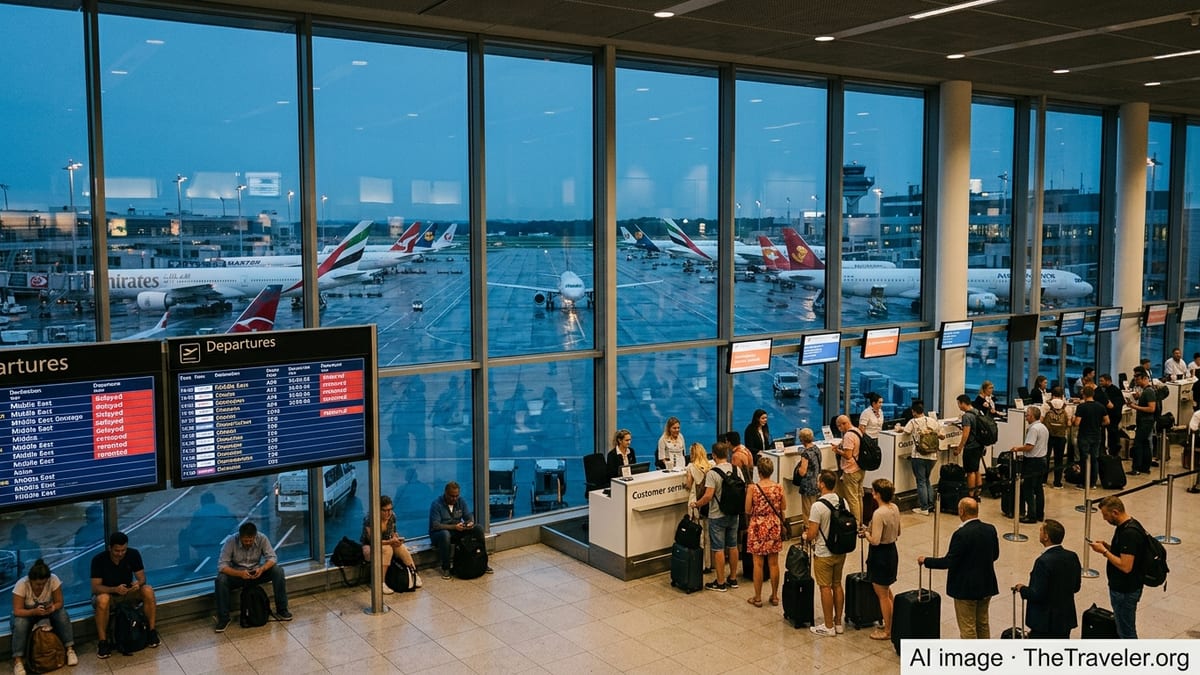
War in Iran Upends Key Aviation Corridors
The latest phase of the Iran conflict, which intensified after coordinated strikes on Iranian targets on 28 February 2026, has disrupted some of the world’s most important air corridors between Europe, Asia, and Africa. Publicly available information indicates that multiple Gulf and Levant states, including Bahrain, Kuwait, Qatar, Israel and the United Arab Emirates, have either closed or heavily restricted their airspace at various points since the escalation, forcing airlines to cancel or reroute thousands of flights across the region.
Analysis of open-source aviation data shows that hubs such as Dubai International, Abu Dhabi, Doha, Riyadh and Kuwait City have all experienced significant operational disruption. Reports indicate that strikes and near-miss incidents around major airports, combined with military activity and heightened insurance premiums, have sharply reduced their capacity as transfer points for long-haul passengers. This has had a cascading effect far beyond the Middle East, slowing connections and creating bottlenecks on routes linking Europe with South and Southeast Asia, East Africa and Australasia.
Industry monitoring suggests that the scale of the disruption rivals the early months of the COVID-19 pandemic in terms of stranded travelers and rapidly changing schedules. Advisory notices circulated in early March describe airspace closures across much of the Gulf, with some carriers operating limited repatriation services and special flights while regular schedules remain suspended or heavily curtailed.
Fuel Shock Pushes Global Airfares to New Highs
The conflict’s impact on energy supplies, particularly around the Strait of Hormuz, has driven a sharp spike in oil and jet fuel prices. Economic assessments of the 2026 Iran war describe it as one of the most severe supply shocks in decades, with jet fuel costs rising far faster than broader consumer inflation. IATA economic analysis published in March highlights how disruptions to shipping, higher war risk insurance premiums and rerouting of tanker traffic have tightened fuel markets and exposed vulnerabilities in airline fuel supply chains.
In response, carriers across multiple regions have begun rolling out fare increases and fuel surcharges. Coverage in European and Asia-Pacific media indicates that airlines such as Air France–KLM, Air New Zealand, Qantas and SAS have all adjusted ticket prices to reflect higher fuel costs, adding tens of euros or dollars to long-haul economy tickets and more on premium cabins. Reports from North America and Canada note similar moves, with airlines and travel agencies warning that further hikes are likely if elevated fuel prices persist.
Financial analysts cited in recent business reporting warn that the surge in jet fuel, which can account for roughly a third of airline operating costs, poses a particular risk to weaker carriers with limited or no fuel hedging in place. Commentaries suggest that if current price levels are sustained, some airlines could be forced to ground aircraft, trim networks, or accelerate consolidation plans, further constraining capacity and keeping airfares elevated into the northern summer travel season.
Middle East Hubs Stumble as Europe and Asia Absorb Demand
With much of the Gulf airspace periodically restricted and some airports operating at reduced capacity, long-haul passengers are rapidly rerouting via alternative gateways. Travel industry reporting indicates that European hubs such as Istanbul, Frankfurt, Paris and Amsterdam, along with Asian centers including Singapore, Bangkok and Kuala Lumpur, are absorbing displaced demand that would normally flow through Dubai, Doha or Abu Dhabi.
Flight tracking data and airline advisories show that carriers are lengthening routes to avoid closed or high-risk airspace, adding hours to some journeys between Europe and South or Southeast Asia. Routes that once threaded through the Gulf are now being reoriented over the eastern Mediterranean, Central Asia or the Indian Ocean, depending on evolving risk assessments and diplomatic overflight permissions. These detours increase fuel burn and crew costs, reinforcing fare pressure even on routes that remain technically open.
Regional reports from the Middle East note that some national and low-cost carriers have suspended services to multiple Gulf destinations and cities such as Tel Aviv, Doha and Dubai for weeks at a time. Others are focusing on rescue and repatriation flights to clear backlogs of stranded passengers from Europe, North Africa and South Asia. Travel advisories urge passengers not to proceed to airports without confirmed bookings, underscoring the volatility of schedules and the risk of last-minute cancellations.
Tourism Economies Hit Hard as Travelers Pivot Destinations
The travel and tourism sector across the Middle East is absorbing heavy economic losses as the conflict drags on. Analysis released by the World Travel & Tourism Council estimates that the regional industry is losing hundreds of millions of dollars per day in international visitor spending compared with pre-conflict forecasts for 2026. With air corridors disrupted and security concerns elevated, many leisure travelers are postponing or cancelling trips to the Gulf and nearby destinations.
At the same time, booking data compiled by airline analytics and reported by specialist travel media indicates shifting demand patterns. Preliminary figures suggest weaker interest in itineraries transiting the Middle East, alongside renewed appetite for itineraries connecting through European and Asian hubs. Some transatlantic flows are softening, while intra-European, Mediterranean and Southeast Asian routes appear to be benefitting from travelers seeking perceived safer or more predictable options.
Destination marketing agencies in parts of Europe and Asia are beginning to position themselves as stable alternatives for long-haul connections and stopover stays, emphasizing established safety protocols and diversified air links. While this creates opportunities for secondary hubs and emerging tourism markets, it also heightens competition for limited capacity at a moment when airlines are constrained by fleet delivery delays and maintenance bottlenecks that predate the current crisis.
What Travelers Can Expect in the Months Ahead
Industry outlooks published in recent weeks converge on a picture of continued turbulence for global air travel through at least the first half of 2026. Risk consultancies and aviation analysts describe an environment where airspace restrictions can change with little warning, prompting rolling schedule revisions, elongated flight times, and periodic surges in demand for alternative routing via Europe and Asia.
Travel media coverage stresses that flexibility has become essential. Passengers are being advised to anticipate higher base fares, additional fuel surcharges and fewer ultra-cheap promotional deals, particularly on long-haul routes touching Europe, Asia and Oceania. Some airlines are offering more generous change policies, vouchers or rerouting within the same geographic zones, but these measures vary widely by carrier and are often time-limited.
Despite the disruption, global demand for air travel remains robust according to recent IATA traffic statistics and industry commentary. The underlying appetite for international trips built up in the post-pandemic period shows little sign of collapsing, even as prices rise. For now, the Iran conflict has turned the Gulf from a hyper-efficient crossroads of global aviation into a chokepoint whose instability is rippling across continents, driving travelers and airlines alike to redraw the mental map of how the world connects by air.