

More news on this day
The sudden escalation of war involving Iran is reverberating across global aviation, forcing airlines to reroute aircraft around closed Middle East airspace while surging demand and higher operating costs propel airfares and revenue for major U.S. carriers.
Get the latest news straight to your inbox!
Middle East War Closes Skies and Scrambles Global Routes
Airspace closures across Iran and neighboring states since late February have triggered one of the most severe disruptions to international aviation in years. Flight-tracking data highlighted large swaths of sky over Iran, Iraq, Kuwait, Israel and parts of the Gulf standing nearly empty as authorities restricted overflights, prompting mass cancellations and emergency diversions.
Major hubs that normally knit together Europe, Africa, Asia and Oceania have been hit hard. Reports indicate that airports in Dubai, Abu Dhabi and Doha, among others, temporarily halted or sharply curtailed operations after missile and drone strikes, cutting vital transit links for long-haul travelers. Passengers have faced abrupt turnbacks, long delays and unplanned stopovers as aircraft avoided conflict zones.
Publicly available information shows that the rerouting of Europe to Asia and Australia services has added hundreds to thousands of extra kilometers per flight. The longer paths increase fuel burn and crew costs, straining airline operations but also justifying steep fare adjustments on many international routes, including itineraries that never touch the Middle East but must navigate around its now-dangerous skies.
Security briefings note that these disruptions come on top of pre-existing airspace restrictions in the region, compounding the complexity of flight planning. Airlines are recalibrating schedules on an almost daily basis as the conflict spills across borders and as new advisories from aviation regulators reshape where and how commercial jets can safely fly.
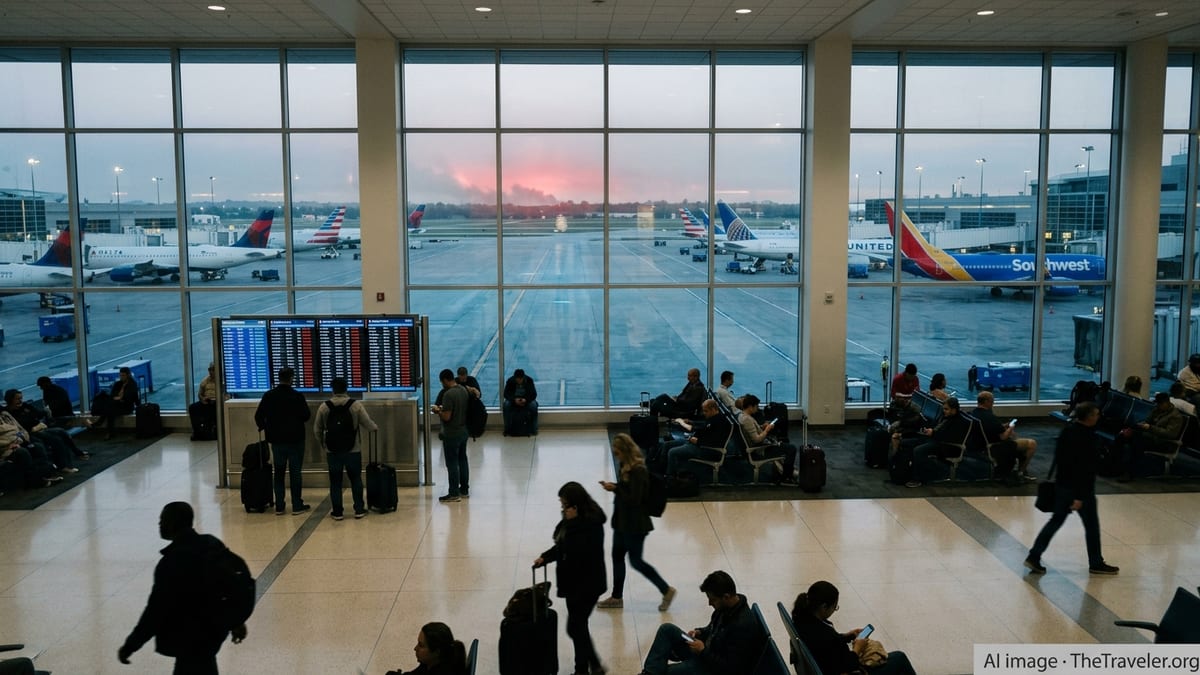
Delta, American, United and Southwest Ride a Wave of Pricing Power
For the four largest U.S. carriers, the Iran conflict has arrived at a moment of resilient post-pandemic demand and already-tight capacity, giving the companies unusual pricing power. Recent financial disclosures from Delta indicate record revenue for 2025 and solid guidance for 2026, underpinned by strong leisure and corporate demand. American and United have reported similar momentum in bookings, particularly on long-haul routes.
Analysts following the sector say the latest Middle East turmoil is reinforcing this trend. With many global competitors in the Gulf region operating at sharply reduced capacity and some European airlines trimming or rerouting services, the big three U.S. network carriers find themselves in a stronger position on transatlantic and transpacific corridors where connecting options via the Gulf once undercut them on price.
Published coverage of airline earnings suggests that non-fuel costs at Delta and its peers remain relatively contained, while fare levels and ancillary revenue continue to rise. This creates a powerful combination: higher headline ticket prices, growing revenue from premium cabins and extras, and the ability to fill seats despite macroeconomic uncertainty. The conflict-driven spike in fuel prices is pressuring margins, but so far robust demand has allowed most carriers to pass at least part of these costs on to passengers.
Southwest, which has no direct exposure to Middle Eastern routes, is nonetheless benefiting from the broader domestic spillover. As some travelers avoid itineraries that require long-haul connections through volatile regions, demand for point-to-point U.S. travel remains high. This environment supports firm fares across many domestic markets, helping the low-cost giant sustain healthy unit revenue alongside its larger network rivals.
Sky-High Fares Confront Leisure and Business Travelers
For travelers, the most immediate and visible consequence of the Iran conflict is the surge in ticket prices on affected routes. Data cited in recent industry and news reports show sizable increases on itineraries connecting North America and Europe with South and Southeast Asia, as airlines factor in longer flying times, war-risk insurance surcharges and reduced competition from Gulf carriers.
Travelers heading to or transiting near the Middle East face a double hit of constrained capacity and heightened uncertainty. Many have been forced to rebook on more circuitous routings, sometimes via secondary European or Asian hubs, with fare differences that can reach several hundred dollars or more per ticket. Flexible policies have softened the blow for some, but change-fee waivers typically do not shield passengers from the underlying jump in base fares.
Corporate travel managers are also recalculating budgets. Publicly available corporate survey data already pointed to stable or increasing business travel volumes in 2026 before the war erupted. Now, companies seeking to keep staff off higher-risk routes are shifting demand onto a narrower set of carriers and corridors, reinforcing the pricing power of Delta, American and United on key transatlantic and transpacific markets.
Within the United States, the ripple effects are subtler but still significant. Domestic fares on routes feeding international gateways have firmed as travelers consolidate itineraries around the most stable hubs. Southwest and other domestic-focused carriers are capturing overflow demand from passengers who abandon overseas trips altogether and pivot to U.S. destinations, particularly during peak holiday and school-break periods.
Record Revenue Potential Amid Operational and Safety Headwinds
Despite the operational turmoil, the big U.S. airlines collectively appear on track for another year of strong top-line performance. Guidance from Delta and commentary across the industry highlight expectations of record or near-record revenue in 2026, driven by sustained demand and the ability to command higher yields on many long-haul and premium routes.
At the same time, the conflict has intensified long-standing concerns over safety, insurance and the resilience of global aviation networks. Industry presentations from international aviation bodies published prior to the current crisis warned that geopolitically driven airspace closures were already forcing airlines onto costlier and less efficient routings. The Iran war has magnified these challenges, with war-risk insurance, fuel costs and security protocols adding layers of expense for carriers and complexity for travelers.
Airlines are investing heavily in network planning, real-time risk assessment and crew training to navigate this environment. Publicly available information on operational updates shows a constant recalibration of flight paths, schedules and equipment deployment as conditions shift from day to day. These efforts aim to protect both safety and reliability, two pillars critical to sustaining traveler confidence even as fares climb.
For now, the balance of forces still favors revenue growth over retrenchment for Delta, American, United and Southwest. As long as demand remains robust and alternative routings can be found around the Middle East, the conflict is more likely to reshape global air corridors and tilt pricing power toward the largest U.S. carriers than to trigger a collapse in travel.
Travelers Adapt as Airlines Consolidate Their Advantage
Looking ahead, travel patterns are already shifting in response to the new reality. Vacationers are favoring itineraries that avoid multiple connections and volatile regions, funneling more long-haul traffic through North American and European hubs instead of Gulf megahubs. This plays to the strengths of Delta’s Atlanta and New York operations, United’s Chicago and Newark gateways, and American’s network out of Dallas-Fort Worth and other major bases.
Reports from travel agents and booking platforms suggest that travelers are increasingly willing to pay a premium for perceived stability, especially on complex international trips. Flexible tickets, comprehensive travel insurance and carriers with strong records of operational resilience are becoming more attractive, even at higher price points. That trend supports the major U.S. airlines as they seek to differentiate on reliability and network breadth rather than pure price competition.
For cost-conscious passengers, adapting often means trading spontaneity for careful planning. Monitoring advisories, avoiding tight connections and building in extra time for potential disruptions are becoming standard recommendations for trips that once seemed straightforward. While these adjustments may add friction to the travel experience, they also reflect a broader recalibration of expectations in a world where geopolitics can reshape flight maps overnight.
The Iran conflict has underscored just how quickly global aviation can be upended, but it has also revealed the structural advantages of large, diversified U.S. carriers. As Delta, American, United and Southwest navigate the crisis, their combined pricing power and network reach are helping to turn a period of heightened risk and volatility into one of surging revenue, even as travelers grapple with higher fares and more complicated journeys.