

More news on this day
Escalating conflict involving Iran is triggering severe global travel disruption for US passengers, as airspace closures, mass flight cancellations and urgent warnings to leave high-risk destinations converge into a fast-moving crisis.
Get the latest news straight to your inbox!
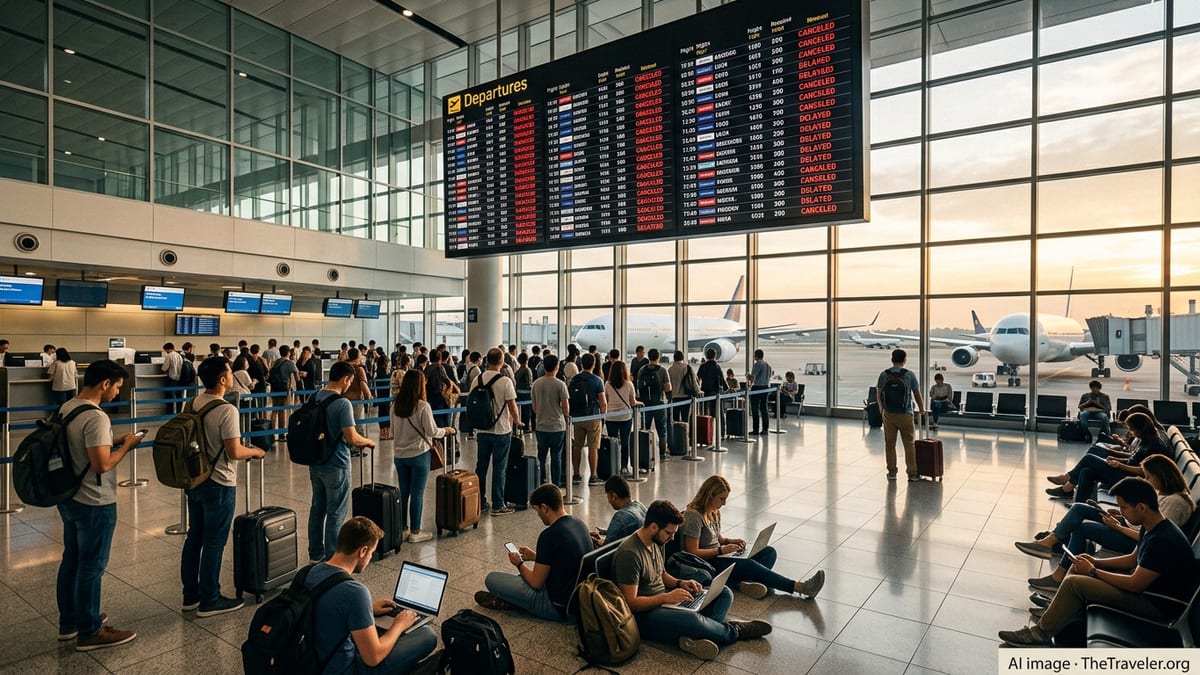
Airspace Closures Turn Middle East Hubs into No-Go Zones
Widely used aviation corridors across the Middle East have been abruptly constricted in recent weeks as the war in Iran intensifies, transforming once routine transit hubs into chokepoints and, in some cases, temporary no-fly zones. Publicly available aviation tracking data and regional media coverage indicate that airspace over Iran, Iraq and parts of the Gulf has been intermittently closed or heavily restricted since late February 2026, forcing airlines to divert or suspend flights on a massive scale.
Reports from regional outlets in the United Arab Emirates describe how incoming Iranian fire and retaliatory strikes led authorities to briefly close the country’s airspace and halt passenger operations, with Dubai International Airport experiencing widespread cancellations despite being one of the world’s busiest hubs. Similar disruptions have been noted in Qatar and other Gulf states, where closures and heightened security postures have limited civilian flights and cargo flows.
Aviation industry analysis cited in recent coverage suggests the scale of the disruption is already comparable to some of the most severe shocks since the pandemic. Tens of thousands of flights touching the wider Middle East have been canceled or rerouted since hostilities escalated, with major carriers in the Gulf region at times suspending large portions of their schedules. For US travelers who rely on one-stop connections via Doha, Dubai or Abu Dhabi to reach Asia or Africa, itineraries that once offered seamless overnight transits have become unreliable or unavailable.
With conflict zones overlapping some of the world’s most heavily used east west flight paths, airlines are being forced to fly longer detours south or north of the region, adding hours to journey times and complicating aircraft rotations. Industry observers warn that even when certain airports reopen and airspace is technically available, sudden closures or new military activity can lead to cascading delays with little warning.
US State Department Urges Americans to Leave High-Risk Destinations
As the security environment deteriorates, the US Department of State has sharply escalated its language around travel to the broader region. Recent public advisories and security alerts reviewed by travel media show that Americans in several Middle Eastern countries, including Iraq and Lebanon, are being urged to depart while commercial options remain available, with references to the risk of armed conflict, missile strikes and attacks on critical infrastructure.
In Iraq, an early March 2026 security alert ordered non-emergency US government personnel to leave the country and strongly encouraged private US citizens to do the same if they could depart safely. Separate messaging related to Lebanon and other frontline states in the conflict has warned that further escalation could rapidly reduce or entirely cut off commercial flight options, leaving travelers dependent on difficult overland routes or uncertain evacuation arrangements.
More broadly, the State Department’s regional travel advisories for Iran and its immediate neighbors already carried some of the highest warning levels prior to the latest war. Updated public guidance now emphasizes that US citizens should avoid travel to Iran entirely and reconsider nonessential travel to countries that may be subject to spillover attacks, including missile or drone strikes on airports, seaports and tourism areas.
Travel-risk consultancies monitoring the situation note that embassies and consular sections in several affected countries are operating with reduced staffing and limited capacity to assist in a fast-moving emergency. For Americans still in high-risk locations, that combination of security threats and constrained consular support raises the stakes of any decision to wait out the conflict rather than departing while flights can still be booked.
Global Airlines Slash Routes and Reroute US-Bound Traffic
For US-bound travelers, the immediate impact of the Iran conflict is being felt in airline schedules and route maps that are shifting by the day. Industry monitoring services cited by international media report that European, Asian and Middle Eastern carriers have canceled or significantly reduced flights to Israel, Lebanon, Iraq and parts of the Gulf, and in some cases are operating only limited repatriation services.
Several Middle East-based airlines that normally carry a large share of long-haul traffic between North America, Europe and Asia have, at times, suspended all operations or cut back drastically due to airspace closures and security concerns. As a result, US passengers who would typically travel from cities such as New York, Chicago or Los Angeles to India, Southeast Asia or East Africa via Doha or Dubai are being forced to seek alternative routings through Europe or, in some cases, to postpone travel altogether.
Publicly available airline notices and customer communications show that major US carriers have introduced temporary travel waivers for itineraries touching the Middle East, allowing affected passengers to change dates or rebook via different gateways without typical change fees. Some long-haul flights between India and North American destinations have been rerouted to avoid conflict zones, occasionally adding refueling stops in southern Europe to maintain safe distances from high-risk airspace.
At the same time, war-risk insurance premiums for airlines operating near the region have reportedly surged, and some carriers are reassessing the viability of certain routes until the conflict stabilizes. Analysts warn that even travelers on indirect routes that avoid obvious hotspots may encounter delays or missed connections as aircraft and crews are repositioned around the world to adapt to the sudden loss of key hubs.
Energy Shock and Aviation Costs Add to Traveler Uncertainty
The conflict’s impact on energy markets is further complicating the picture for US travelers. Coverage of the war’s economic fallout notes that attacks and threats around the Strait of Hormuz, along with damage to regional energy infrastructure, have sharply reduced oil exports from several Gulf producers and driven benchmark crude prices higher.
For airlines, elevated fuel costs come on top of longer flight paths that already consume more jet fuel. Carriers that are rerouting around closed airspace over Iran, Iraq and parts of the Gulf are adding hundreds of miles to certain routes, which can translate into higher operating costs and, over time, higher fares on affected long-haul sectors. Travel analysts caution that while promotional fares may still appear in the short term, sustained disruption could push average ticket prices up later in 2026, especially on routes linking North America, Europe and South Asia.
For destination economies, particularly those reliant on tourism and transit traffic, the combination of conflict risk and reduced connectivity is proving damaging. Publicly available economic assessments highlight sharp declines in visitor arrivals to several Middle Eastern countries, along with heavy financial losses for airlines based in the region. That downturn may also spill over into nearby destinations that traditionally rely on Gulf hubs for international access.
From a traveler’s perspective, the possibility of sudden route suspensions or fare spikes is contributing to a climate of uncertainty. Many US passengers now face the choice between booking complex multi-stop journeys via alternative regions or delaying trips until the picture becomes clearer, particularly for discretionary travel such as vacations and family visits.
How US Travelers Can Navigate the Fast-Changing Risk Landscape
With conditions evolving rapidly, travel security experts and aviation analysts stress the importance of preparation and flexibility for anyone in the United States planning international trips over the coming weeks. Recent guidance from travel-risk firms emphasizes starting with an honest assessment of whether travel to, or through, the Middle East is essential at this time, and exploring itineraries that avoid the region entirely where possible.
For Americans already in high-risk countries, publicly available embassy advisories consistently highlight the need for travelers to keep documents and emergency funds accessible, maintain multiple exit strategies, and monitor local news and airline updates closely. Many airlines now urge passengers to check flight status and route changes frequently rather than relying on automated notifications, which can lag behind real-time operational decisions.
For those planning future travel to destinations not directly affected by the conflict but traditionally connected via Gulf hubs, industry commentary suggests considering routings through Europe, East Asia or other alternative gateways, even if they involve longer travel times or higher upfront costs. Travelers are also being encouraged to review ticket conditions and travel insurance policies carefully to understand coverage around war-related cancellations and delays, as many standard policies contain exclusions for armed conflict.
While there is hope in some quarters that diplomatic efforts and shifting military calculations could ease the crisis in the coming weeks, recent events underscore how quickly the travel landscape can change when conflict escalates. For now, publicly available information points to a sustained period of volatility in air travel linked to the Iran war, and US travelers are being advised to plan accordingly, stay informed and be prepared to adjust their itineraries at short notice.