

More news on this day
A rapidly escalating conflict centered on Iran is rippling across global aviation in early 2026, shutting key Gulf air corridors, driving up fuel costs and ticket prices, and pushing millions of travelers to scramble for alternative routes through Europe and Asia.
Get the latest news straight to your inbox!
Airspace Closures Turn the Gulf From Global Hub to No-Go Zone
Since late February, the war involving the United States, Israel and Iran has triggered sweeping airspace restrictions across the Persian Gulf and Levant, transforming one of the world’s busiest aviation crossroads into a patchwork of no-fly zones and emergency corridors. Publicly available aviation notices and port advisories indicate that civil airspace over Iran, Iraq, Israel, Kuwait, Qatar, Bahrain and large parts of the United Arab Emirates has been subject to prolonged closures or severe curbs, effectively removing major Gulf hubs from normal long-haul networks.
Reports on the economic impact of the conflict describe a near-total halt of operations for leading Gulf carriers such as Emirates, Etihad and Qatar Airways as airspace bans and missile threats pushed regional aviation activity close to zero. Several large airports that collectively handle a substantial share of global connecting traffic, including Dubai International and Doha’s Hamad International, have shifted from high-volume transit operations to limited emergency or evacuation movements only.
According to conflict-zone bulletins from European regulators, airlines are being strongly advised to avoid the entire conflict area, not just specific national flight information regions. The result is a broad arc of restricted skies that stretches from the Eastern Mediterranean, across the Persian Gulf and deep into the northern Arabian Sea, forcing airlines to rip up long-established flight plans almost overnight.
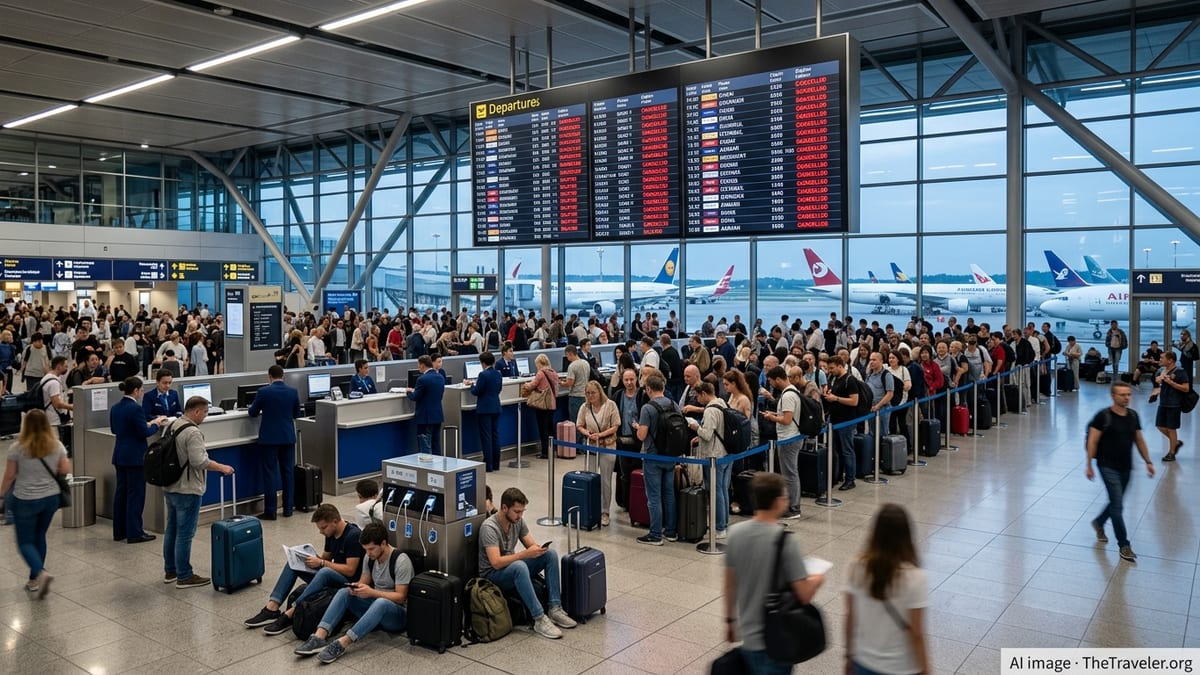
Travelers who once relied on Gulf megahubs as convenient one-stop gateways between Europe, Asia, Africa and Australia are confronting mass cancellations, rolling delays and complex rebookings. Online flight data shows traffic thinning dramatically over the Gulf while congestion and holding patterns build up over alternative waypoints to the north and south.
Jet Fuel Supply Shock Sends Airfares Surging Worldwide
The aviation turmoil is being compounded by a sharp tightening of global jet fuel supplies linked to the conflict. Analysis from international airline industry bodies highlights that the fighting and related missile and drone attacks have disrupted energy infrastructure across the wider region, from Iranian export terminals to refineries and gas facilities in Qatar and Saudi Arabia. The effective paralysis of tanker movements through the Strait of Hormuz, which normally carries a large share of the world’s oil exports, has left refiners scrambling for alternative crude and created bottlenecks for refined products.
Industry data indicates that jet fuel prices have more than doubled since hostilities intensified at the end of February, with Europe singled out as particularly exposed because roughly a quarter or more of its jet fuel needs are usually sourced from the Persian Gulf. Traders report widening product premiums for jet fuel compared with other refinery outputs, reflecting airlines’ limited ability to substitute or hedge against sudden shortages.
Aviation analysts note that higher fuel costs are feeding directly into airfares. With carriers already rerouting around blocked airspace, adding hundreds of kilometers and extra flight hours to some intercontinental services, the combination of additional fuel burn and elevated wholesale prices is pushing ticket costs sharply higher. Reports from fare-tracking services point to double-digit percentage increases on many Europe–Asia routes in the space of a few weeks, with premium cabins and last-minute bookings seeing the steepest rises.
Some airlines are attempting to contain the immediate shock by trimming frequencies, consolidating lightly booked services and temporarily suspending marginal routes. Others are adding fuel surcharges or so-called disruption fees across wide parts of their network, a move that is quickly visible to consumers shopping for spring and summer travel. For leisure travelers and small businesses operating on tight budgets, the new fare environment is already reshaping destination choices.
Europe Becomes a Pressure Valve as Travelers Reroute
As Gulf transit hubs struggle under airspace closures, Europe is emerging as a primary pressure valve for disrupted long-haul traffic. Major European carriers are adding capacity where possible on routes to South and East Asia that can avoid the most volatile areas, often by flying further north over Turkey, the Caucasus and Central Asia. While this keeps key city pairs connected, it also lengthens journey times and concentrates connecting traffic in already busy European hubs.
Economic analysis of the conflict’s fallout suggests that airports such as London Heathrow, Frankfurt, Paris Charles de Gaulle, Amsterdam Schiphol and Istanbul are absorbing travelers who would previously have routed via Dubai, Doha or Abu Dhabi. This sudden concentration of demand is tightening seat availability, particularly for summer peak dates, and is likely to push European hub fares even higher than seasonal norms.
Short-haul carriers in Europe are also benefiting from the shift in traveler behavior. Commentary by market observers points to a surge in regional bookings as risk-averse travelers choose to stay closer to home, swapping long-haul trips to Asia or Australia for Mediterranean breaks or city getaways within a few hours’ flying time. Low-cost airlines focused on intra-European leisure routes are positioning additional aircraft and frequencies for the upcoming holiday period, hoping to capture demand displaced from long-haul markets.
At the same time, European regulators and air navigation providers are wrestling with the operational consequences of rerouted traffic flows. Conflict-zone guidance remains fluid, and airlines are revising routings repeatedly as military activity and risk assessments change. This dynamic environment is raising the likelihood of uneven delays, with some days and city pairs more heavily affected than others depending on weather, military movements and air traffic control capacity.
Asia-Pacific Hubs Fight For New Transit Traffic
Beyond Europe, key Asia-Pacific hubs are moving quickly to capture travelers seeking alternatives to the Gulf bridge between continents. Airlines based in Singapore, Bangkok, Kuala Lumpur and Seoul are marketing one-stop connections between Europe and destinations across Southeast and North Asia, often by linking with European partners that can avoid the conflict zone on westbound legs.
Travel data shared by booking platforms indicates rising search interest and bookings for itineraries that route via Singapore, Bangkok, Hong Kong and Tokyo, as well as secondary hubs in South Asia that remain outside the restricted airspace footprint. In some cases, these routings are significantly longer than traditional Gulf connections, but remain attractive to travelers looking for predictable operations and relative distance from the conflict.
However, Asia-Pacific carriers are not immune to the broader fuel and insurance shock. Higher jet fuel prices are affecting them just as heavily, and war-risk insurance premiums for flights that skirt the edges of the conflict area have risen, even when aircraft remain well clear of active hostilities. Network planners in the region are therefore juggling the opportunity to gain market share against the financial risk of opening or expanding long thin routes that depend on volatile connecting traffic.
Tourism authorities in popular destinations such as Thailand, Indonesia and Japan are closely tracking booking trends from Europe and North America. Early data points to a mixed picture, with some long-haul visitors deferring trips until airfares stabilize, while others press ahead, accepting longer travel times and higher prices in order to avoid itineraries that pass near the Gulf.
Travelers Confront Uncertainty, Complex Routing and Price Shocks
For individual travelers, the evolving conflict is translating into a volatile planning environment reminiscent of the early months of the pandemic. Airline advisories and customer forums are filled with accounts of last-minute cancellations, involuntary rerouting through unfamiliar hubs and unexpectedly long layovers as carriers attempt to stitch together workable itineraries around closed skies.
Publicly available tracking data shows that some long-haul flights between Europe and Asia now take significantly longer than before the war, in certain cases adding two to three hours of flight time or requiring additional fuel stops. This has knock-on effects for crew scheduling, aircraft utilization and airport slot timings, all of which can lead to cascading delays if a disruption occurs early in the day.
Consumer advocates warn that travelers need to pay close attention to fare rules and insurance coverage before committing to expensive international tickets in the current climate. Policies that exclude war-related disruption or classify conflict as a “known event” may leave passengers with limited recourse if routes are altered or canceled after booking. Flexible tickets, rebooking waivers and documented disruption policies are becoming key decision factors, alongside traditional considerations such as price and schedule.
With the trajectory of the Iran-centered conflict still uncertain, analysts expect global aviation to remain fragile well into the northern summer season. Even if airspace restrictions are gradually eased, elevated fuel prices, damaged infrastructure and altered traffic flows are likely to keep pressure on fares and capacity. For now, the 2026 travel landscape is being reshaped in real time, with Europe and parts of Asia stepping in as the primary lifelines for a world suddenly cut off from its Gulf aviation superhighway.