

More news on this day
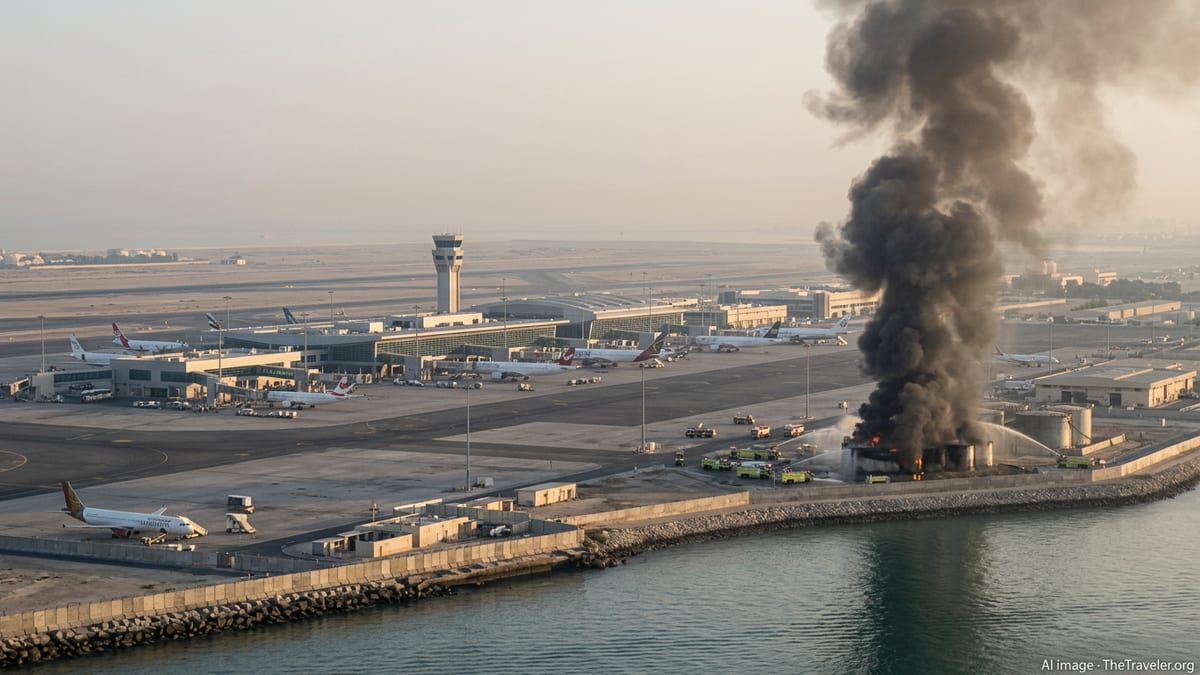
An overnight Iranian drone strike has ignited a major fire at a fuel storage facility on Bahrain’s Muharraq Island, near Bahrain International Airport, heightening fears of a wider regional escalation and raising fresh concerns over the security of critical transport and energy infrastructure across the Gulf.
Get the latest news straight to your inbox!
Strike on Muharraq Island Targets Critical Aviation Lifeline
Bahraini officials said drones launched from Iran struck fuel storage tanks in Muharraq Governorate in the night from March 11 to 12, setting off powerful explosions and sending plumes of black smoke into the sky within sight of Bahrain International Airport. The island, just off the capital Manama, hosts the kingdom’s main civilian air hub as well as key oil and fuel facilities that serve both the aviation sector and the wider economy.
Civil defence authorities reported that firefighters battled for hours to contain the blaze and prevent it from spreading to adjacent tanks and airport-related infrastructure. Initial assessments indicated that the fire was largely limited to a cluster of fuel storage units, but officials warned that further inspections would be needed once the site had cooled enough to be safely entered.
While Bahrain has not confirmed extensive structural damage to the airport itself, aviation sources said the proximity of the flames to jet fuel depots and service roads forced emergency suspension of some ground operations and prompted diversions and delays across the Gulf’s tightly interconnected air network.
The attack follows earlier strikes in late February that hit sites in and around Manama, including civilian buildings and areas close to US and allied military facilities, underscoring the island kingdom’s growing vulnerability as tensions between Iran, the United States and Israel spill across regional borders.
Passenger Disruption and Network Ripples Across the Gulf
The blaze near Bahrain International Airport immediately triggered operational disruptions, with inbound flights placed in holding patterns or rerouted to airports in Saudi Arabia’s Eastern Province, according to regional aviation monitors. Although Bahrain’s Civil Aviation Affairs authority stopped short of declaring a full airfield closure, airlines were instructed to slow arrivals and adjust schedules while authorities assessed runway visibility, air quality and the integrity of fuel supply lines.
Gulf Air, Bahrain’s flag carrier, began repositioning part of its fleet to nearby airports as a precaution, echoing earlier contingency steps taken after missile and drone strikes in February. Passengers transiting through Manama reported missed connections and extended layovers as airlines scrambled to rebook travelers and crew around the evolving security situation.
Travel agents in Manama and Dubai said they were fielding a wave of inquiries from customers concerned about upcoming itineraries involving Bahrain, particularly ahead of the busy spring holiday period. Some corporate clients have begun requesting routings that avoid Bahrain altogether, at least in the short term, adding pressure to carriers already juggling congestion and security-related diversions at other Gulf hubs.
Industry analysts warned that even temporary disruptions at Bahrain International Airport can cause disproportionate ripple effects, given the Gulf’s role as a global connecting corridor between Europe, Asia and Africa. Diversions and extended routings increase fuel burn and operating costs for airlines, while passengers face longer journey times and heightened anxiety about flying through a region experiencing frequent drone and missile alerts.
Regional Escalation Puts Gulf Aviation and Energy in the Crosshairs
The strike on Muharraq comes amid a broader Iranian campaign of drone and missile attacks on critical infrastructure across the Gulf, including airports, ports, oil facilities and digital infrastructure. In recent days, Iranian projectiles have been blamed for fires and damage at sites in the United Arab Emirates, Saudi Arabia, Kuwait and Qatar, as Tehran seeks to exert pressure over the ongoing conflict involving Israel and US forces.
Security analysts note that by targeting sites adjacent to major airports and energy hubs, Iran is attempting to send a dual message: it can disrupt both global energy flows and the aviation corridors that connect the region to the rest of the world. The fire near Bahrain International Airport, following earlier reported damage to nearby refineries and industrial zones, reinforces the perception that Gulf transport and energy nodes are now squarely in the line of fire.
The attacks have prompted urgent reviews of airspace risk assessments by global carriers. Some airlines had already been routing flights farther from Iran’s coastline and the Strait of Hormuz; the latest strikes on Bahrain and neighboring states are likely to accelerate those trendlines, particularly for European and Asian carriers that rely on safe overflight corridors across the Gulf.
Insurance premiums for airlines and energy operators in the region are also expected to rise, adding further cost pressures and potentially discouraging some carriers from scheduling additional capacity through affected hubs. For smaller states such as Bahrain, which depend heavily on their role as transport and logistics gateways, the strategic and economic stakes could hardly be higher.
Government Response and Calls for De-escalation
The Bahraini government swiftly condemned the strike as a “blatant Iranian aggression” and a violation of its sovereignty, announcing that it had summoned Tehran’s chargé d’affaires to deliver a formal protest. State media highlighted the work of civil defence and medical teams, noting that dozens of civilians were treated for smoke inhalation and minor injuries linked to blasts and flying debris.
Officials emphasized that the fire at the fuel storage facility had been contained and posed no ongoing threat to airport passengers or residential neighborhoods, an attempt to reassure both the domestic public and international travelers that Bahrain remained open for business. Still, authorities urged residents in some parts of Muharraq to keep windows closed and limit outdoor activity until air quality improved.
Regional allies, including Saudi Arabia and the United Arab Emirates, expressed solidarity with Bahrain and criticised Iran’s continuing use of drones and missiles against civilian-adjacent targets. At the United Nations, diplomats from Western and Gulf states renewed calls for Tehran to halt attacks on airports, shipping lanes and energy infrastructure, warning that further escalation risked a wider conflict that could severely disrupt global trade and travel.
Despite those appeals, there was little immediate sign of a diplomatic breakthrough. Analysts cautioned that as long as the underlying confrontation between Iran, Israel and the United States continues, Gulf states such as Bahrain will remain exposed, with airports, ports and fuel facilities serving as highly visible pressure points.
Travel Advisory Outlook for Visitors and Transit Passengers
Travel consultants say Bahrain remains accessible but advise visitors to monitor official advisories and airline updates closely in the days ahead. Several Western governments have already updated their guidance to warn of an elevated risk of drone and missile attacks on infrastructure in Bahrain and the wider Gulf, while stopping short of recommending that travelers avoid the kingdom entirely.
For leisure travelers planning short breaks in Manama or island resorts, the main impact is likely to be uncertainty around flight timings and potential last-minute schedule changes. Experts recommend allowing extra connection time, maintaining flexible hotel and ticket bookings where possible, and registering contact details with consular services before departure.
Transit passengers using Bahrain International Airport as a connecting hub are being urged to keep a close eye on airline apps and airport communication channels, particularly for overnight departures and arrivals when regional air activity has been most volatile. While the probability of any one traveler being directly affected by security incidents remains low, the psychological impact of repeated alerts and visible military activity has become an increasingly prominent part of the Gulf travel experience.
For Bahrain, the challenge now is to restore confidence in its airport as a safe and reliable gateway while reinforcing physical protection for the fuel, energy and logistics assets that support it. How effectively it responds will shape not only its tourism and aviation prospects, but also its position within a Gulf region adjusting to a new era of contested skies.