

More news on this day
A cascading fuel crisis tied to the Iran war is rippling through global aviation, triggering large-scale flight cuts, steep cost increases and severe travel disruptions for passengers who depend on Bahrain and other Gulf hubs as key transit gateways.
Get the latest news straight to your inbox!
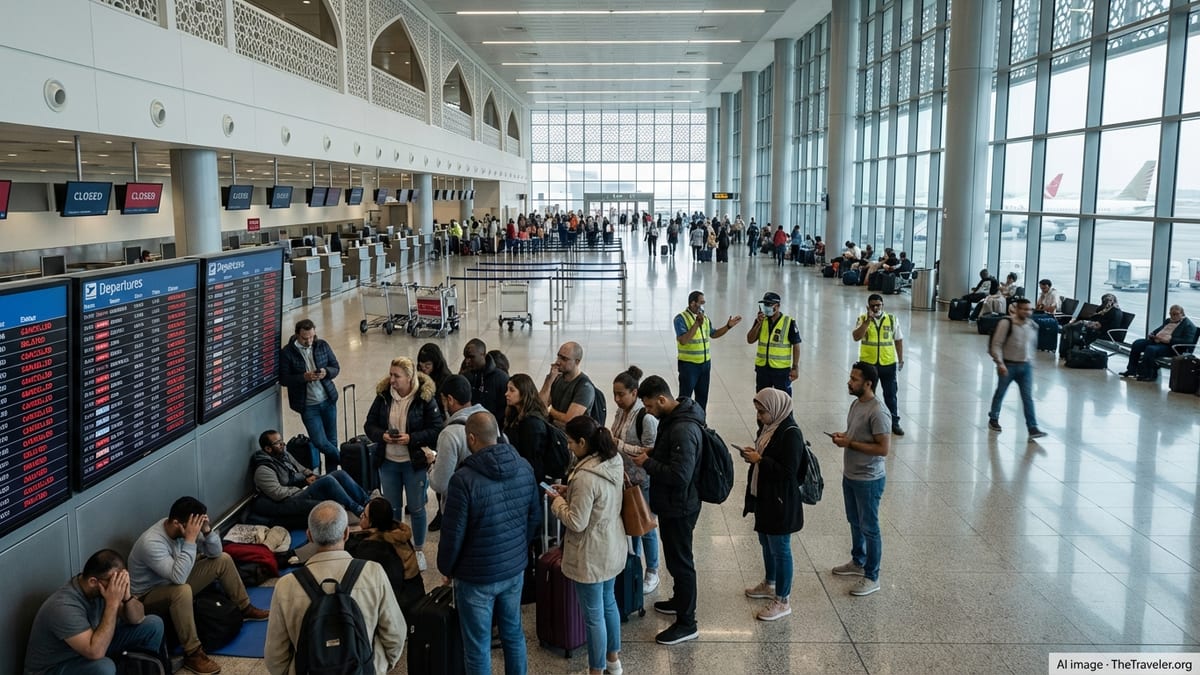
War-Driven Fuel Shock Hits Iran and the Wider Gulf
The latest phase of the Iran conflict has collided with a fragile energy system, exposing deep vulnerabilities in jet fuel supply across the Gulf. After the closure of the Strait of Hormuz in early March, a chokepoint that handles a significant share of the world’s seaborne oil and liquefied natural gas flows, oil prices surged above 120 dollars a barrel and tightened regional access to refined products, including aviation fuel.
Published analyses of the economic fallout indicate that disrupted exports and damage to Iranian oil and gas infrastructure have further strained fuel availability. Recent strikes on key Iranian energy assets have hit facilities linked to a large share of the country’s gas production, compounding pressure on domestic refining and distribution networks. This has limited Iran’s capacity to stabilize jet fuel supply at home while reducing surplus volumes that might otherwise reach nearby markets.
Aviation-focused assessments warn that the combination of higher crude prices, restricted refining output and logistical constraints around the Gulf has elevated jet fuel benchmarks to between roughly 150 and 200 dollars per barrel in some markets, more than double pre-war levels. Industry groups caution that if airport fuel stocks remain tight, airlines will have no option but to ground parts of their fleets, particularly on long-haul and fuel-intensive routes.
Iran’s own civil aviation sector, already squeezed by sanctions and aging fleets, now faces a sharper squeeze from these energy shocks. Publicly available information suggests that Iranian carriers are prioritizing limited fuel supplies for essential domestic links and politically sensitive international services, leaving a growing list of secondary routes at risk of deep cuts.
Mass Flight Cancellations and Longer Routes Reshape Global Networks
The fuel squeeze is landing on an aviation system already distorted by widespread airspace closures over and around Iran. Since late February, large stretches of sky from Tehran to the eastern Mediterranean have been periodically off-limits to commercial traffic, forcing airlines to redesign their route maps in real time.
Industry trackers report that more than 8,000 flights have been canceled at major Gulf hubs in recent weeks, including Dubai, Abu Dhabi, Doha, Riyadh, Jeddah and Bahrain. Carriers that rely on overflying Iran and neighboring states to link Europe with Asia and Australia have been forced onto long detours over Turkey, Central Asia or deep into Africa, adding hours to flight times and sharply increasing fuel burn and crew costs.
Data compiled by air travel analysts suggests Middle East airline capacity fell by more than half in March compared with a year earlier, helping to push global seat supply lower for the first time since the pandemic recovery. At the same time, fuel surcharges on some long-haul tickets have climbed to the equivalent of around 75 dollars or more per one-way journey, particularly on routes between North America, Europe and East Asia.
European network airlines have adjusted by adding services that bypass the Gulf entirely, rerouting traffic via northern corridors or partnering with Asian carriers that can operate through alternative hubs. Low-cost and leisure-focused airlines have also begun trimming schedules, particularly where fuel-intensive long sectors are no longer commercially viable under current price and insurance conditions.
Bahrain’s Strategic Hub Brought to a Standstill
No state illustrates the travel shock more starkly than Bahrain, a country that has invested heavily in aviation as an economic lifeline. Bahrain International Airport, long a key transfer point for Gulf Air and a growing roster of foreign carriers, suspended all passenger operations in March after regional missile and drone strikes raised security and insurance concerns across the Gulf’s airspace corridor.
Flight tracking data and specialist aviation coverage describe a rapid exodus of aircraft from Bahrain as airspace closures spread. Gulf Air has shifted a large part of its operation to Dammam in neighboring Saudi Arabia, running a skeleton schedule to a limited set of destinations such as London and Mumbai while Bahrain’s skies remain effectively closed.
Travelers who once relied on Bahrain as a convenient midway point between Europe, South Asia and the wider Middle East now face lengthy diversions and patchwork itineraries. Some are being rebooked through Saudi, Turkish or Omani hubs, while others report outright cancellations with little clarity on when normal services might resume.
The crisis has also tightened local fuel dynamics. Publicly available industry reports show that recent disruptions and shutdowns affecting Bahrain’s refining sector, including units that supply jet and marine fuel, have reduced regional buffer capacity just as airlines are seeking alternative uplift points. This has increased dependence on a smaller number of refueling locations, adding congestion and cost to every rerouted flight.
Soaring Costs Translate Into Higher Fares and Thinner Schedules
For passengers, the most immediate impacts are visible on ticket prices and schedule reliability. Studies of recent fare trends across transcontinental markets indicate sharp increases on routes that previously transited Iran or the Gulf, with some Asia–Europe and Asia–North America journeys now priced several times higher than at the start of the year.
Carriers have responded in part by selectively pruning their networks. Several European and Asian airlines have suspended services to Bahrain, Qatar, the United Arab Emirates and nearby markets for at least the next few months, citing fuel price volatility, war-risk insurance costs and limited confidence in the near-term stability of airspace arrangements. British and continental European operators have extended cancellations to destinations such as Dubai, Amman and Bahrain, erasing key connection options for travelers originating in secondary European cities.
At the same time, some long-haul low-cost carriers in Asia are openly recalibrating their business models. Publicly reported statements from airline executives in the region describe fare hikes of up to 40 percent on selected routes and the elimination of unprofitable or fuel-heavy sectors. Expansion plans that involve new bases or partnerships in Bahrain and nearby hubs are being delayed, even where airlines maintain that long-term Gulf growth remains part of their strategy.
Industry groups stress that these measures are intended to preserve liquidity during a period when every additional hour in the air erodes margins. With jet fuel now accounting for an outsized share of operating expenses, airlines face difficult choices between protecting network reach and safeguarding their balance sheets.
Uncertain Timeline for Recovery in Bahrain and Beyond
How long this aviation turbulence will last depends on a cluster of factors extending far beyond the control of airlines and airports. The duration of the Iran war, the status of the Strait of Hormuz and the resilience of critical energy and transport infrastructure across the Gulf will all shape the availability and price of jet fuel in the months ahead.
Economic assessments of the conflict highlight its potential to rival or exceed the travel disruption seen during the early stages of the pandemic, at least within the Middle East and on the major intercontinental corridors that depend on Gulf stopovers. Airspace closures affecting Bahrain, Iraq, Kuwait, Qatar, Syria and parts of the United Arab Emirates have already removed a substantial share of global connecting capacity, and there is limited scope to replace that overnight through alternative hubs.
For Bahrain specifically, published aviation analysis suggests that a meaningful recovery in traffic will require not only the safe reopening of its airspace but also the restoration of local refining capacity and regional fuel logistics. Until confidence returns to insurers and route planners, many airlines are likely to favor more northerly or southerly routings that avoid the most exposed portions of the Gulf.
In the meantime, travelers are advised by industry observers to expect longer journeys, fewer nonstops and higher prices on routes that previously took advantage of Iran’s air corridors and Bahrain’s position as a compact yet strategically located hub. Even if hostilities ease in the near term, the fuel crisis exposed by this conflict is likely to leave a lasting imprint on how global airlines plan, price and power their flights across the Middle East.