

More news on this day
Escalating conflict between Iran and the United States is rapidly reshaping the risk map for Middle East tourism, with new Iranian threats against hotels seen as hosting or supporting US forces in Bahrain, Kuwait, the United Arab Emirates, Qatar, Saudi Arabia and other Gulf states raising alarms for travelers and the region’s high-end hospitality sector, including flagship destinations on Dubai’s Palm Jumeirah.
Get the latest news straight to your inbox!
Hotels Caught Between Military Targets and Civilian Guests
Publicly available reporting on the 2026 Iran war shows that Iran has expanded its retaliatory strikes beyond strictly military installations to include locations in Gulf cities where US personnel and interests are believed to operate alongside civilians. Recent assessments reference missile and drone attacks affecting Bahrain, Kuwait, Qatar, Saudi Arabia and the United Arab Emirates, with strikes in some cases impacting hotels and nearby residential areas.
In Bahrain, coverage of Iranian salvos toward the capital Manama describes damage in the Juffair district, home to the US Navy’s 5th Fleet, and at least one hotel reportedly affected by an attack that injured US defense staff. Travel advisories and embassy notices now single out hotels in central Manama as potential targets, reflecting concern that properties accommodating foreign government or military staff could be drawn deeper into the confrontation.
Security briefings and think tank analyses note that Iranian officials and affiliated media have repeatedly framed “US-linked infrastructure” and “US-aligned assets” across the Gulf as legitimate targets in the event of further escalation. That language, while imprecise, has raised fears that any hotel known to host official delegations, contractors or logistical hubs may face heightened scrutiny, even when also serving large numbers of leisure travelers.
Analysts following the conflict caution that the blurring of lines between military and civilian sites complicates compliance with international humanitarian law and significantly widens the circle of facilities at risk. For global hotel groups such as Marriott, Hilton, IHG and Accor, which operate dozens of properties across these markets, the possibility that their buildings could be perceived as dual-use locations represents a serious operational and reputational challenge.
Palm Jumeirah and Dubai’s Luxury Icons Under Strain
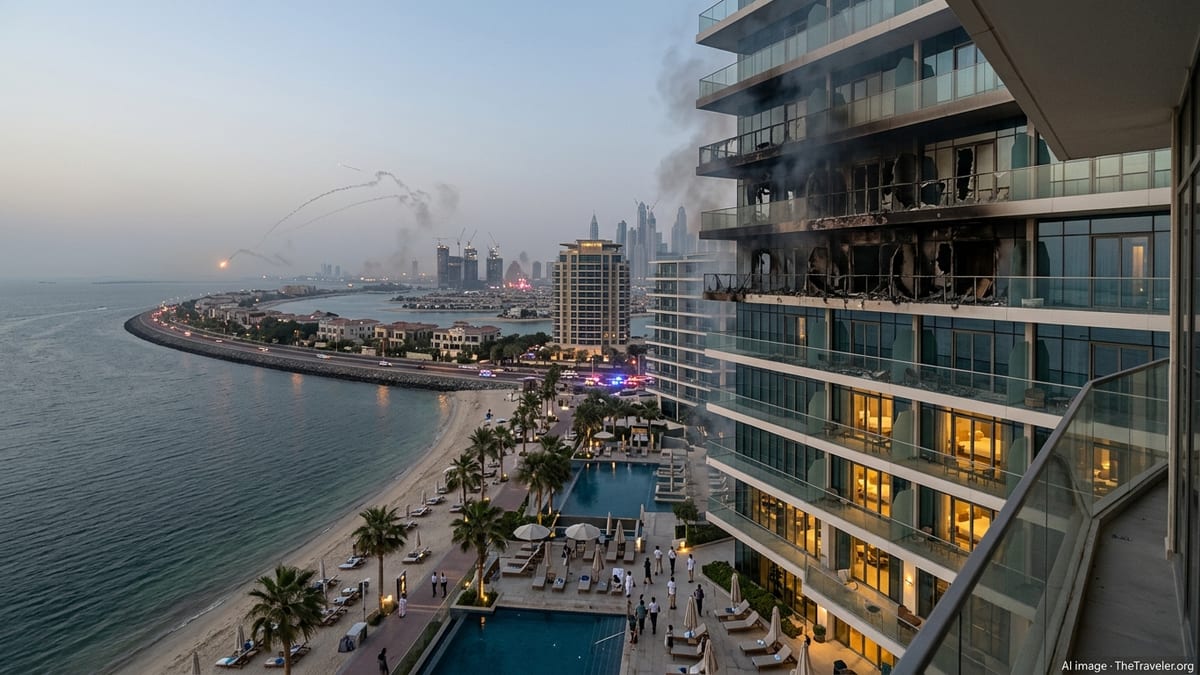
Dubai’s Palm Jumeirah, one of the world’s most recognizable leisure enclaves, has already felt the immediate impact of the crisis. According to regional and international media coverage, debris from intercepted missiles and drones has caused fires and façade damage at high-profile waterfront hotels in Dubai, including on the Palm and at nearby landmark properties. Social media footage and subsequent reporting have documented explosions near the man-made island and a heavy security presence around luxury resorts.
While there is no confirmation that Palm Jumeirah hotels themselves are being deliberately selected as primary targets, the combination of their visibility, proximity to key maritime routes and role in hosting foreign visitors makes them a focal point for risk assessments. Commentaries on the conflict indicate that US-linked facilities in the wider UAE, such as air bases and logistics nodes, have been explicitly referenced by Iranian officials in warning statements, increasing anxiety about collateral damage in surrounding urban and resort areas.
Industry-focused travel outlets now describe Dubai as a destination operating under constant threat of further missile and drone activity, with particular attention on hotel clusters that define the city’s global brand. Coverage notes that even when interception systems function as intended, falling debris can compromise hotel exteriors, spark fires and trigger large-scale evacuations, unsettling paying guests and complicating insurance coverage.
Hotel operators on the Palm and elsewhere in the city are reported to be refining crisis protocols, rehearsing shelter-in-place plans, and coordinating closely with local authorities on air raid alert procedures. Despite these efforts, the perception that some of the world’s most luxurious stays are within range of an active regional war is reshaping how both tourists and corporate clients evaluate Dubai’s risk profile.
Travel Advisories, Airspace Disruptions and Booking Collapse
Government advisories in key outbound markets have shifted rapidly as the conflict has intensified. Updated guidance for the United Arab Emirates, Bahrain, Kuwait, Qatar and parts of Saudi Arabia now frequently references the threat of ongoing Iranian missile and drone strikes, disruption to commercial aviation, and the possibility of further attacks on civilian infrastructure, including hotels and airports.
Specialist travel publications report that, by mid-March, tens of thousands of flights across the wider Middle East had been cancelled or rerouted due to airspace closures and the risk of missile activity over Gulf hubs. This turbulence has hit regional transit centers hard and left hotels facing a sudden collapse in arrivals from Europe, North America and Asia, particularly among risk-averse leisure travelers and conference organizers.
Economic analyses from tourism researchers and industry bodies suggest that the US–Israel–Iran conflict is costing Middle Eastern tourism hundreds of millions of dollars per day in lost visitor spending. Forecasts for 2026 visitor numbers across the Gulf have been revised sharply downward, with warnings that tens of millions of potential trips may evaporate if hostilities drag on into the peak winter season.
For major chains such as Marriott, Hilton, IHG and Accor, which have invested heavily in new-build resorts and branded residences across the Gulf in recent years, the combination of higher insurance premiums, security spending and weaker demand poses a strategic dilemma. Operators must balance the long-term appeal of resilient destinations like Dubai and Riyadh against the near-term reality of reduced occupancy, volatile revenues and questions from shareholders about geopolitical exposure.
Operational Challenges and Duty-of-Care Pressures for Global Brands
The emerging pattern of strikes and threats across the Gulf is forcing hotel groups to confront complex duty-of-care obligations toward guests and staff. Legal analysts note that employers and property operators in high-risk zones face increasing scrutiny over their security measures, evacuation plans and communication practices during crises. Failure to demonstrate robust preparedness could expose brands to litigation and reputational damage if future attacks impact their properties.
Operations teams across the region are reported to be revisiting everything from reinforced safe areas and blast-resistant glazing to backup power, water and communications capabilities. In countries where Iran has hinted at potential strikes on critical infrastructure such as ports and desalination plants, hotels are also evaluating the resilience of utility supplies that underpin daily operations and guest comfort.
Insurance markets are reacting as well. Brokers and risk consultants describe a tightening environment for war, terrorism and political violence coverage, with higher premiums and more exclusions for properties in locations explicitly mentioned in Iranian warnings or singled out in security briefings. Some underwriters are reassessing aggregate exposure in marquee districts, including parts of Dubai, Doha and Manama, where concentrations of high-value hotels sit within relatively small geographic areas.
Multinational hospitality groups must also navigate differing national responses across Bahrain, Kuwait, Qatar, Saudi Arabia and the UAE, each with its own alert systems, regulatory requirements and information-sharing practices. Ensuring consistent brand standards for safety while adapting to local conditions has become a core leadership task as the regional security environment grows more unpredictable.
Traveler Behavior Shifts and the Uncertain Road Ahead
Behavioral research on war and tourism indicates that perceived risk often has a stronger impact on travel decisions than statistically measured danger. The highly visible nature of missile interceptions over Gulf skylines, extensive social media footage from Palm Jumeirah and other hotspots, and viral claims about hotel strikes are therefore likely to have an outsized influence on how global travelers view the region in the coming months.
Travel agents and tour operators are already reporting sharp interest in alternative winter-sun destinations outside the Gulf, from the Indian Ocean to Southeast Asia, as well as closer-to-home options in Southern Europe. Corporate travel managers, sensitive to duty-of-care and insurance constraints, are said to be redirecting meetings and incentive trips away from cities perceived to be within range of Iranian missiles, at least until there is a clear de-escalation.
At the same time, past conflicts suggest that some segments of demand may return quickly once a ceasefire or negotiated pause takes hold, especially among seasoned travelers familiar with the region. Analysts point out that Gulf tourism has historically recovered from previous episodes of tension, supported by strong infrastructure, aggressive marketing and substantial state backing for flagship projects such as Palm Jumeirah.
For now, however, the combination of active Iranian strikes, direct or implied threats against hotels linked to US forces, and heightened geopolitical uncertainty has created one of the most challenging environments for Middle East hospitality in decades. The decisions taken in the coming weeks by policymakers, military planners and industry leaders will shape whether destinations like Dubai’s Palm Jumeirah can maintain their status as global tourism icons amid an evolving security landscape.