

More news on this day
Thousands of flights to key Middle Eastern hubs including Dubai, Doha and Abu Dhabi have been cancelled or diverted after the Israel–Iran conflict flared into open strikes, triggering sweeping airspace closures and leaving hundreds of thousands of travelers facing severe disruption.
Airspace Closures Empty Skies Over the Gulf
What began as military strikes between the United States, Israel and Iran has rapidly transformed into one of the most significant shocks to global aviation since the pandemic. Large swathes of airspace across the Middle East have been shut, including Iran, Israel, Iraq, Qatar, Kuwait, Bahrain and parts of the United Arab Emirates, forcing airlines to cancel, divert or heavily reroute services.
Flight-tracking data shows skies over the Gulf region unusually clear as civilian aircraft are redirected around the conflict zone. Aviation analytics firm Cirium reported that of more than 4,200 flights scheduled to land in Middle Eastern countries on Saturday, nearly a quarter were cancelled, with total cancellations surpassing 1,800 when outbound services are included. Delays and knock-on disruption are rippling across Europe, Asia, Africa and North America as aircraft and crews are left out of position.
Regulators have underscored the seriousness of the situation. The European Union Aviation Safety Agency has warned of high risk to civil aviation in affected airspace, advising carriers to avoid conflict zones and neighbouring states where military bases and overflight corridors could be exposed to missile or drone activity. Similar guidance from national regulators has prompted a cascade of schedule cuts far beyond the immediate warzone.
Dubai, Doha and Abu Dhabi Hubs Brought to a Standstill
At the heart of the disruption are the Gulf’s mega-hubs, normally among the busiest transit points on earth. Dubai International Airport and Dubai World Central have suspended all flight operations until further notice after the UAE partially and temporarily closed its airspace. Home carrier Emirates, the world’s largest long-haul airline, has halted operations to and from Dubai, while low-cost sister airline flydubai has also grounded its network.
In Abu Dhabi, Zayed International Airport is experiencing major disruption after Etihad Airways temporarily suspended all departures from the emirate, with services on Sunday morning paused until at least 2:00 p.m. local time. Flights already en route have in some cases been forced to return to their origin or divert to secondary airports, putting additional pressure on regional infrastructure.
Qatar Airways has suspended flights to and from Doha following the temporary closure of Qatari airspace. Hamad International Airport, usually a vital crossroads for Europe–Asia and Africa–Asia connections, is operating only limited services as airlines adjust routings or ground aircraft. Other Gulf carriers, including those based in Bahrain and Saudi Arabia, have also cut flights as they await clearer guidance on safe operating corridors.
Ripple Effects From Europe and North America to South Asia
While the epicentre of the crisis is in the Gulf, its effects are being felt at airports around the world. European groups such as Lufthansa, Air France and KLM have suspended flights to several Middle Eastern destinations, including Tel Aviv, Beirut, Dubai, Doha, Riyadh and Oman, while also avoiding certain regional airspaces on long-haul routes that would normally overfly Iran or Iraq.
North American carriers are rapidly unwinding their own Middle East schedules. Delta Air Lines, United Airlines and American Airlines have cancelled or suspended flights to Dubai, Doha, Abu Dhabi and Tel Aviv. Some services that continue to operate are taking lengthy detours over the Mediterranean, the Caucasus or southern routing options, adding hours of flying time and significant fuel costs.
South Asian gateways are also under strain. In India, the aviation regulator has advised airlines to avoid airspace over as many as eleven countries, prompting carriers such as Air India, IndiGo, Air India Express, SpiceJet and Akasa Air to suspend most services to the Gulf. Airports in cities including Mumbai and Thiruvananthapuram have reported dozens of cancellations to Doha, Dubai, Abu Dhabi and Dammam, stranding migrant workers and family travelers who rely heavily on these routes.
Hundreds of Thousands of Travelers Stranded Worldwide
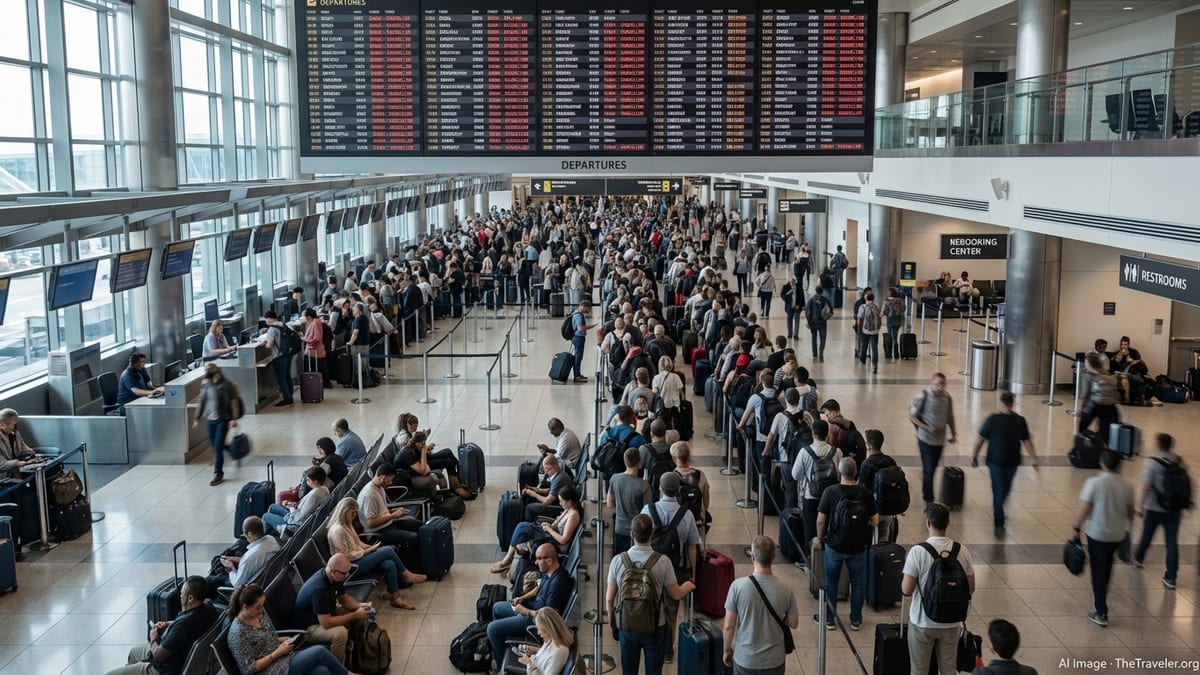
The immediate human impact is visible in crowded terminals, long check-in queues and overnight lines at airline transfer desks. With hubs including Dubai, Doha and Abu Dhabi effectively offline, passengers have been left mid-journey, unable to reach final destinations in Africa, South Asia, Southeast Asia and Australasia that are normally served through one-stop Gulf connections.
Airlines are waiving change fees, offering refunds and, where possible, rebooking passengers on alternative routings via Europe or other regional hubs. However, capacity on these detour routes is limited and many flights are already full. Hotels near major airports are reporting a spike in last-minute bookings as travelers brace for one or more unscheduled nights away from home.
Some long-haul flights have been forced into dramatic mid-air course changes. Services from Europe and North America bound for the Gulf have diverted to cities such as Athens, Istanbul and New Delhi, where passengers must disembark and await updates. Others have turned back to their point of origin, burning fuel and valuable crew duty hours with no passengers reaching their intended destination.
Travel insurers are fielding rising numbers of claims as families and business travelers seek compensation for missed events, cruises and onward connections. Yet many policies have tight exclusions around war and conflict, leaving some customers uncertain whether their losses will be covered.
What Travelers Should Expect in the Coming Days
Aviation experts say the duration and severity of the disruption will depend on how quickly military tensions ease and whether airspace reopens in phases. Even under a best-case scenario, they warn that the operational fallout will linger, with aircraft and crews displaced, maintenance schedules disrupted and connections backed up across global networks for days to come.
Passengers with plans to fly to or through the Middle East in the next week are being urged to treat their itineraries as highly provisional. Airlines are advising customers not to proceed to the airport until their flight status is confirmed on official channels, and to expect last-minute schedule changes, long call centre waits and limited availability for rebooking on peak routes.
Industry analysts note that rerouting around both Russian and much of Middle Eastern airspace leaves airlines with very few efficient paths between Europe and Asia. Longer flight times will increase fuel burn and costs, potentially feeding into higher fares if the situation persists. Cargo operations, which rely heavily on belly space in passenger aircraft across these corridors, are also being hit, raising the prospect of delays for high-value goods and time-sensitive shipments.
For now, the message from carriers and regulators is one of caution. Safety, they stress, outweighs schedule reliability, and normality will only return once there is confidence that civilian aircraft can traverse the region without risk of being caught in the crossfire.