

More news on this day
A rare United States Air Force E-3 Sentry airborne warning and control aircraft, often described as an “eye in the sky,” has been destroyed in an Iranian missile and drone strike on Saudi Arabia’s Prince Sultan Air Base, according to emerging open-source imagery and defense reporting. The loss of the high-value command-and-control platform is drawing global attention to the vulnerability of critical surveillance assets and the wider risks to air operations across the Gulf region.
Get the latest news straight to your inbox!
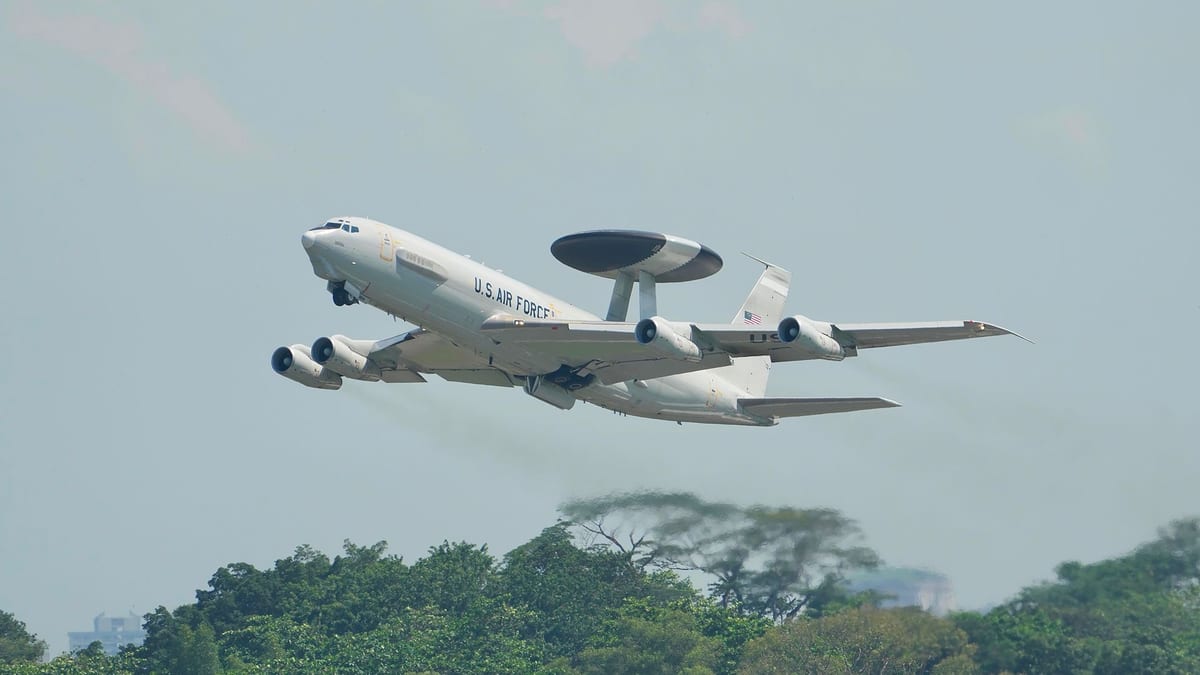
Image by Simple Flying
Strike on Prince Sultan Air Base Targets High-Value Assets
Publicly available reporting indicates that Iran launched a coordinated attack on Prince Sultan Air Base in central Saudi Arabia on March 27, involving ballistic missiles and drones aimed at U.S. positions and aircraft on the ground. Earlier accounts focused on injuries to U.S. personnel and damage to several refueling aircraft. New imagery and analysis now point to catastrophic damage to at least one E-3 Sentry, one of a small number of such aircraft in the U.S. inventory.
Satellite photographs and ground-level visuals circulating through defense monitoring communities appear to show an E-3 airframe engulfed in fire, with its distinctive radar dome shattered and the forward fuselage heavily damaged. Aviation specialists commenting in open forums suggest the aircraft is a constructive total loss, given the destruction of mission-critical radar systems and structural components that would be extremely difficult, if not impossible, to restore.
The attack on Prince Sultan Air Base follows a series of Iranian strikes on U.S. and partner facilities across the region, as tensions linked to the broader Iran–U.S.–Israel confrontation have escalated through March. The base, long used as a key hub for U.S. air operations in Saudi Arabia, has increasingly come under scrutiny from analysts who warn that the concentration of high-value aircraft in relatively fixed locations presents an attractive target.
Why the E-3 Sentry Matters for Regional Air Operations
The E-3 Sentry serves as an airborne command post and radar platform, providing wide-area surveillance, target tracking, and battle management over hundreds of kilometers. Fitted with a rotating radar mounted in a large circular radome above the fuselage, the aircraft can monitor aircraft, missiles, and drones far beyond the line of sight of ground-based systems, cueing fighters and surface defenses in real time.
Only a limited number of E-3s remain in U.S. service, as the fleet has aged and modernization plans have shifted toward newer platforms. Industry and defense analyses note that each aircraft represents not only a significant financial investment, often estimated in the hundreds of millions of dollars when mission systems and lifecycle costs are considered, but also years of specialized training for onboard crews and maintenance personnel.
The reported destruction of an E-3 in Saudi Arabia therefore carries both operational and symbolic weight. Operationally, it reduces airborne command-and-control capacity at a time when U.S. and partner forces are attempting to manage a complex air picture stretching from the Eastern Mediterranean to the Gulf. Symbolically, it underscores that even traditionally rear-area assets, once thought relatively secure, are now exposed to long-range precision strikes.
Implications for Air Security and Civil Aviation
The loss of a major surveillance and command aircraft in the heart of the Gulf region is likely to sharpen concerns about airspace stability for both military and civilian aviation. Long-haul commercial flights already navigate around large portions of Iranian airspace and adjacent conflict zones, lengthening routes between Europe, the Middle East, and Asia. Any further degradation of situational awareness tools in the region could add to the complexity of managing congested skyways.
Security analysts following the conflict note that the attack demonstrates Iran’s growing ability to hold distant, high-value targets at risk using a mix of ballistic missiles and drones. The strike on Prince Sultan Air Base comes after other reported incidents involving U.S. aircraft, including refueling tankers and fighters, highlighting a pattern of sustained pressure on air operations infrastructure across the Gulf.
For regional governments hosting U.S. forces, the destruction of the E-3 will likely prompt renewed debate over base defenses, dispersal of aircraft, and the political sensitivities of hosting foreign assets that may draw retaliatory fire. For travelers, the immediate impact may be less visible, but route planners and risk consultants will be watching closely for any additional airspace restrictions or advisories that could affect flight times and connectivity.
Strategic Signals and Next Steps in the Gulf
According to widely cited coverage from international news agencies, the broader Iranian strike on Prince Sultan Air Base injured at least ten U.S. service members and damaged multiple aircraft, including refueling tankers vital for sustaining long-range missions. The subsequent identification of an E-3 among the destroyed assets marks a significant escalation in the material cost of the confrontation.
Defense commentators suggest that the targeting of such an important command platform may be intended to signal that key U.S. enablers are vulnerable, not only on the front lines but even at well-established hubs. The attack may complicate U.S. planning, requiring the redeployment of remaining E-3s or the accelerated use of alternative systems such as ground-based radars, allied surveillance aircraft, and space-based monitoring to maintain coverage.
As March draws to a close, the strike on Prince Sultan Air Base adds another volatile dimension to an already complex regional crisis. For now, commercially available imagery and open-source reporting are filling gaps in public knowledge about the incident, while travelers and airlines track potential knock-on effects in one of the world’s most critical aviation corridors.