

More news on this day
Missile and drone strikes attributed to Iran ignited fires at the Crowne Plaza Manama and nearby residential towers in Bahrain’s capital this week, thrusting one of the Gulf’s key business and leisure hubs into the front line of the escalating US-Israel-Iran conflict and jolting confidence in regional travel safety.
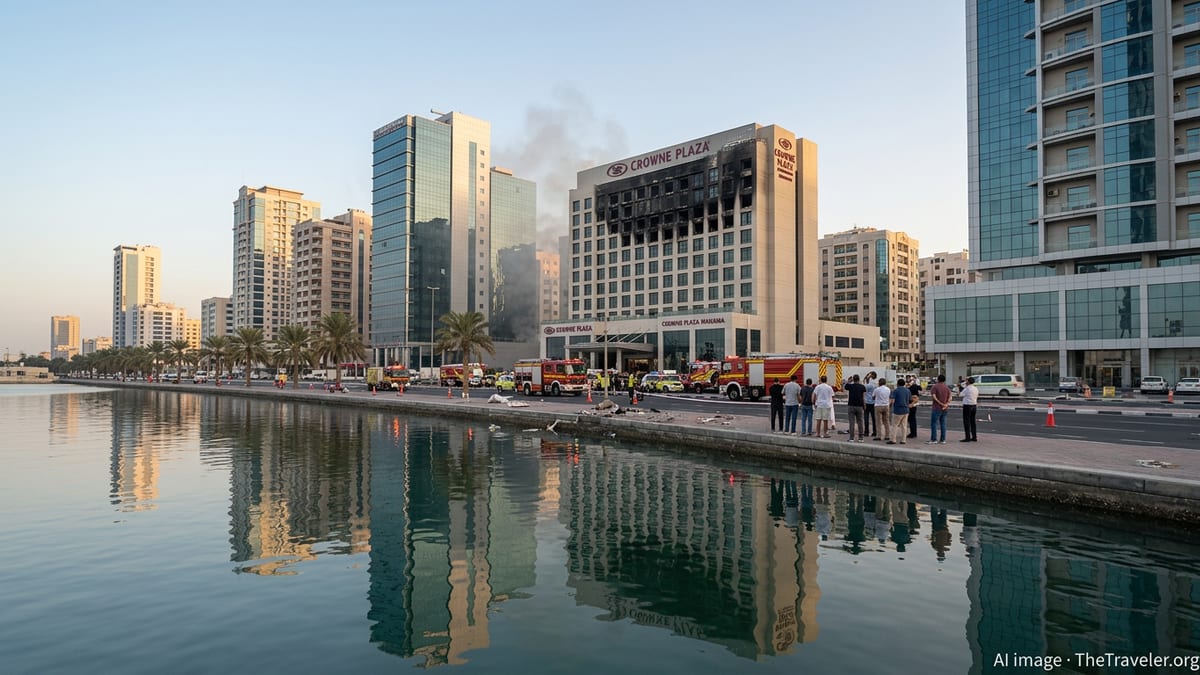
Prestigious Crowne Plaza Hotel Hit as Iran Widens Retaliation
The Crowne Plaza Manama, a prominent waterfront leisure and business hotel near Bahrain’s diplomatic and financial districts, was struck in an early-morning drone attack as Iran expanded its retaliation for joint US-Israeli strikes on Tehran. Bahraini authorities and regional media reported that a drone impact triggered a blaze at the multistory property, sending smoke into the pre-dawn sky and prompting a large civil defense response.
Emergency services rushed to evacuate guests and staff, with fire crews battling flames on the hotel’s exterior and upper levels. Initial official tallies indicated no fatalities at the Crowne Plaza itself, though at least one foreign worker has been reported dead elsewhere in the city amid the wider barrage, and multiple injuries have been recorded across the capital.
Footage verified by regional outlets and defense analysts shows a projectile slamming into the hotel complex, underscoring the precision of the strike and raising questions over whether the site was targeted for its proximity to US-linked facilities in the Al Juffair district. The hotel is a popular choice for visiting business delegations, Western contractors and conference groups, making the incident especially unsettling for international travelers.
The attack came days after a US-Israeli air campaign killed Iran’s supreme leader in Tehran, prompting Iranian officials to vow that American forces and their partners across the region would face sustained retaliation. Bahrain, long a close security ally of Washington and host to the US Navy’s Fifth Fleet, has quickly found itself among the most exposed Gulf states.
Explosions Rock Manama as Residential Towers and Oil Site Also Hit
The Crowne Plaza strike was one of several impacts reported in and around Manama between 28 February and 6 March, as Iranian missiles and drones targeted what Tehran described as US and Israeli military-linked assets. Bahraini officials said two high-rise residential buildings, including towers in the Juffair and Fontana districts, suffered direct hits or fires triggered by falling debris from intercepted projectiles.
Residents described scrambling down smoke-filled stairwells in darkness after blasts shattered windows and knocked out power in upper floors. Civil defense teams worked through the night to douse fires clinging to tower facades, scenes that contrasted sharply with Bahrain’s usual image as a calm financial and tourism hub framed by glass towers and marinas.
Separately, authorities confirmed that a missile strike on Bahrain’s main state-owned refinery complex ignited a blaze at a unit of the facility, adding an energy-security dimension to the escalating confrontation. The attack on critical oil infrastructure, located not far from heavily trafficked shipping lanes, further rattled markets and underlined how the conflict now reaches far beyond Iran and Israel’s borders.
Manama’s skyline, anchored by hotel towers, residential complexes and malls catering to weekend visitors from Saudi Arabia, now bears several charred facades and broken curtain walls. For a kingdom that has marketed itself as a safe, easily accessible Gulf getaway, the images mark a dramatic reversal.
Travel Shock: Hotels, Airlines and Tourists Scramble
The strikes have triggered an immediate shock to Bahrain’s travel and hospitality sector. The US Embassy in Manama has advised its citizens to avoid hotels in the capital after the Crowne Plaza incident, warning that accommodation used by Western visitors could face further targeting. Other embassies have urged travelers to monitor advisories closely and reconsider non-essential trips.
Inside Bahrain, hotel managers report a wave of cancellations from regional corporate clients and international tour operators, particularly for meetings, incentives and conferences scheduled over the coming weeks. Several properties near Juffair and the diplomatic area have moved guests away from street-facing rooms, tightened security screening and rehearsed shelter-in-place procedures.
Regional aviation has also felt the tremors. Airlines serving Bahrain International Airport briefly adjusted flight paths and schedules as air defenses responded to multiple waves of missiles and drones across the Gulf. Neighboring hubs in Dubai and Doha, themselves targets of Iranian projectiles and intercepts in recent days, are coordinating closely with airspace regulators to maintain operations while minimizing exposure to potential strikes and debris.
Travel insurers are reassessing coverage terms for journeys to conflict-adjacent Gulf destinations, with some providers adding special clauses or surcharges for policies that include Bahrain. Industry analysts say that while business travel may return more quickly once hostilities ease, leisure demand from Europe and Asia could lag if images of burning towers and hotel fires remain fresh in travelers’ minds.
Tourism Image of the Gulf Under Strain
The assault on the Crowne Plaza Manama and neighboring towers lands at a delicate moment for the wider Gulf, which has spent years positioning itself as a safe, modern crossroads for global tourism, finance and aviation. From mega-resorts in Dubai to heritage-focused campaigns in Saudi Arabia and boutique island retreats in Bahrain, the region has invested heavily in branding that emphasizes stability in contrast to turmoil elsewhere in the Middle East.
With residential skyscrapers and high-end hotels now visibly scarred in several Gulf capitals, that narrative faces an unprecedented stress test. Images of guests fleeing lobbies thick with smoke, combined with air-raid sirens wailing over renowned skylines, risk reshaping traveler perceptions far beyond the duration of the current crisis.
Tourism boards in Bahrain and neighboring states have shifted their messaging, prioritizing safety updates and operational status over glossy promotion. Hoteliers are working with local authorities to highlight the effectiveness of civil defense responses and the rapid restoration of services, but privately acknowledge that long-haul holidaymakers often react cautiously to any hint of regional instability.
Analysts note that previous Gulf crises, including missile and drone incidents in Saudi Arabia and the United Arab Emirates, produced temporary dips rather than lasting collapses in visitor numbers. Yet the current confrontation stands out for its scale and for the direct targeting of urban civilian and hospitality sites, leaving industry leaders bracing for a longer and more complex recovery arc.
Uncertain Outlook for Travelers and the Region
For now, Manama’s hotel sector is focused on immediate safety and continuity. Properties near strategic facilities have reinforced coordination with security services, reviewed evacuation routes and in some cases relocated staff housing away from potential target zones. Guests checking into the city’s major hotels are encountering more visible screening, emergency briefings and reinforced shelter areas.
Travel experts advise would-be visitors to Bahrain and the wider Gulf to track official advisories, airline updates and local media closely, particularly regarding areas near ports, refineries, military installations and diplomatic compounds. They also recommend flexible booking policies, comprehensive insurance that covers security-related disruptions, and up-to-date contact information with embassies or consulates.
Despite the shock of the Crowne Plaza attack and the explosions that rocked Manama’s residential skyline, regional officials continue to stress that air defense systems have intercepted the majority of incoming threats and that core tourism infrastructure remains functional. Yet as Iran signals that its response to the US-Israel strikes is far from over, uncertainty hangs over the Gulf’s travel-dependent economies.
How quickly Bahrain can reassure international visitors will depend not only on repairs to damaged hotels and towers, but on broader diplomatic efforts to rein in the conflict that has now reached its waterfront promenades and luxury lobbies. Until then, the Crowne Plaza’s scorched facade stands as a stark symbol of how a rapidly widening war is reshaping the map of perceived safe havens for global travelers.