

More news on this day
Overnight Iranian missile and drone strikes that damaged Dubai International Airport and the iconic Burj Al Arab hotel have triggered sweeping airspace closures across the United Arab Emirates and Qatar, unleashing a wave of cancellations, diversions and anxiety for tourists traveling through the Gulf’s busiest hubs.
What Happened in Dubai and Qatar
In the early hours of Sunday, March 1, authorities in the United Arab Emirates confirmed that one concourse at Dubai International Airport sustained damage during Iranian retaliatory strikes, with four airport staff injured as operations came to a sudden halt. The airport, one of the world’s busiest international gateways and a critical connector between Europe, Asia and Africa, suspended all flights as emergency teams moved in and passengers were cleared from most terminals before the impact.
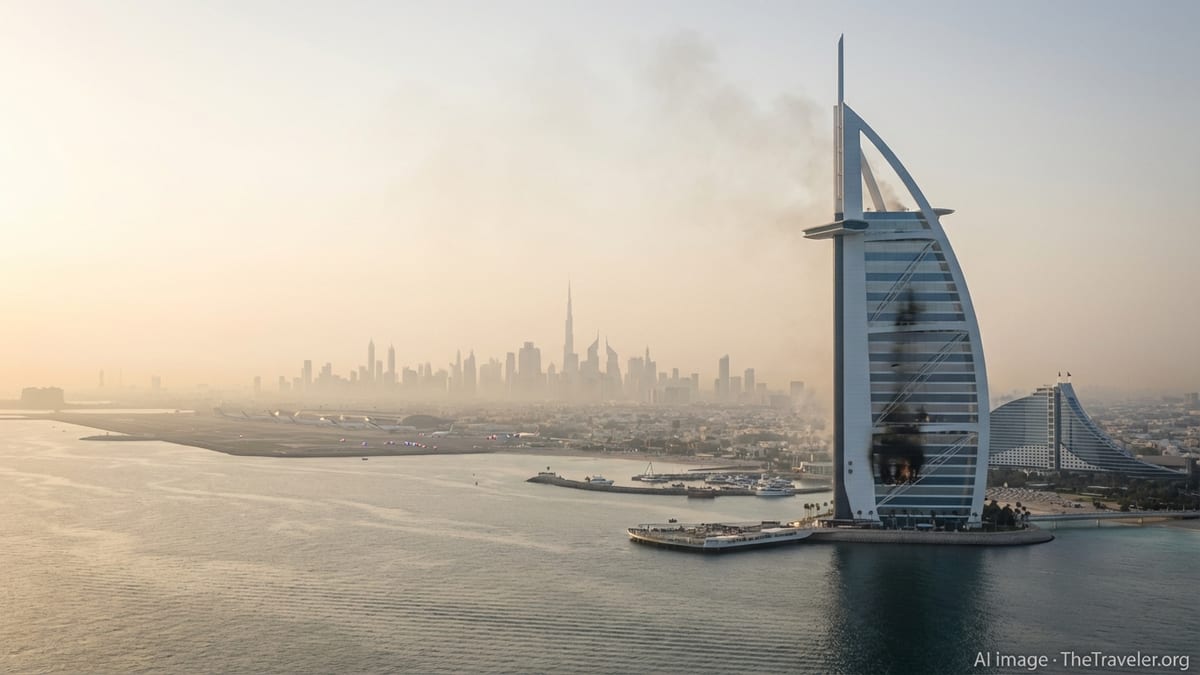
Dubai’s media office also reported that debris from an intercepted drone caused a minor fire on the outer facade of the sail-shaped Burj Al Arab, one of the city’s most recognisable luxury landmarks. Fire crews brought the blaze under control and officials said there were no injuries at the hotel, but images of smoke curling from the base of the tower quickly circulated among travelers and residents, underlining how deeply the strikes had pierced the emirate’s carefully curated image of safety and stability.
Elsewhere in the UAE, authorities confirmed incidents at Zayed International Airport in Abu Dhabi, where at least one person was reported dead and several injured, while debris from aerial interceptions sparked fires at Jebel Ali Port and on Dubai’s Palm Jumeirah. At the same time, missiles and drones targeted the broader Gulf region, including areas around Doha, turning the normally crowded skies over Qatar into near-blank space on flight-tracking maps.
Iran said the barrage was a retaliation for earlier United States and Israeli strikes on its territory, but the effects have spilled well beyond military targets, hitting the civilian aviation and tourism infrastructure that underpins the economies of Dubai, Abu Dhabi and Doha. For tourists on the ground and in the air, the result has been confusion, worry and extended disruption.
Airlines Grounded and Routes Rerouted
The immediate travel impact has been severe. With the UAE and Qatar closing their airspace or sharply restricting movements, airlines including Emirates, flydubai, Etihad Airways and Qatar Airways have suspended or drastically reduced operations through their respective hubs. Long-haul carriers from Europe and Asia have also pulled flights or rerouted them around the Gulf, adding hours to journeys and causing crews and aircraft to go out of position.
Industry estimates point to hundreds of thousands of passengers affected across the wider Middle East, with cancellations, missed connections and last-minute diversions rippling as far as London, Frankfurt, Mumbai and Singapore. Travellers who thought they were simply transiting through Dubai or Doha have suddenly found themselves stranded in third countries as aircraft diverted to alternative airports with available capacity and open airspace.
Within the Gulf itself, airports have been operating on emergency footing. Passengers who were already at Dubai International Airport before the concourse was damaged were ushered into holding areas or moved to safe zones, where many spent the night on camp beds or terminal flooring while awaiting information from carriers. In Doha, flights at Hamad International Airport have faced rolling delays as authorities balanced security considerations with mounting pressure to restore some semblance of normal operations.
Despite the closures, aviation experts stress that Gulf carriers and airports are well practiced in contingency planning, with playbooks developed during previous crises including regional blockades, volcanic ash clouds and global health emergencies. However, the combination of physical damage to infrastructure and broad regional airspace restrictions makes this disruption one of the most complex the Gulf’s aviation industry has faced in years.
What Tourists in the Region Should Expect Right Now
For leisure travelers currently in Dubai, Abu Dhabi or Doha, the most immediate impact is on mobility rather than personal safety. Authorities in the UAE have emphasized that fires at Burj Al Arab and other affected sites have been contained and that tourist districts remain under tight security. Hotels are operating, malls and beaches are open in many areas, and local transport systems continue to run, albeit with heavier policing and sporadic road closures near sensitive sites.
The more pressing challenge is getting in and out. Many visitors with imminent departures from Dubai or Abu Dhabi face cancellations or significant delays as airlines await clearance to resume even limited traffic. Some may be rebooked via alternative regional hubs in Saudi Arabia, Turkey or Europe, while others are being advised to delay non-essential travel until the situation stabilizes. Travelers who booked through online agencies or tour operators report long waits on customer-service lines as companies work through a mounting backlog of disrupted itineraries.
In Qatar, tourists and business travelers are also encountering uncertainty, particularly those planning to use Doha as a stopover point on longer itineraries. While authorities have been cautious in publicly detailing the extent of damage or risk, the partial closure of airspace has already led to cancellations and longer routings that erode the appeal of short city breaks or quick regional hops.
On the ground, visitors should be prepared for heightened security screenings at hotels, malls and attractions, as well as spontaneous checks around key infrastructure. Travel advisers recommend that tourists carry identification at all times, follow local news closely and remain flexible about daily plans, as access to some waterfronts, ports or vantage points may be temporarily restricted.
Advice for Future Visitors and Those Yet to Depart
For travelers with upcoming trips to the UAE or Qatar in the next days and weeks, the picture remains fluid. Aviation analysts expect airspace and airport operations to gradually reopen in stages once military tensions ease, but there is no firm timeline and schedules are likely to remain unstable for some time. Prospective visitors are being urged to treat all forward bookings as tentative, to build in additional transit time and to avoid tight same-day connections involving Gulf hubs.
Those who have not yet departed should monitor advisories from their airlines and, where relevant, their home governments. Many carriers are offering flexible rebooking or waiver policies for tickets touching Dubai, Abu Dhabi or Doha during the current window of disruption, allowing changes without fees or the option to route around the Gulf entirely. Travel insurers are scrutinizing the situation, and policy coverage may vary depending on whether the trip was purchased before the escalation and whether government advisories have shifted to formal warnings.
Tourism insiders note that both the UAE and Qatar have strong incentives to restore their reputations as secure, reliable destinations and transit points. Even with visible damage to flagship landmarks and terminals, authorities will likely prioritize rapid repairs and highly visible security measures designed to reassure visitors. In previous crises, Gulf tourism has often rebounded quickly once flight networks are restored, though repeated shocks can gradually reshape traveler perceptions of the region.
For now, the most realistic posture for would-be tourists is cautious patience. Booking fully flexible fares, ensuring that hotels can be cancelled or changed without penalty, and keeping alternative routings in mind will all help mitigate risk. Travelers should also be prepared for a more subdued atmosphere on arrival, with less of the carefree spectacle that typically defines a Dubai or Doha holiday and more visible signs of an ongoing security response.
The Broader Impact on Middle East Travel
The strikes come at a sensitive moment for Middle Eastern tourism, which has been working to diversify beyond business travel and transit passengers by promoting cultural festivals, major sporting events and beach escapes. The UAE and Qatar have been at the center of that push, investing heavily in museums, entertainment districts, cruise terminals and high-end resorts designed to lure visitors who might once have only passed through their airports.
Damage to marquee symbols such as Burj Al Arab carries a psychological weight that extends far beyond the relatively minor physical impact described by officials. Images of a damaged luxury hotel or smoke near a runway can linger in the minds of travelers evaluating future holiday options, raising questions about whether the region’s rapid rise as a leisure playground can be sustained in the face of recurring geopolitical shocks.
At the same time, the disruption underscores just how central Gulf hubs have become to global aviation. When airports in Dubai, Abu Dhabi and Doha shut down or scale back operations, the ripple effects are felt across continents, affecting not only those headed to the Middle East but also millions who rely on these airports as midpoints between cities like London and Sydney or Mumbai and New York. That interconnectedness means instability in the Gulf is no longer a distant headline for travelers elsewhere; it is a tangible factor in planning even far-flung journeys.
How quickly tourism flows return will depend on both the pace of repairs and the trajectory of the wider conflict. If the latest exchange of attacks gives way to a renewed diplomatic effort, the Gulf’s powerful airlines and glittering skylines may again attract visitors seeking winter sun and stopover glamour. If instead the strikes herald a longer period of tension, tourists weighing trips to the Middle East will increasingly have to balance the allure of world-class hotels and attractions against the risk of sudden, sweeping disruption similar to what the region is experiencing today.