

More news on this day
Airstrikes on Iran and cascading airspace closures across the Gulf have plunged Middle East aviation into fresh turmoil, with King Fahd International Airport among the hubs grappling with mass cancellations, stranded passengers and a rapidly shifting global route map.
King Fahd Becomes a Flashpoint for Saudi Travelers
While Dubai, Doha and Abu Dhabi have absorbed the worst of the shock, King Fahd International Airport in Dammam has emerged as a critical pressure point for Saudi Arabia’s Eastern Province. As carriers slash services into and across the Gulf, flights to and from King Fahd are being cancelled or rerouted at short notice, catching weekend travelers and overseas workers in a tightening net of disruption.
Industry analysts say the airport’s role as a regional connector, particularly for traffic to the wider Gulf and South Asia, has left it vulnerable to the sweeping closures of neighboring airspace. With Iran, Iraq, Kuwait, Bahrain and Qatar all either closing or severely restricting their skies, routes that would normally hop across the Gulf now need long diversions or are being shelved entirely, leading to cascading cancellations across Saudi schedules.
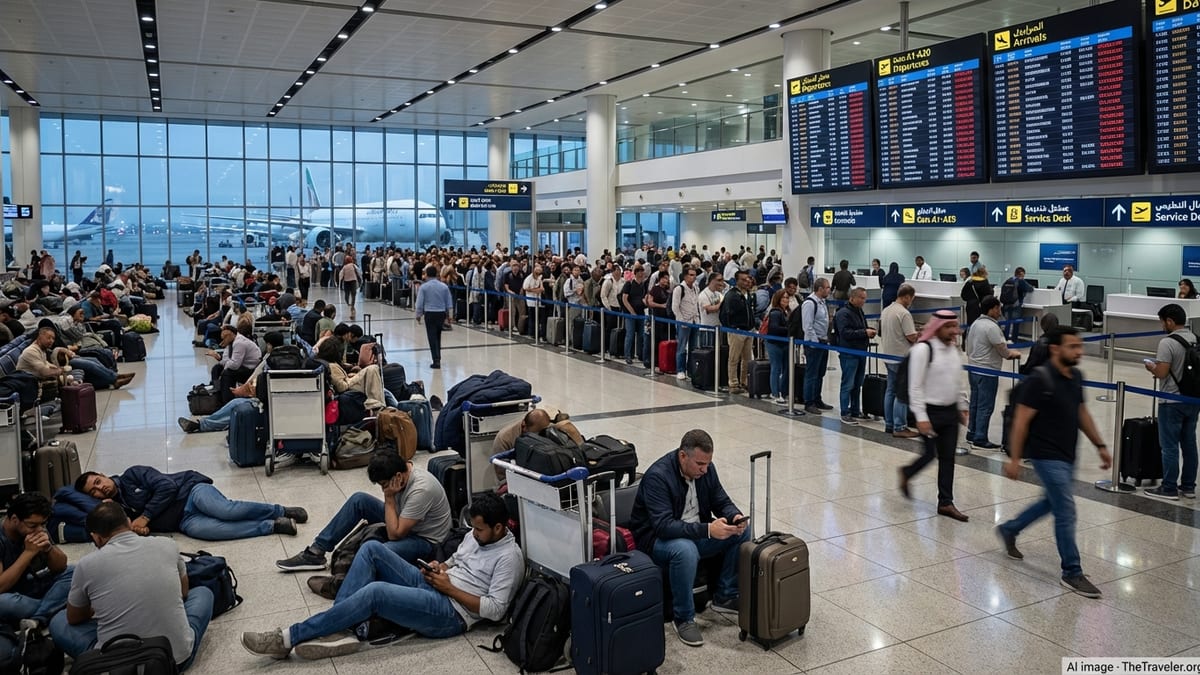
Passengers arriving at King Fahd on Sunday reported snaking queues at airline counters and crowded waiting areas as families tried to rebook onward journeys that had vanished from departure boards. Some domestic flights into Dammam continued to operate, but onward links to key Gulf cities were either grounded or delayed for hours as airlines waited for clearance to use alternative corridors.
Saudi aviation officials have yet to publish a full tally of cancellations at King Fahd, but travel agents in Dammam and nearby Khobar describe a situation changing by the hour. Many are advising customers to postpone nonessential trips through Gulf hubs and warning that even confirmed tickets may offer little certainty in the days ahead.
Airspace Closures Empty Skies Across the Region
The abrupt escalation followed coordinated strikes by the United States and Israel inside Iran, prompting Tehran to close its airspace “until further notice” and triggering a wave of defensive measures from neighbors. Israel, Iraq, Kuwait, Qatar, Bahrain, parts of Syria and the United Arab Emirates have all restricted or suspended civilian overflights, creating one of the largest contiguous no-go zones for commercial aircraft in recent history.
Flight-tracking data on Sunday showed skies over much of the northern Gulf nearly empty, apart from scattered military and emergency movements. Global carriers that depend on Middle East corridors to bridge Europe, Asia and Africa have been forced to redraw flight plans on the fly, with some long-haul services diverting over the Caucasus and North Africa and others turning back to their origin airports.
International aviation bodies are warning that these closures may not be resolved quickly. Conflict-zone bulletins issued for the region highlight a high risk to civil aviation in and around Iran and its neighbors, citing ongoing missile and drone activity and the danger of misidentification in crowded skies. For airlines already contending with restrictions on Russian airspace, the loss of major Gulf corridors compounds an already complex global routing puzzle.
For travelers, the impact is immediate and highly visible: more missed connections, longer flying times and an increase in last-minute changes as carriers attempt to keep crews and aircraft out of harm’s way. Even travelers whose itineraries do not include Middle East stops are discovering their flights depend on airspace above the region to stay on schedule.
Hub Airports from Dubai to Doha Grind to a Halt
The most dramatic scenes of chaos have unfolded at the Gulf’s heavyweight hubs. Dubai International Airport and Al Maktoum International suspended all flights after the United Arab Emirates declared a temporary and partial closure of its skies, halting operations at what is normally the world’s busiest international hub and sending shockwaves through global connectivity.
In Abu Dhabi, Zayed International Airport reported inbound and outbound disruptions, with some flights cancelled and others diverted amid reports of a drone strike that caused casualties on the ground. To the north, Doha’s Hamad International also saw operations curtailed as Qatar closed its airspace, forcing home carrier Qatar Airways to suspend services until conditions improve.
These hubs ordinarily move tens of thousands of transfer passengers each day, stitching together itineraries from Sydney to London and Sao Paulo to Mumbai. Their near-simultaneous slowdown has fractured that network, leaving travelers from Europe, Asia and Africa stranded not only in the Gulf but at origin airports worldwide as airlines preemptively scrub services into the region.
For Saudi travelers who rely on connections via Dubai, Abu Dhabi or Doha when flying from Dammam, Riyadh or Jeddah, the closures have effectively erased key options overnight. Many are now looking to reroute via Istanbul, Cairo or European hubs, only to find those alternatives themselves struggling under the weight of diverted traffic and tightening safety advisories.
Global Ripple Effects and a New Layer of Uncertainty
The sudden paralysis across Middle East corridors has quickly morphed into a global aviation crisis. Analytics firms estimate that roughly a quarter of all flights scheduled to the broader Middle East were cancelled on the day of the initial strikes, with thousands more delayed worldwide as aircraft and crews fell out of position and complex long-haul rotations began to unravel.
Major international airlines including Emirates, Qatar Airways, Etihad, Turkish Airlines, Lufthansa, Air France, British Airways and key Indian carriers have either cancelled services into affected cities or rerouted around the region, adding hours and fuel costs to journeys. Schedules that were already finely balanced in the wake of pandemic-era cuts and ongoing shortages of aircraft capacity are now being redrawn with new detours, recovery flights and emergency repositioning of wide-body jets.
Aviation security experts warn that even once some airspace corridors reopen, the aftershocks will linger. Aircraft out of place, stranded crews and overburdened maintenance facilities will likely mean rolling delays and sporadic cancellations well into the coming weeks. Insurance premiums and war-risk surcharges are also expected to climb, raising operating costs on many intercontinental routes.
For travelers, that translates into an extended period of uncertainty reminiscent of the early days of the global health crisis: rapidly changing advisories, last-minute itinerary changes and a renewed emphasis on flexibility. Travel insurers and consumer advocates are already urging passengers to read the fine print on coverage for conflict-related disruptions and to expect refunds or vouchers to take time as airlines work through an unprecedented claims backlog.
What Stranded Passengers Are Facing on the Ground
Inside terminals across the Gulf, the crisis has taken on a human face. Images from airports in Dubai, Doha and Abu Dhabi show passengers camping beside baggage trolleys, queues snaking toward airline service desks and crowded boarding areas where departure screens flash wave after wave of red cancellations. At King Fahd, long-haul passengers heading for Europe and Asia via Gulf hubs have been left in limbo as their connecting flights disappear.
With hotels in airport catchment areas quickly filling, some carriers are struggling to meet obligations to provide accommodation and meals, particularly for transit passengers who lack visas to enter the country. Families with young children and elderly travelers are being prioritized for limited hotel rooms, while many others are being handed meal vouchers and blanket packs as they bed down in transit halls.
Travel agents and airline call centers from Riyadh to London report surging call volumes as passengers seek alternative routings, refunds or reassurance. In many cases, options are scarce: rerouting around the Gulf can push itineraries beyond crew duty limits or into airspace that aviation regulators are advising carriers to avoid. Some travelers have opted to cancel trips altogether rather than face marathon journeys of uncertain duration.
For those still planning to fly through the region in the coming days, aviation experts recommend building in generous buffers for connections, avoiding tight layovers at any Middle East hub and closely monitoring airline communications up to the moment of departure. As events on the ground continue to evolve, the only certainty for now is that global aviation has entered another turbulent chapter.