

More news on this day
Hamad International Airport in Doha, repeatedly ranked among the world’s top aviation hubs, has been thrust into crisis after targeted Iranian strikes and sweeping airspace closures brought operations to an abrupt standstill, rippling disruption across global travel networks.
Missile Threat Forces Shutdown at a Global Hub
Qatar’s Civil Aviation Authority ordered the closure of national airspace after Iranian missiles targeted key infrastructure around Doha over the weekend, including the vicinity of Hamad International Airport. Regional air defenses, including Qatari batteries and allied systems, intercepted most of the barrage, yet authorities suspended all aircraft movements at the airport as a precaution while debris assessments and safety checks got underway.
The shutdown at Hamad International, which Skytrax recently ranked as the world’s second-best airport, instantly severed one of the most important corridors linking Europe, Asia and Africa. Alongside simultaneous strikes on Dubai International and Abu Dhabi’s Zayed International, the attack on Doha transformed the Gulf’s meticulously choreographed aviation ecosystem into a patchwork of diversions, forced layovers and outright cancellations.
Officials in Doha described the Iranian action as a direct threat to civilian infrastructure and vowed that operations at the airport would only resume once the skies above Qatar were deemed fully secure. Aviation regulators said an updated security and safety assessment, including damage checks to runways, fuel farms and navigation systems, is now a prerequisite for any restart of commercial flights.
While Qatari authorities have reported only limited physical damage near airport facilities so far, the decision to keep Hamad International effectively frozen underscores mounting concern that further missile or drone salvos could follow as the wider Iran conflict continues.
Passengers Stranded as Qatar Airways Grounds Operations
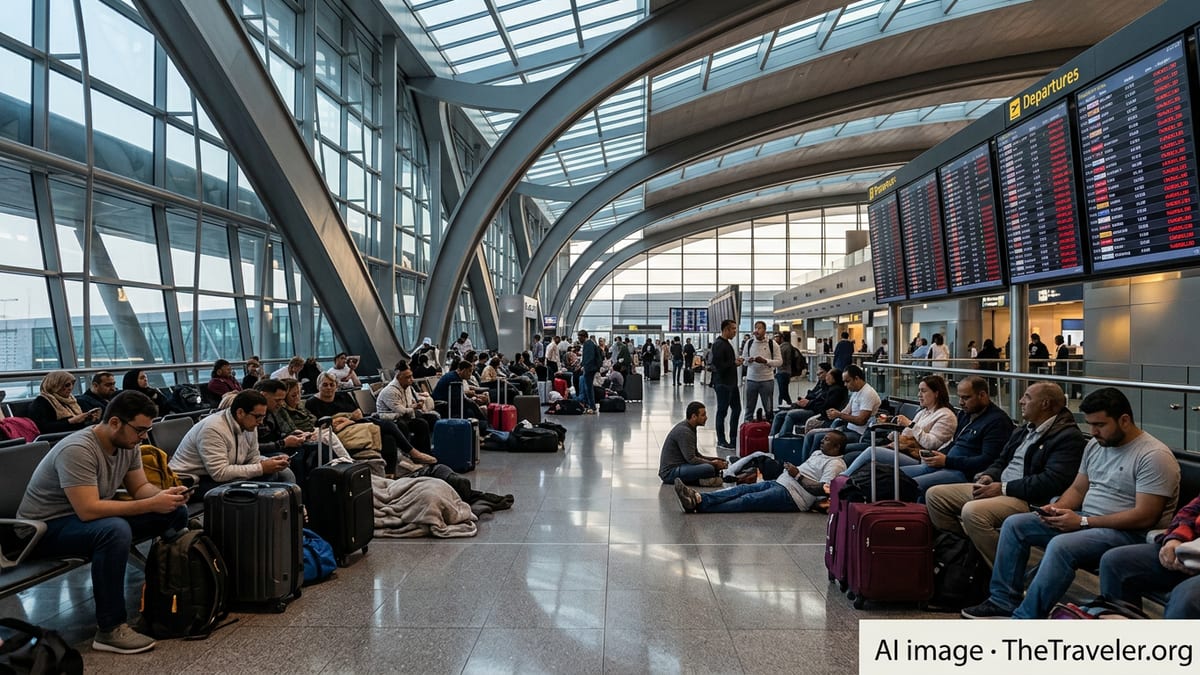
Inside Hamad International’s glass-and-steel terminals, scenes of confusion and fatigue played out as passengers awoke to find onward flights scrubbed from departure boards. Thousands of travelers on round-the-world itineraries, South Asian labor routes, and European–Asia connections were left stranded overnight as Qatar Airways, the country’s flag carrier, halted departures and awaited clearance to resume operations.
Terminal seating, transit hotels and quiet lounges quickly filled with families stretched out on carry-on bags, business travelers anxiously refreshing airline apps, and cabin crews awaiting reassignment. With hotels across Doha also busier than usual due to diverted flights, some passengers reported being advised to remain in the terminal complex until security conditions stabilized.
Qatar Airways, one of the world’s largest long-haul carriers, has extended waivers for rebooking and refunds as it works to reposition aircraft and crew that were left out of place by the sudden shutdown. Industry analysts warned that even once Qatari airspace reopens, the carrier faces a complex puzzle of restoring its intricate bank of connections, with knock-on delays expected to spill into the week ahead.
Travellers who had transited through Doha en route from North America and Europe to Asia described the experience as a “sudden standstill,” with some long-haul flights turned back mid-route or diverted to secondary airports when airspace closures spread rapidly across the Gulf.
Global Flight Networks Reeling From Gulf Airspace Closures
The paralysis at Hamad International is feeding into a broader aviation shock as Iran, Iraq, Qatar, Bahrain, Kuwait and the United Arab Emirates impose varying degrees of airspace restrictions in response to the escalating conflict involving Iran, the United States and Israel. Flight-tracking data over recent days show a steep drop in traffic traversing the Gulf, with many long-haul services between Europe and Asia forced to take lengthier detours to the north or south.
According to aviation consultancies, nearly six thousand flights were cancelled worldwide over the first days of the crisis, with more than a thousand additional cancellations reported on Monday alone. A significant share of those disruptions relate to routes touching the Middle East, where flagship carriers such as Qatar Airways, Emirates and Etihad typically funnel millions of passengers through vast hub complexes every month.
Airlines from India, Europe and North America have also suspended or rerouted services to Doha and other Gulf cities, citing security advisories and insurer concerns about flying near active conflict zones. The result has been extensive knock-on disruption for travelers far from the region, from Dublin and London to Singapore and Sydney, as aircraft and crews are displaced across multiple time zones.
Aviation experts caution that the full impact on global connectivity will depend heavily on how long airspace restrictions remain in place and whether further military escalation drags more countries into the conflict. For now, they say, the once seamless experience of transiting through the Gulf’s megahubs has been replaced with a patchwork of improvised routings and rolling cancellations.
Security Fears Undermine Qatar’s Aviation Ambitions
The turmoil at Hamad International arrives at a sensitive moment for Qatar, which has spent the past decade carving out a reputation as a stable, high-end crossroads for global travelers. The airport’s gleaming expansion, art installations and efficient connections helped it challenge Dubai for the crown of the region’s premier hub, while Qatar Airways became synonymous with long-haul comfort and reliability.
That carefully cultivated image has been shaken by images of missile trails over the Gulf and passengers camped out on terminal floors in Doha. While Qatari officials stress that air defenses have so far prevented catastrophic damage, the mere perception that a top-tier civil aviation hub lies within reach of hostile fire is likely to weigh on traveler confidence and airline scheduling decisions.
Security analysts note that Hamad International, like its Gulf peers, was built with robust hardened infrastructure and extensive contingency planning. Yet few of those plans envisioned sustained missile and drone campaigns of the kind now being launched by Iran across multiple neighboring states. The need to maintain “zero-risk” thresholds for civilian flights means even near-miss incidents or debris falls can force extended closures and safety sweeps.
For Qatar, which leverages its aviation sector as a pillar of economic diversification, sports tourism and soft power, the challenge will be to convince both airlines and passengers that the current turmoil is temporary and that long-term investments in security, diplomacy and infrastructure can shield Hamad International from becoming a recurring frontline in regional conflict.
Uncertain Timeline for Recovery as Conflict Evolves
As of Tuesday, officials had not provided a clear timeline for the full reopening of Qatari airspace or a return to normal operations at Hamad International. Statements from regional authorities suggest that decisions will hinge on real-time assessments of Iranian military posture and consultations with international partners providing air and missile defense support.
Aviation planners warn that even a rapid resumption of flights will not erase the backlog of stranded passengers or the complex task of repositioning aircraft that were diverted to airports in Europe, South Asia and East Africa. Airlines typically rebuild disrupted schedules in layers, meaning some routes through Doha could remain curtailed or subject to last-minute changes for days or weeks.
Travel industry observers say the episode underscores just how central Gulf hubs like Doha have become to the functioning of global aviation. With Hamad International effectively offline, capacity on alternative routings via Istanbul, Riyadh and other secondary hubs is being stretched, raising the prospect of higher fares and tighter seat availability on key long-haul corridors if the crisis endures.
For the tens of thousands of passengers still sleeping in terminals, monitoring alerts on their phones and waiting for word that the skies over Qatar are safe again, the world’s second-best airport now feels less like a cutting-edge gateway and more like an uneasy refuge on the front line of a widening regional war.