

More news on this day
A sudden escalation in the conflict involving Iran, the United States and Israel on February 28 has plunged Middle East airspace into chaos, as sweeping flight cancellations, emergency rerouting and national airspace closures ripple through global travel and trade networks.
Airspace Lockdowns Spread Across the Region
Within hours of coordinated US-Israeli strikes on targets in Iran on Saturday, aviation authorities across the Middle East moved to shut or heavily restrict their skies, citing high security risks to civilian aircraft. Iran’s civil aviation authority effectively sealed national airspace to most commercial traffic, while Israel, Iraq, Jordan, Qatar, Bahrain, Kuwait and the United Arab Emirates each announced at least partial closures or tight restrictions on overflights.
Flight tracking data showed normally busy corridors over Iran and its neighbors almost empty at peak times, with long-haul aircraft forced into abrupt diversions or mid-route returns to origin airports. In some cases, carriers that had just departed European hubs for Gulf destinations were instructed to turn back as new notices to air missions took effect.
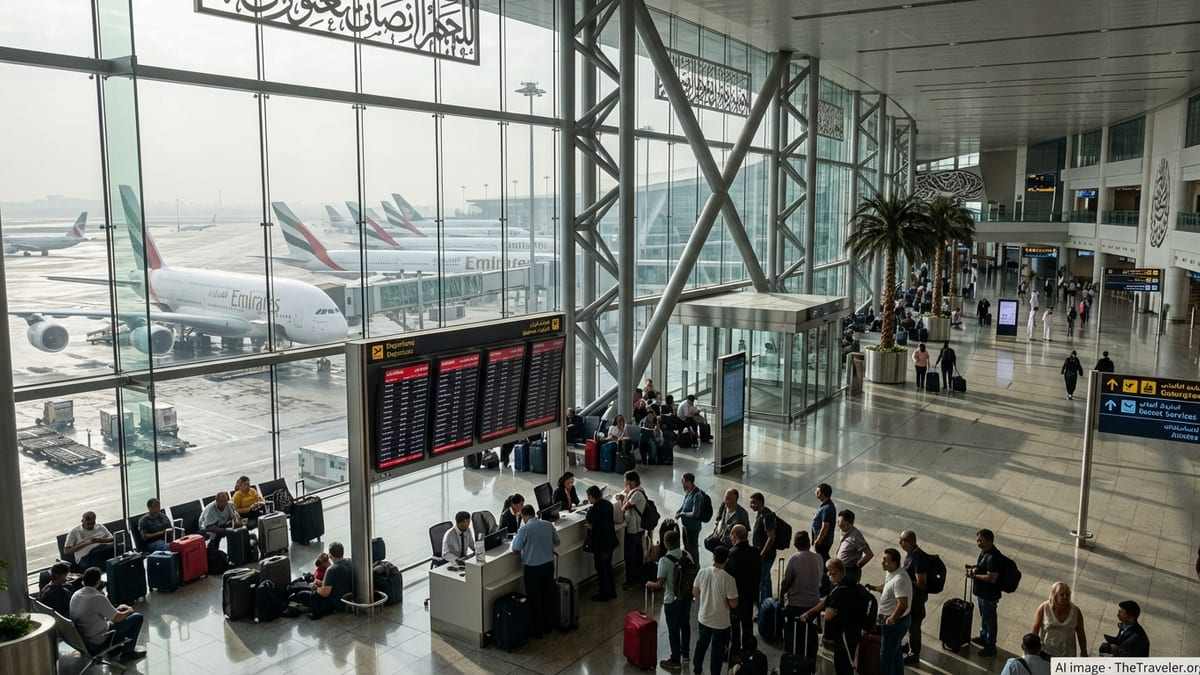
Regional hub airports, particularly in the Gulf, were hit immediately. Dubai International and Al Maktoum International suspended all flights as the UAE implemented a temporary but sweeping airspace shutdown, while Qatar restricted access around Doha. Authorities indicated the measures would remain in place at least into the coming days, depending on the trajectory of the conflict and the risk of further missile or drone activity.
Regulators in Europe added to the pressure. The EU Aviation Safety Agency issued a conflict-zone bulletin warning of a high risk to civil aviation in affected skies and strongly advising carriers to avoid large sections of Middle Eastern airspace until the situation stabilizes.
Global Airlines Race to Reroute and Cancel
The sudden loss of key air corridors left airlines scrambling to redesign flight plans on one of the world’s most strategically important aviation crossroads. Flag carriers across Europe, the Gulf and South Asia suspended or diverted services touching Iran, Israel and neighboring states, while many also halted the use of surrounding airspace that might be exposed to military activity.
Major Middle Eastern airlines, including Emirates, Etihad, Qatar Airways and Saudia, announced widespread cancellations and suspensions. Services to and from Dubai and Doha were heavily curtailed, while flights into Kuwait, Bahrain, Oman and Jordan were also reduced or put on hold as governments tightened access to their skies. EgyptAir temporarily halted multiple routes from Cairo to Gulf and Levantine cities as a precaution.
European and Asian carriers followed suit. Lufthansa, British Airways, Air France-KLM, ITA Airways, Turkish Airlines and several low-cost operators cancelled flights to Tel Aviv, Tehran, Amman, Beirut and Gulf hubs and began avoiding Iranian, Iraqi and Israeli airspace in their routings. Some airlines extended suspensions through the first week of March, warning that schedules could be adjusted again at short notice.
In India, the civil aviation regulator advised airlines to steer clear of affected Middle East corridors, prompting Air India and IndiGo to reroute or suspend certain Westbound services. With Russian and Ukrainian skies already restricted for many Western carriers due to the separate war in Eastern Europe, the fresh closures over West Asia have left airlines with very limited options for viable, fuel-efficient paths between Europe and Asia.
Economic Shock for Hubs and Passengers
The disruption has immediate and far-reaching economic consequences. Gulf hubs such as Dubai, Doha and Abu Dhabi form the backbone of many global route networks, feeding millions of transit passengers between Europe, Asia, Africa and Australasia. A prolonged shutdown or severe restriction in these hubs threatens not only airline revenue but also tourism and trade flows that depend on fast, predictable air connections.
Aviation analysts warn that even if demand for travel remains strong, airlines will face sharply higher operating costs as they burn more fuel on longer routes, pay higher war-risk insurance premiums and absorb the financial hit of irregular operations. Extended detours around closed airspace can add hours to certain Europe-to-Asia sectors, complicating crew scheduling and aircraft utilization and putting further strain on already tight fleets.
Travelers are feeling the impact in real time. Airports from Dublin to New Delhi reported stranded passengers as flights to Middle Eastern hubs were cancelled mid-morning on Saturday, leaving those booked on onward connections with limited rebooking options. Many airlines introduced waiver policies allowing passengers to change dates or routes without penalties, but availability on alternative flights is scarce on short notice.
Beyond tourism, the cargo sector is bracing for delays and rising costs. Middle Eastern carriers play a pivotal role in global air freight, particularly along Europe–Asia and Asia–Africa lanes. Disrupted schedules and longer routings threaten supply chains for high-value and time-sensitive goods, from electronics to pharmaceuticals, adding another layer of uncertainty to already fragile global logistics.
Governments Issue Warnings as Risk Perception Shifts
As airspace closures mounted, foreign ministries and aviation regulators around the world moved swiftly to update travel advisories and risk assessments for the broader Middle East. Several European governments urged citizens to avoid non-essential travel to Iran, Israel and Lebanon, and to exercise extreme caution or shelter in place if already in affected countries. Similar warnings were issued in parts of Asia for popular transit hubs in the Gulf.
Regulators framed their guidance around the potential for miscalculation in crowded skies where military and civilian operations might intersect. The specter of previous incidents involving civilian aircraft in conflict zones has made authorities particularly cautious, pushing them to err on the side of wide exclusion zones rather than narrow route adjustments.
For the travel industry, the shift in perceived risk could have lingering effects even if hostilities ease quickly. Tour operators and corporate travel managers are reassessing itineraries that rely on Middle Eastern stopovers, while insurers review coverage and premiums for trips passing through high-tension corridors. Some business travelers are already being rebooked via alternative hubs in Europe or Southeast Asia, even at higher cost and longer journey times.
The heightened caution also raises the prospect of a longer-term reputational hit to Middle Eastern hubs as neutral, reliable connection points. While these airports have historically marketed themselves as safe, efficient gateways between continents, the current crisis underscores their exposure to regional geopolitics in a way that may influence route planning and traveler preferences for months to come.
Uncertain Outlook for Restoring Normal Flight Patterns
Airlines and aviation authorities stress that the situation remains highly fluid, with any further military action likely to trigger fresh waves of cancellations and diversions. Carriers are reviewing their schedules on a rolling basis, often updating operations day by day as intelligence and regulatory guidance evolve.
If airspace reopens within days, analysts suggest the immediate operational damage could be contained, with airlines gradually restoring affected routes and absorbing short-term cost spikes. However, the combination of lingering security concerns, elevated insurance costs and already-constrained routing options due to other conflicts leaves the system more brittle than before.
Industry experts note that the Middle East’s role as a central bridge between regions magnifies the impact of any disruption there. Even modest restrictions on key flight information regions can cascade through global schedules, tightening connections, squeezing capacity and raising prices on far-flung routes that never touch the region on a map.
For now, travelers planning journeys through the Middle East in the coming days are being urged by airlines and regulators alike to monitor flight status frequently, build in extra buffer time for connections, and be prepared for last-minute changes as the geopolitical and aviation picture shifts from hour to hour.