

More news on this day
Hamad International Airport, regularly ranked among the world’s top aviation hubs, has been thrust into crisis after Iranian missile and drone attacks on Qatar triggered sweeping airspace closures, mass flight cancellations and cascading disruptions across global travel networks.
Missile Barrage Forces Sudden Shutdown of Qatar’s Airspace
Qatar’s civil aviation authorities were forced to close the country’s airspace on February 28 after Iran launched a barrage of ballistic missiles across the Gulf in retaliation for US and Israeli strikes. The decision instantly froze operations at Doha’s Hamad International Airport, a critical crossroads linking Europe, Asia, Africa and Australasia, and one of the busiest transfer hubs for long-haul travelers.
Officials said defensive systems intercepted the incoming missiles, but falling debris injured at least 16 people in Qatar and sparked localized fires as shrapnel rained down. Residents reported explosions and interception booms over Doha, while social media images showed smoke rising on the horizon. Authorities urged people to remain indoors, avoid documenting impact sites and follow official safety updates.
While no direct hit on Hamad International’s core terminal complex has been confirmed, the threat of further strikes and the nationwide airspace shutdown brought departures and arrivals to an abrupt halt. With Qatar Airways heavily reliant on transit passengers, the disruption rippled through hundreds of daily connections, stranding travelers both in Doha and at airports around the world.
Hamad International’s Global Role Amplifies the Impact
Hamad International’s prominence as the second-best airport worldwide in recent industry rankings magnified the consequences of the sudden standstill. The airport functions not just as Qatar’s primary gateway but as an essential bridge between continents, funnelling tens of millions of passengers annually through its single, highly choreographed hub.
Qatar Airways’ network is built around tight connection windows in Doha, meaning even a short closure can unravel schedules across multiple regions. With airspace restrictions now entering several days and security conditions fluid, airlines have been forced into large-scale cancellations, long diversions around the Gulf and, in some cases, complete route suspensions to and from Doha.
Industry trackers report thousands of flights canceled or delayed across the wider Middle East since the first strikes on Iran, with Hamad International among the most heavily affected. Routes that typically pass over Iran and neighboring states have been rerouted via longer corridors over Turkey, the Caucasus or the Arabian Sea, adding hours to journeys and straining airline crews and aircraft utilization.
Passengers Face Confusion, Crowding and Limited Options
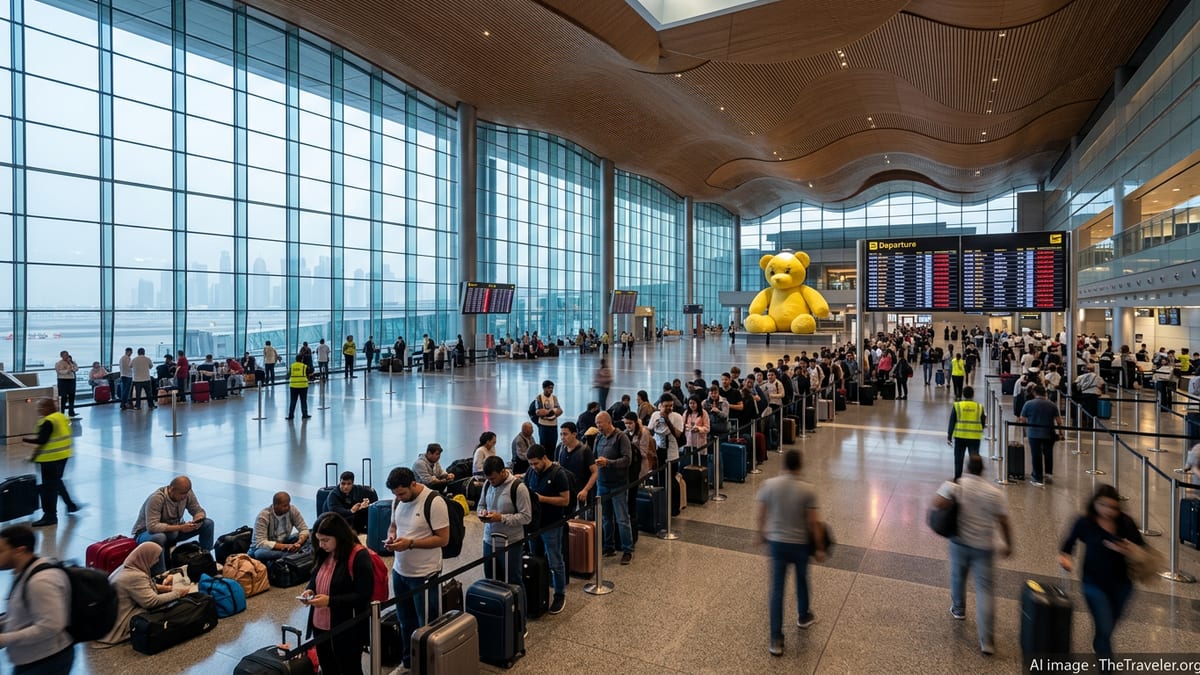
For passengers, the fallout has been immediate and deeply disruptive. Long queues formed at airline service desks in Doha as travelers sought scarce rebooking options or emergency accommodation amid rapidly changing security advisories. Some passengers stuck in transit found themselves unable to enter Qatar due to heightened security controls, yet also unable to continue onward as flights disappeared from departure boards.
Those en route to Doha when the closures took effect experienced diversions to alternate airports in the region or returns to their origin cities after hours in the air. With neighboring hubs in Dubai and Abu Dhabi also affected by attacks and closures, traditional fallback options for rerouting traffic were severely constrained, amplifying the pressure on carriers and airport authorities.
Travelers attempting to reach airline call centers or use digital channels reported long waits and limited real-time information as operations teams worked through unprecedented levels of disruption. Consumer-rights advocates have warned that standard compensation and care rules will be tested by a crisis driven by active conflict, leaving many passengers unsure of their entitlements or timelines for getting home.
Security Priorities Clash With the Need to Restore Connectivity
Qatari officials have emphasized that airspace restrictions and airport slowdowns are driven above all by security concerns. Military spokespeople say multiple waves of Iranian missiles and drones have been intercepted over recent days, including projectiles reportedly aimed at or near strategic sites around Doha. The government has condemned the strikes as a reckless violation of sovereignty and reserved the right to respond within international law.
Within Hamad International, heightened security protocols have been visible in stepped-up patrols, restricted access to certain zones and periodic evacuations of exposed areas when interception alerts sound. Staff have been instructed to move passengers away from glass-fronted spaces and airside observation areas during escalations, while terminal announcements stress that operational changes may come at short notice.
Aviation analysts note that while Gulf hubs have robust contingency plans for geopolitical shocks, the current round of hostilities is uniquely intense and geographically widespread, targeting or threatening multiple major airports at once. That raises complex questions about how quickly Qatar can safely reopen its skies on a sustained basis without exposing civil aviation to unacceptable risks.
Global Airlines Brace for Prolonged Turmoil
Major international carriers are now bracing for the possibility that severe disruption at Hamad International and other Gulf hubs could persist for weeks. Airlines that rely on overflight of Iranian and Gulf airspace to connect Europe with Asia and Australasia are modeling extended detours, higher fuel burn and crew-rotation challenges, costs that could eventually be passed on to passengers.
Some carriers have begun quietly advising customers to avoid non-essential travel through the region or to build in extensive buffers for critical trips, such as business travel or onward cruise and tour departures. Corporate travel managers are reassessing routing policies, while global distribution systems show dwindling seat availability on remaining services that bypass the current conflict zone.
For Qatar, the stakes are high. Hamad International and Qatar Airways are central to the country’s soft power and economic diversification strategy, projecting an image of efficiency, safety and seamless connectivity. As Iranian attacks test the resilience of that model, Doha’s response in the coming days will be closely watched by travelers, airlines and regulators seeking signals on whether the world’s second-ranked airport can quickly reclaim its role at the heart of global aviation, or whether a prolonged conflict will redraw long-haul flight maps for months to come.