

More news on this day
Iran’s stark warning that “parks, recreational areas and tourist destinations” linked to its enemies could become targets in the escalating Middle East war is reshaping risk calculations for travelers and travel businesses worldwide, as missile and drone strikes spread beyond traditional battlefields and inch closer to major hubs of global tourism.
Get the latest news straight to your inbox!
A New Phase in Iran’s Global Threat Messaging
Recent public statements from Iranian leaders during the current conflict with the United States and Israel have explicitly broadened the range of threatened targets, moving from military bases and energy facilities to the everyday civilian spaces where people gather and travel. According to published coverage, Iran has asserted that its adversaries should no longer expect safety in parks, leisure venues and tourist destinations around the world, language that effectively places global tourism on the frontline of strategic warfare.
This shift in rhetoric comes as the war, triggered by coordinated United States and Israeli strikes on Iranian military and nuclear-related sites on 28 February 2026, enters its fourth week with no clear path to de-escalation. Publicly available reporting shows that Iran has responded with waves of ballistic missiles and drones against bases and infrastructure across the Gulf, while allied groups and proxies have intensified attacks on shipping lanes and Western-linked interests across the wider region.
The explicit reference to tourism sites does not appear to be tied to a single, named target, but it represents a clear attempt to project psychological pressure well beyond the Middle East. Travel analysts note that even in the absence of a specific plot, such messaging can create a “chilling effect” on discretionary travel, especially to destinations seen as closely aligned with Washington or Tel Aviv or heavily dependent on Western visitors.
Tourism Hubs Drawn Closer to the Line of Fire
While Iran’s broad threats are global in tone, many of the immediate security concerns are focused on the Middle East’s own major tourism and aviation gateways. Publicly available information on recent strikes shows Iran has already hit or threatened infrastructure that sits close to, or directly underpins, popular visitor destinations in the Gulf, including sites in the United Arab Emirates and Oman.
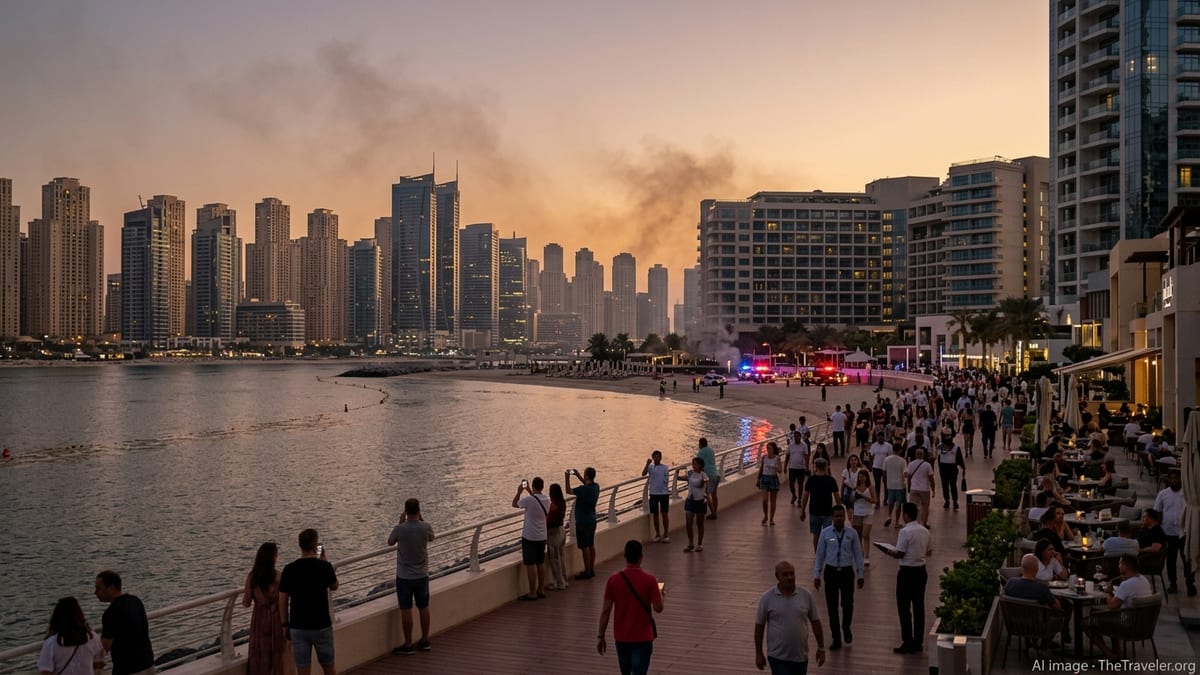
In the UAE, reporting on the ongoing missile and drone barrage since late February indicates that one wave of attacks included a Shahed-type drone that exploded near the Fairmont The Palm Hotel on Dubai’s Palm Jumeirah, a high-profile district of luxury resorts and residential towers. The strike shattered windows and disrupted activity in a neighborhood that caters heavily to international tourists, underscoring how quickly a leisure enclave can be drawn into a regional confrontation.
Elsewhere along the Arabian Peninsula, Iranian drones and missiles have been documented striking or threatening port infrastructure in Oman and Saudi Arabia that lies close to coastal cities marketed as emerging tourism and cruise destinations. Although many of the attacks have focused on energy assets and military-linked facilities, the proximity to hotels, seafront promenades and cruise terminals raises the risk of collateral damage to tourist areas, as well as the possibility of more direct targeting should the conflict further intensify.
Tourism businesses in affected cities have responded with visible security measures and contingency plans, according to regional media, but many face the same core challenge: the perception that previously insulated visitor hubs are now within reach of long-range precision weapons.
Travel Advisories, Airspace Restrictions and Itineraries in Flux
The evolving threat to tourist destinations is already reflected in shifting government travel advisories and operational decisions by airlines, cruise operators and tour companies. Publicly accessible guidance from multiple Western governments in recent days has urged citizens to avoid nonessential travel to parts of the Middle East, citing the risk of missile and drone strikes, potential retaliatory attacks and a broader climate of unpredictability.
Commercial aviation has been particularly quick to react. Route-tracking data and industry reports show carriers diverting flights away from Iranian and Gulf airspace, lengthening travel times between Europe, Asia and Africa but reducing exposure to conflict zones. Some airlines have temporarily suspended services to specific hubs, while others have adopted dynamic routing that can be adjusted on short notice in response to new strikes or threats.
At sea, the disruption is even more pronounced. The conflict has severely constrained shipping through the Strait of Hormuz and compounded earlier security concerns in the Red Sea, both vital corridors for cruise itineraries and ferry services that tie together ports in the Middle East, East Africa and the Mediterranean. According to recent maritime assessments, vessels have been rerouted around longer and more expensive paths, with some cruise lines cancelling or reconfiguring itineraries that previously showcased Gulf cities as marquee stops.
For individual travelers, this environment translates into a more fragmented, last-minute approach to trip planning. Travel risk firms advise monitoring advisories up to the hour of departure, building flexibility into itineraries, and considering whether travel insurance policies explicitly cover war- and terrorism-related disruption, issues that were once niche but are now edging toward the mainstream of travel decision-making.
Ripple Effects Beyond the Middle East
Iran’s warning about global tourist sites is also being interpreted through the lens of its longstanding network of allied non-state groups and security incidents well outside its borders. Analysts note that Iran-linked actors have previously been connected, directly or indirectly, to plots and attacks spanning from the Eastern Mediterranean to Latin America, feeding concerns that symbolic tourist sites far from the Middle East could be used as pressure points in a broader confrontation.
European and North American destinations are closely watching the situation, particularly cities with large visitor numbers and prominent cultural landmarks. While there are no confirmed attacks on tourist venues in these regions tied to the current war, some security assessments point to an elevated risk of copycat or opportunistic violence inspired by the rhetoric of targeting leisure and travel spaces.
Regions heavily reliant on inbound tourism from the Gulf, including parts of Southern Europe and Southeast Asia, are also exposed to indirect fallout. Reduced outbound travel from Middle Eastern source markets due to economic uncertainty, higher airfares, or security worries could dent arrival numbers, hotel occupancy and retail spending, even if those destinations remain physically distant from any missile or drone trajectories.
Insurance markets and corporate travel programs are beginning to price in these wider risks. Industry briefings indicate that some multinational firms are reevaluating large-scale conferences, incentive trips and other events that would concentrate employees in high-profile tourist districts, especially in locations perceived as politically exposed in the current standoff.
What Travelers and the Industry Are Watching Next
For now, much hinges on whether Iran’s threats to tourist destinations remain rhetorical or evolve into more concrete plots or attacks beyond the Gulf. Security observers are tracking any sign of targeting patterns that would link specific cities, brands or types of venue to the conflict’s frontlines, as well as any new statements from Tehran that narrow or expand the category of potential “enemy” tourism sites.
Travel companies are likewise focused on operational indicators: the stability of air corridors over and around the Middle East, the status of key ports and cruise terminals, and the pace and severity of new government advisories. Should a major international tourism hub suffer a direct, well-publicized strike, travel executives suggest this could trigger a broader recalibration of risk assumptions across the industry, accelerating trends toward diversification of source markets and destinations.
In the meantime, the message from many travel risk specialists is measured but sober. The conflict has already demonstrated the vulnerability of energy infrastructure and shipping lanes long considered secure. With Iran now publicly naming parks and tourist sites as potential arenas of confrontation, both travelers and the tourism sector are being forced to confront the possibility that leisure spaces once marketed as escapes from geopolitics may increasingly be shaped by it.