

More news on this day
Escalating conflict between Iran, Israel and the United States has entered a new phase, with Iran threatening to extend retaliatory attacks to recreational and tourist sites worldwide just as Washington expands its military presence across Israel, Saudi Arabia, Iraq and the United Arab Emirates, raising urgent questions for travelers far beyond the Middle East’s borders.
Get the latest news straight to your inbox!
Iran’s New Threats Against Tourist and Leisure Sites
In recent days, Iranian leaders have publicly warned that the country’s retaliation could reach “parks, recreational areas and tourist destinations” worldwide, according to multiple international news reports. The language marks a sharp widening of the conflict’s scope, moving beyond conventional military and energy targets toward locations that are closely associated with international leisure travel.
The threats followed a series of missile and drone attacks on Israel and on energy infrastructure in neighboring Gulf states during one of the holiest days on the Islamic calendar, as well as continued exchanges of fire involving Israeli strikes on Iranian oil and gas facilities. Coverage from outlets tracking the conflict indicates that these actions are being framed in Tehran as part of a broader campaign to punish countries seen as supporting Israel and the United States.
Analysts note that although there is no publicly available evidence of imminent, specific plots against particular tourist attractions, the rhetoric alone is significant. Tourism hubs, theme parks, waterfront promenades, large shopping malls and popular urban districts where foreign visitors congregate are now being discussed in open-source reporting as potential symbolic targets, particularly in countries perceived as aligned with the US and Israel.
Travel risk consultants are warning that even unfulfilled threats can prompt rapid changes in security postures, from heightened policing and visible military patrols to new screening measures at major attractions. For visitors, that can translate into longer queues, intermittent closures and a more heavily securitized atmosphere in some of the world’s best-known urban leisure districts.
US Military Buildup Across Israel, Saudi Arabia, Iraq and the UAE
Against this backdrop, the United States has launched its largest military buildup in the Middle East in more than two decades. Open-source defense analysis and public reporting describe additional warships, Marines and advanced fighter aircraft being deployed to the region since late January 2026, building on an already substantial American footprint in Israel, Iraq, Saudi Arabia, the United Arab Emirates and other Gulf states.
According to publicly available research on force posture, the US maintains thousands of personnel at bases across the Gulf, with new deployments focused on air defense, naval presence in critical maritime chokepoints and reinforcement of existing facilities. Recent updates indicate that at least one carrier strike group is operating in regional waters, while advanced fighters such as F-22 and F-15E aircraft have been moved into bases in Israel and neighboring countries.
The stated objective of this buildup, as described in defense policy papers and media coverage, is to deter further Iranian escalation and to protect key allies and shipping lanes, including the tense Strait of Hormuz. In practice, however, the heightened military profile contributes to a perception of volatility that directly affects how governments and insurers assess travel risk, not only in active conflict zones but also in nearby destinations that serve as transit hubs.
Travel industry observers point out that large-scale deployments often precede, accompany or respond to airspace restrictions, temporary airport closures and rerouted civilian flights. For travelers, the presence of additional US forces in the Middle East is a sign that more sudden operational changes are possible, even in countries that remain formally open to tourism.
Flight Disruptions, Airspace Closures and Stranded Tourists
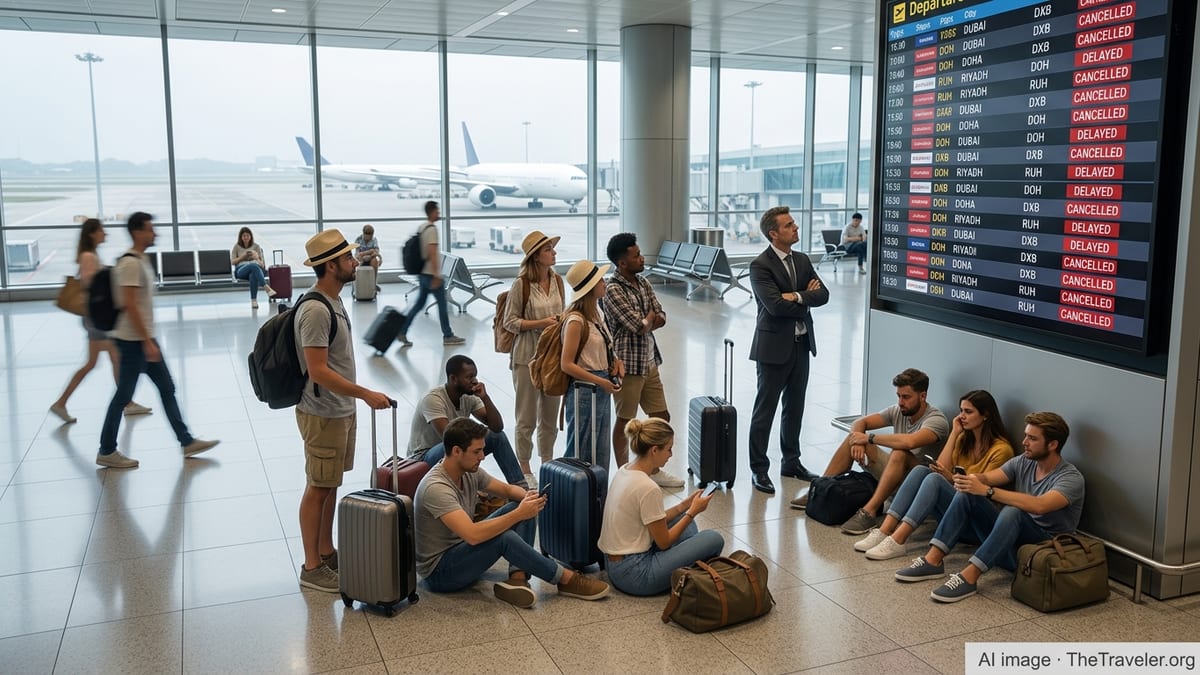
The war has already upended air travel across the Middle East. Recent reporting from international outlets describes hundreds of thousands of passengers stranded after widespread flight cancellations, as airlines suspend services to conflict zones, avoid Iranian and Iraqi airspace and reroute long-haul flights between Europe, Asia and Africa.
Advisories circulated by maritime and aviation risk firms in early March detail a sharp reduction in commercial traffic through the Strait of Hormuz and note that airspace has been temporarily closed or heavily restricted over several Gulf states during peak phases of the fighting. Some airports, including major hubs in Iran, have reportedly suspended civilian operations, while others in the region are operating at reduced capacity with frequent schedule changes.
Tourism-focused coverage from European and Middle Eastern media highlights how popular destinations such as Dubai, Abu Dhabi, Doha and key Saudi cities have experienced an abrupt downturn in visitor numbers. Hotels are responding with rate cuts, staycation offers for local residents and flexible booking policies as international arrivals falter. Travelers transiting through these hubs on their way to Asia or Africa are facing tight rebooking timelines, limited alternative routings and, in some cases, the need for emergency accommodation.
Experts in travel risk management emphasize that disruptions are not confined to the Middle East. Because Gulf airports serve as major connectors between continents, cancellations and reroutings ripple outward, affecting itineraries in Europe, East Africa, South Asia and Southeast Asia. Passengers who are not traveling to the region directly may still encounter delays, diversions and missed connections triggered by evolving security assessments over Middle Eastern skies.
Government Advisories and Insurance Implications for Travelers
Governments have responded to the intensifying conflict with some of the strongest travel advisories seen in years. Public information from the US Department of State shows a broad set of Level 4 “Do Not Travel” warnings across parts of the region, including Iran, Iraq and several other conflict-affected territories, while a recent wide-ranging alert urged Americans in multiple Middle Eastern countries to leave as soon as it is safe to do so.
Similar moves have been reported by European and Asia-Pacific governments. The United Kingdom’s Foreign, Commonwealth and Development Office has hardened guidance for Gulf and Levant destinations, advising against most or all travel to certain countries and warning that previously routine journeys may face sudden disruption. Australian and Canadian advisories have likewise been tightened, with language emphasizing the risks of missile attacks, civil unrest and limited consular assistance.
These official warnings have direct consequences for travel insurance. Policy documents and consumer guidance from insurers typically state that coverage may be void if travelers enter countries, or regions within countries, that are subject to “Do Not Travel” advisories at the time of departure. Industry commentary suggests that even travelers with existing bookings may find claims rejected if they proceed against government advice, particularly for nonrefundable expenses or interruption costs tied to foreseeable conflict-related disruption.
Travel law specialists quoted in consumer media recommend that travelers scrutinize their policies for war, terrorism and civil disorder exclusions. Some comprehensive plans may still cover medical emergencies or evacuation in lower-risk neighboring states, but many explicitly exclude losses arising from declared wars or acts of war. For destinations near the conflict zone, the fine print can make the difference between a manageable inconvenience and a significant financial loss if plans are derailed.
How the Escalating Conflict Is Reshaping Global Tourism Choices
Beyond immediate flight cancellations and safety concerns, the Iran war and associated military buildup are beginning to reshape global tourism flows. Prior to the latest escalation, the Middle East had been one of the fastest-growing tourism regions in the world, with destinations such as Saudi Arabia, the United Arab Emirates, Oman and Egypt reporting record arrivals and ambitious investment in new hotels, museums and cultural attractions.
Economic analysis from international organizations has highlighted how tourism has become a central pillar of diversification strategies across the Gulf and wider Middle East, supporting hundreds of thousands of jobs. The sudden downturn in visitor numbers therefore carries significant economic implications, from reduced tourism receipts and lower occupancy rates to delayed projects and pressure on small businesses that depend on international guests.
For travelers, the conflict is accelerating a shift in destination planning. Industry data and booking trends reported by airlines and tour operators show growing demand for alternative hubs and leisure markets in southern Europe, the Indian Ocean, Southeast Asia and parts of the Americas. Some carriers are strengthening services through non-Middle Eastern gateways to keep long-haul itineraries viable, while tour companies are promoting itineraries that avoid unstable air corridors.
Travel analysts note that this recalibration may persist even after an eventual cease-fire, as risk perceptions often lag behind real-time security improvements. Destinations once seen as reliably safe stopovers may need sustained periods of calm, coupled with clear communication from governments and the travel industry, to rebuild confidence among holidaymakers and business travelers wary of being caught in the next round of sudden airspace closures or geopolitical shocks.