

More news on this day
Escalating war between Iran, the United States and regional allies is rippling through global travel in early 2026, triggering mass flight cancellations, volatile fuel prices, strategic airspace closures and a new wave of uncertainty for tourists and business travellers worldwide.
Get the latest news straight to your inbox!
Middle East War Becomes a Global Aviation Crisis
The latest phase of the Iran–US confrontation, which intensified after coordinated strikes on Iranian targets on 28 February 2026, has rapidly turned into one of the most disruptive shocks to commercial aviation since the Covid-19 pandemic. Published coverage from international outlets describes air traffic across the Middle East as effectively paralysed, with tens of thousands of flights cancelled or rerouted in just a few weeks.
Gulf hubs that normally act as critical junctions between Europe, Asia, Africa and Australasia have been particularly hard hit. Reports indicate that major carriers in the United Arab Emirates, Qatar and other Gulf states have suspended most or all services as airports contend with damage, security lockdowns and restricted access. With Dubai International Airport and other regional gateways operating at sharply reduced capacity or temporarily closed, global itineraries built around one-stop connections through the Gulf have unravelled almost overnight.
International airlines that rely on overflying Iran, Iraq and neighbouring countries to link Europe with Asia and Oceania have been forced into complex detours or outright cancellations. Publicly available tracking data shows wide arcs of avoided airspace stretching from the eastern Mediterranean through the Persian Gulf, pushing more traffic onto already busy corridors over Turkey, Central Asia and the southern Indian Ocean.
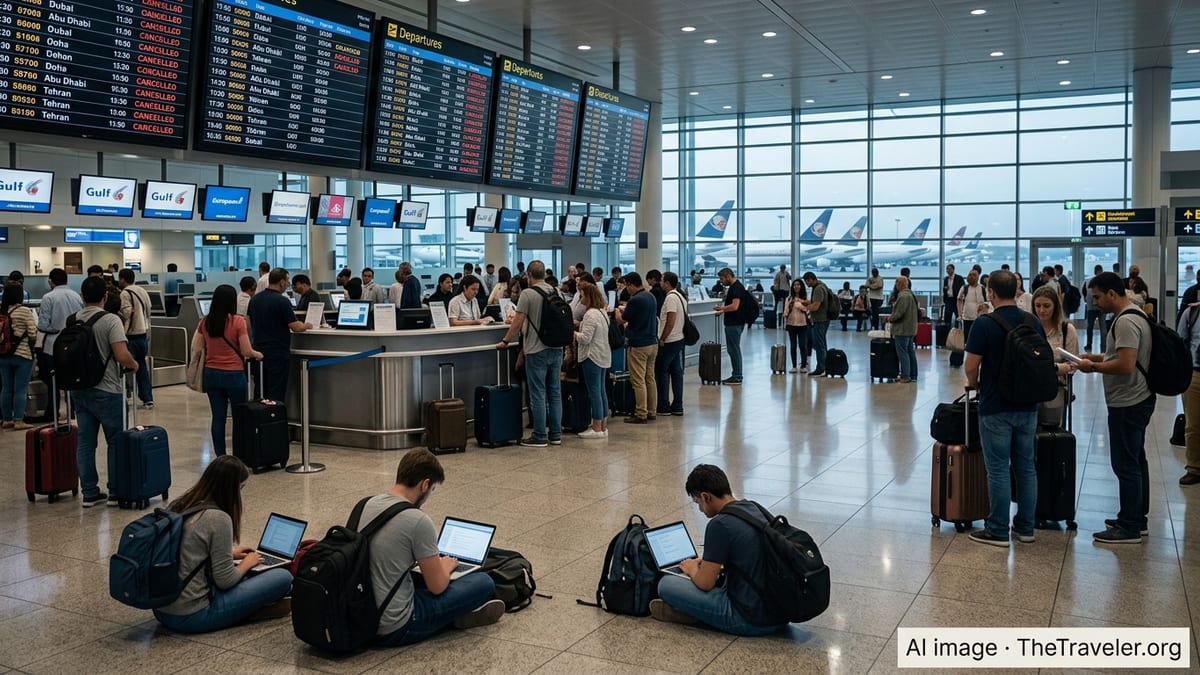
For travellers, the result has been long queues at rebooking desks, fragmented journeys and a surge in demand for scarce seats on alternative routings that bypass the conflict zone. Industry analyses suggest that operational pressures and war-related insurance costs are now the biggest shock faced by airlines since the initial pandemic shutdowns.
Oil Market Shock Drives Up Airfares and Travel Costs
The war has also struck at the heart of global energy supply. Strikes on oil and gas facilities in Iran and around the Gulf, combined with attacks and threats against shipping, have sharply reduced traffic through the Strait of Hormuz, a narrow passageway that handles a substantial share of the world’s seaborne crude. Business media and energy analysts report that nearly all tanker movements through the chokepoint stalled in mid March, forcing producers to cut output and traders to scramble for alternative routes.
Brent crude prices surged back above 100 dollars per barrel in early March and briefly spiked to well over 120 dollars as markets reacted to the risk of prolonged disruption. For airlines, fuel costs that were already elevated have risen further, undermining thin profit margins and piling additional pressure on ticket prices. Carriers with long-haul fleets and limited hedging now face a particularly steep cost squeeze.
Travellers are starting to feel the impact in higher base fares, surcharges and fewer discounted seats, especially on intercontinental routes where long detours add both fuel burn and crew time. Travel management companies are warning corporate clients to budget for sustained volatility in air pricing through at least the northern summer season, even if a ceasefire is reached, because supply contracts, insurance premiums and hedging positions will take time to normalise.
Beyond flights, the surge in energy costs is feeding into wider travel spending. Cruise lines and tour operators reliant on marine fuel are signalling possible itinerary changes and supplemental charges, while hotel and resort operators in energy-importing countries face rising utility bills that may eventually filter through to room rates.
Airspace Closures Redraw Global Flight Maps
What began as targeted restrictions over parts of Iran has expanded into a broad patchwork of closed or heavily constrained airspace across the region. Aviation advisories and flight-tracking snapshots from late March show minimal civilian traffic over Iran, Iraq and parts of Israel, Jordan, Kuwait, Qatar, Bahrain and the United Arab Emirates as military operations intensify and risk assessments are repeatedly revised.
Regulators in multiple jurisdictions have issued directives advising or requiring airlines to avoid designated conflict zones at cruising altitudes, citing the risk of misidentification and potential strikes near major airports. Insurers are simultaneously reassessing war-risk coverage, raising costs for any carrier that continues to operate near the affected areas or across adjacent corridors considered at heightened risk.
These closures have forced airlines to redesign flight plans on a global scale. Europe–Asia services that once took relatively direct paths over the Middle East are now being rerouted via the Caucasus, Central Asia, Russia’s southern periphery where permitted, or deep over the Indian Ocean. Africa–Asia routes are being pushed farther south and east, increasing block times and complicating aircraft rotations.
The knock-on effects extend far beyond the immediate war zone. Congestion in alternative corridors is lengthening delays and straining air traffic control capacity, while crew duty limits and aircraft maintenance schedules are being tested by the extra hours required on long-haul missions. Even travellers whose journeys do not touch the Middle East are encountering schedule changes as airlines shuffle aircraft and crew across their global networks.
Tourism Slump and Shifting Demand Patterns
The conflict has triggered an abrupt collapse in inbound tourism to much of the Middle East. Destination marketing agencies and hotel groups across the Gulf states, Jordan and parts of the eastern Mediterranean are reporting mass cancellations of leisure and pilgrimage trips for the first half of 2026. Major events planned in regional hubs, from sporting fixtures to trade shows, have scaled back or postponed as participants reconsider travel plans.
According to recent economic assessments, suspended air links and security concerns are dealing a significant blow to Gulf economies that have spent years positioning themselves as global tourism and transit centres. Analysts suggest that even once flights resume, recovery may be uneven and heavily dependent on perceptions of safety, insurance coverage and the resilience of consumer demand in key source markets such as Europe, India, China and North America.
At the same time, demand is being redirected rather than disappearing entirely. Booking data cited in industry commentary points to increased interest in alternative hubs and stopover cities outside the conflict zone, including Istanbul, various European capitals and Southeast Asian gateways. Some travellers are shifting from multi-country itineraries that once included Gulf stopovers to itineraries that remain within a single region or rely more heavily on direct point-to-point services.
Travel businesses worldwide are recalibrating their forecasts. Tour operators that previously specialised in Middle Eastern cultural, religious or adventure travel are pivoting toward safer destinations, while global hotel chains are rebalancing investment plans to focus on markets less exposed to geopolitical flashpoints.
What Travellers Need to Do Now
For travellers with upcoming trips in 2026, the rapidly changing situation means proactive planning is essential. Airline and insurance advisories released in March highlight that many carriers have introduced flexible rebooking policies and waivers for itineraries touching the Middle East or overflying affected areas, but the details vary widely between companies and may change with little notice.
Passengers are being encouraged by consumer groups and travel agents to monitor their bookings closely, checking airline apps and email for schedule changes and tracking departure and arrival airports for any new restrictions. Because war-related events are often excluded from standard travel insurance, policy wording needs to be reviewed carefully before purchase; products that specifically address cancellation, delay and medical coverage in the context of conflict remain limited and may carry higher premiums.
Experts in risk assessment stress the importance of understanding not only whether a destination is open, but also whether transit points en route are stable and adequately serviced. Travellers may wish to prioritise itineraries that avoid multiple connections, rely on carriers with clear disruption policies, and route through regions where airspace remains fully open and infrastructure is operating normally.
As negotiations and military operations continue, conditions can shift from one day to the next. For the remainder of 2026, the Iran–US war is expected to remain a central factor shaping airline networks, fare levels and destination choices, making flexibility and up-to-date information key tools for anyone planning to travel internationally.