

More news on this day
Escalating warfare involving Iran, the United States and Israel in March 2026 is rapidly reshaping global mobility, as missile attacks on energy and transport hubs combine with sweeping airspace closures and new security warnings to produce one of the most severe shocks to international travel since the Covid-19 pandemic.
Get the latest news straight to your inbox!
Missile Strikes Hit Civilian Hubs as Conflict Intensifies
In recent days, the war has moved ever closer to major population centers and critical infrastructure, with Iranian missile attacks reported near Israel’s main nuclear research area and repeated barrages across the Gulf. Published coverage from regional media and international wire services describes dozens of people injured and buildings shattered after dual strikes in southern Israel, underscoring how quickly front-line violence can spill into civilian zones and nearby transport corridors.
Iranian forces have broadened their target set across the region since mid-March, including strikes linked to the world’s largest natural gas field and other energy facilities. Publicly available information indicates that Gulf Arab governments view the latest attacks as a dangerous escalation that risks pulling additional states directly into combat. This militarization of airspace and coastal waters around the Strait of Hormuz, one of the world’s most important energy and shipping chokepoints, is a central driver of mounting travel disruption.
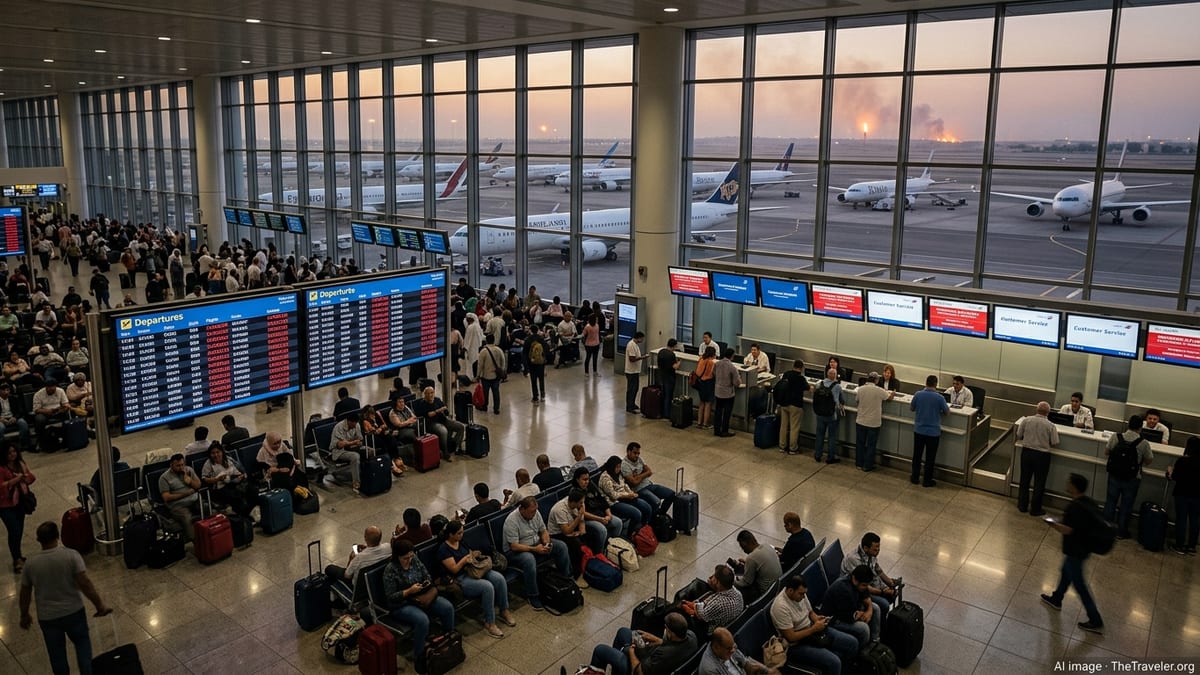
In the United Arab Emirates, reporting indicates that Dubai International Airport, one of the planet’s busiest long-haul hubs, was struck in an early-morning attack, injuring airport staff and forcing an evacuation. Separate accounts describe a fire at Jebel Ali Port tied to debris from aerial interceptions. These incidents have amplified concerns that civilian aviation and maritime facilities across the Gulf are increasingly exposed to the fallout from the conflict.
At the same time, Iranian officials and state-linked channels have threatened to expand retaliatory operations beyond the immediate war zone, including explicit references to recreation and tourist sites worldwide. Such rhetoric, widely covered by global news outlets, is contributing to a climate of uncertainty among airlines, tour operators and travelers who now view a broader geography as potentially vulnerable.
Airspace Closures and Flight Cancellations Ripple Worldwide
The most immediate impact for travelers has been a cascading wave of airspace restrictions and flight cancellations. Aviation data cited in major international reporting indicates that more than 52,000 flights to and from the Middle East have been canceled since the war began in late February, representing well over half of scheduled traffic in the region. Analysts describe this as the most severe test for airlines since the pandemic-era shutdowns.
Iran’s skies are now largely devoid of civilian aircraft, and multiple neighboring countries, including Israel, Iraq, Kuwait, Qatar, Syria and the United Arab Emirates, have enacted partial or full closures of their airspace at various points in the crisis. Air traffic controllers in remaining open corridors are managing uncommonly dense flows as long-haul routes between Europe and Asia divert around the conflict zone, lengthening flight times, increasing fuel burn and adding new layers of operational complexity.
Major Gulf carriers that typically rely on cross-continental connections through Dubai and Doha have faced near-total interruptions as missile threats and airspace restrictions converge. Public data and airline statements compiled by business media show Emirates, Qatar Airways and other operators cutting frequencies, suspending routes and scrambling to reposition aircraft and crews. European and Asian airlines, including those based in Germany, Britain and India, have likewise halted or sharply reduced services to several Middle Eastern destinations.
For passengers, the result has been a surge of missed connections, unplanned layovers and last-minute rerouting across hubs as far apart as Istanbul, Athens and Central Europe. Travel forums, flight-tracking communities and consumer reports describe a patchwork of ad hoc solutions, with some carriers offering limited repatriation flights via specially approved corridors while warning that further changes can occur with little or no notice.
From Regional Violence to a Looming Global Travel Crisis
While the conflict is concentrated in and around Iran and the eastern Mediterranean, its travel impacts are increasingly global. Economic analyses of the 2026 Iran war point to a near-collapse of aviation and tourism in several Gulf states following multi-national airspace closures, with projections of significant GDP contractions in countries heavily dependent on passenger traffic, connecting hubs and large-scale events.
Oil and gas market volatility is feeding into this picture. With strikes reported on key energy facilities and heightened risk in the Strait of Hormuz, benchmark prices for crude and natural gas have spiked repeatedly since late February. Industry-focused coverage notes that higher fuel costs come on top of already elevated expenses for airlines dealing with staffing shortages and aircraft delivery delays, raising the prospect of more expensive tickets, trimmed schedules and reduced capacity even on routes far from the Middle East.
Tourism boards and hospitality groups across North Africa, the eastern Mediterranean and the Gulf are bracing for a prolonged downturn. Analysts quoted in regional economic briefings warn that visitor perceptions often treat the wider Middle East as a single risk zone, meaning incidents in one state can depress demand across several neighbors. Bookings data referenced by travel industry outlets already show weakening interest in itineraries that connect through or visit hubs from the Levant to the Arabian Peninsula.
Financial markets have responded with volatility in airline and travel stocks, as investors weigh the possibility that this conflict could mark a turning point similar to earlier oil shocks. Some commentators argue that a sustained war combined with disrupted energy exports and air connectivity could accelerate structural changes in tourism patterns, nudging travelers toward destinations perceived as more insulated from geopolitical flashpoints.
Governments Issue Sweeping Security Alerts and Warnings
As the military confrontation has intensified, governments are recalibrating their travel guidance. Publicly accessible advisories from multiple foreign ministries now urge citizens to avoid nonessential travel to Iran, Israel and parts of the Gulf, while cautioning about transit through regional hubs that may be subject to sudden operational suspensions or security incidents.
On March 22, 2026, the United States issued a worldwide security alert highlighting the risk that groups aligned with Iran could target American interests, facilities or locations associated with U.S. travelers in various countries. The notice, widely shared across news and social platforms, encourages travelers to maintain heightened awareness, review destination-specific advisories and prepare for rapid changes in local security conditions or transportation availability.
European and Asian governments have adopted similarly cautious language, warning of potential spillover threats and urging travelers to register with consular services when journeying anywhere near the wider conflict zone. Some advisories explicitly flag the possibility of abrupt airspace closures, missile or drone activity, and disruptions to critical infrastructure such as ports, desalination plants and power grids.
Industry groups that monitor corporate travel risk report a marked increase in businesses postponing or canceling trips to the Middle East and adjacent regions, redirecting meetings to virtual formats or relocating them to alternate hubs in Europe and Asia. Insurance providers are revisiting coverage terms, with some policies excluding war-related disruptions or pricing additional protection at a premium.
What Travelers and the Industry Face in the Coming Weeks
Looking ahead, aviation and tourism specialists warn that the situation may deteriorate further if the conflict expands or energy infrastructure sustains more damage. Economic modeling summarized in recent research suggests that prolonged closure of the Strait of Hormuz combined with sustained airspace restrictions could trigger a multi-year shock to global travel, raising costs for airlines and consumers alike and reshaping typical east–west routing patterns.
At the operational level, airlines are evaluating alternative routings over the Caucasus, Central Asia and parts of Africa, but these paths are longer and often constrained by existing congestion and geopolitical sensitivities. Airport operators outside the immediate war zone are assessing whether they can absorb diverted traffic, even as they contend with their own capacity and staffing limitations inherited from the pandemic recovery phase.
For individual travelers, the environment is defined by uncertainty. Publicly available guidance from risk consultancies and government agencies now emphasizes flexible planning, including the use of fully changeable tickets where possible, close monitoring of airline notifications, and readiness for extended layovers or last-minute cancellations. Travelers with itineraries transiting the wider Middle East are being urged to consider alternative routings or to delay journeys altogether if their plans are discretionary.
What began as a regional military confrontation is therefore evolving into a global test of resilience for the travel ecosystem. From missile-damaged hubs in the Gulf to nervous holidaymakers in faraway markets, the Iran war’s latest escalation is exposing how tightly bound modern tourism and aviation are to the stability of a handful of strategic skies and sea lanes.