

More news on this day
As the Iran war grinds into its second month and large parts of Middle East airspace remain closed or heavily restricted, UK travellers are confronting a confusing mix of suspensions, diversions and higher fares, raising urgent questions over how close the country is to widespread flight cancellations.
Get the latest news straight to your inbox!
Aviation Shockwaves From a Rapidly Closing Sky
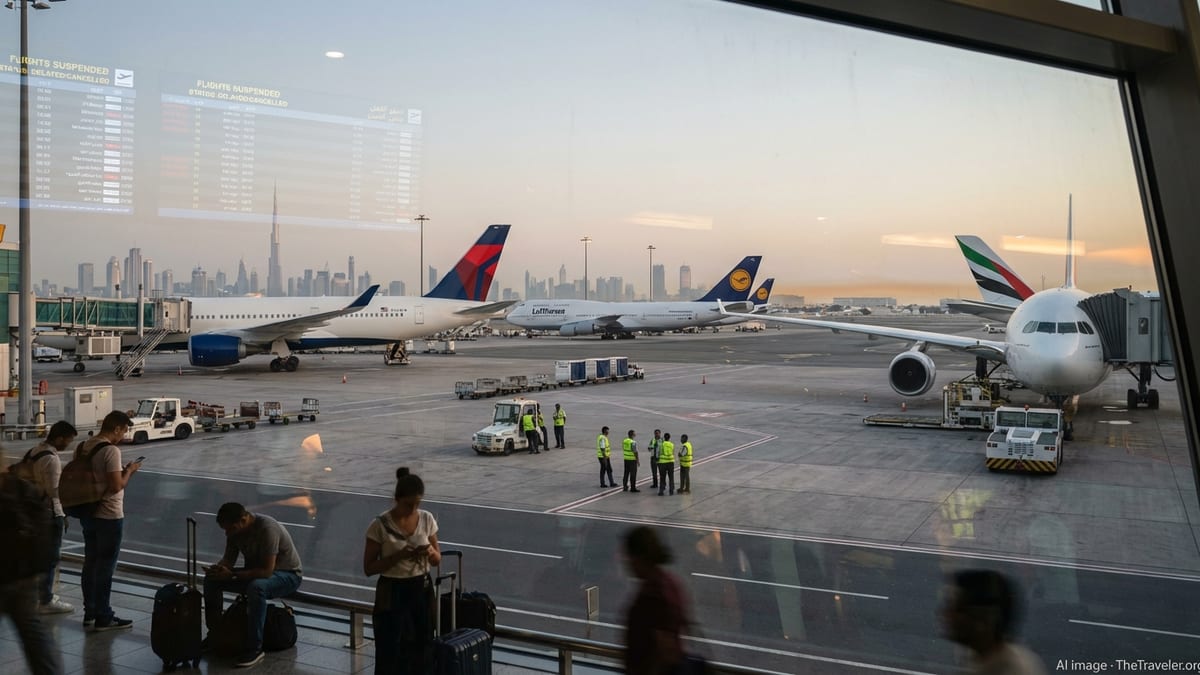
The conflict that erupted on 28 February 2026 with large-scale US and Israeli strikes on Iran has triggered some of the most severe airspace disruptions in years. Reports indicate that Iran’s airspace is effectively closed to civilian aviation, while Bahrain, Iraq, Israel, Kuwait, Qatar, Syria and the United Arab Emirates have imposed varying levels of closures or restrictions. At the same time, major Gulf hubs such as Dubai, Abu Dhabi and Doha have faced shutdowns or severe curbs at different points in the crisis.
European aviation data compiled in late March shows a sharp drop in Europe to Middle East traffic, with flows on some days falling by more than half compared with last year. Industry analysis suggests more than ten thousand flights on Asia to Europe and Europe to Middle East corridors have been cancelled or heavily rerouted since the end of February, as carriers are forced to thread longer paths north via the Caucasus or south over Egypt and the Red Sea.
For UK travellers, that means the indirect effects of the Iran war are already being felt even when flights are not completely cancelled. Longer routings add hours to journey times, push up fuel burn and tighten crew schedules, creating a more fragile network where a single disruption can cascade quickly into delays or pulled rotations.
Where UK Airlines Are Cancelling Flights
Publicly available schedules and airline advisories show that UK carriers have already made substantial cuts to direct services into the conflict zone. Flights to Iran itself are off the boards, with Iran under total civil aviation closure. Services to Israel and Palestine had been significantly reduced since earlier rounds of regional tension and are now described in industry summaries as operating only on a very limited or repatriation basis, if at all.
British Airways has cancelled the majority of its services to key Middle Eastern destinations since the start of March, particularly Tel Aviv and several Gulf cities that sit inside or close to restricted airspace. Travel industry commentary and passenger forums indicate that many of these routes remain suspended into April, with customers being rerouted via alternative hubs in Europe or Asia or offered refunds and credits instead.
Other UK-based and European carriers serving the British market have followed similar patterns. Some have extended bans or suspensions on flying into certain airports in the Gulf and Levant, while keeping skeleton operations to more westerly hubs such as Riyadh or Jeddah where airspace access is still possible. Low-cost operators with thinner fuel and crew margins appear particularly exposed, with additional cancellations when detours would push aircraft beyond their practical range.
However, these cuts are still concentrated on destinations within the immediate conflict footprint. There is no sign that UK airlines are cancelling large numbers of flights between Britain and Western Europe, North America or much of Asia purely because of the Iran war, even though rerouting adds complexity and cost.
Rerouting, Longer Journeys and Rising Fares
Instead of outright cancellations, the most visible impact for many UK passengers is rerouting. Flight tracking data and airline statements show that services which once crossed Iran, Iraq or Israel are now taking indirect paths, often arching north over Turkey and the Caucasus or skirting south across Egypt and Saudi Arabia. Some long-haul flights have required technical stops for refuelling and crew changes, particularly narrow-body services between the Gulf and Europe that are operating close to their maximum range on the new tracks.
These detours are stretching flight times by an hour or more on some routes. That in turn reduces aircraft utilisation, narrows the buffer for turnaround delays and complicates crew rostering. Carriers can respond by trimming frequencies, consolidating lightly booked flights or swapping to larger aircraft, all of which can feel like de facto capacity cuts even when the flight number technically survives.
At the same time, the war has driven up global oil and jet fuel prices. Travel and business media report that airlines have introduced new fuel surcharges and selectively pruned schedules, particularly on marginal routes, to try to protect yields. On heavily affected corridors linking Asia and Europe, analysts are already recording double-digit fare increases, with some direct economy tickets selling out days or weeks in advance.
For the UK market, that combination points toward fewer choices and higher prices on journeys that typically connect through the Gulf, Levant or Iran-adjacent airspace, rather than an immediate collapse of the country’s wider flight network.
Government Warnings and What They Mean for UK Flyers
The UK Foreign, Commonwealth and Development Office currently advises against all travel to Iran, Israel and Palestine, reflecting the severe security and operational risks in those territories. Public travel advisories also urge British nationals already in parts of the region to follow local instructions, be prepared to shelter in place and monitor updates on possible evacuation or repatriation options.
Insurance providers and travel risk consultancies have responded by issuing special notices that treat the Iran war as a defined conflict event. Some policies are limiting or excluding cover for new trips booked into affected countries, while others emphasise that travellers whose flights are cancelled should first seek refunds or rebooking from their airline or tour operator. These moves underline how seriously the industry views the potential for sudden changes in airspace access and airport operations.
None of this automatically translates into blanket flight bans from the UK, but it does mean that routes judged to be high risk can disappear from schedules with little warning. Travellers with tickets to or via the Middle East are being advised by consumer groups to check flight status repeatedly in the days before departure and to build in generous buffers for connecting itineraries.
For now, official planning has focused more on contingency arrangements for British nationals already in the region, including potential evacuation flights, rather than on closing down ordinary commercial traffic out of UK airports.
How Close Is the UK to Broader Cancellations?
Assessing how close the UK is to mass flight cancellations requires separating immediate conflict-zone suspensions from the resilience of the wider network. On the one hand, the scale of airspace closures over Iran and neighbouring states, combined with missile and drone attacks that have reached as far as British bases in Cyprus, has exposed the vulnerability of eastbound traffic that depends on a handful of corridors.
If the war were to escalate further, for example by triggering broader closures across eastern Mediterranean or Turkish airspace, UK routes to South Asia and parts of East Asia could face much more significant disruption. Airlines might be forced into extreme detours over the Arctic or deep southern routes, with some services becoming economically or operationally unviable in the short term. In that scenario, cancellations could extend well beyond the Middle East.
On the other hand, current evidence suggests that carriers and regulators are working to keep as much of the global network open as safety allows. European coordination bodies have issued guidance on slot alleviation and flexible scheduling to help airlines adapt to airspace restrictions without permanently losing their take off and landing rights. UK and European airlines have shown they can pivot capacity quickly, redeploying aircraft to safer routes where demand remains strong.
For British travellers planning trips in the coming weeks, the practical picture is nuanced. Flights directly to Iran, Israel and several neighbouring states are either cancelled or operating at a bare minimum, and connections that rely on Gulf hubs remain at high risk of changes. Yet for now, there is no indication of systemic flight cancellations from the UK across all regions. The risk is highly destination dependent, and the situation is evolving day by day as the Iran war reshapes the map of global aviation.