

More news on this day
The sudden escalation of the Iran war in late February 2026 is reverberating far beyond the Gulf, unsettling Mediterranean cruise plans, reshaping summer 2026 itineraries and forcing travelers to reassess where and how they sail this year.
Get the latest news straight to your inbox!
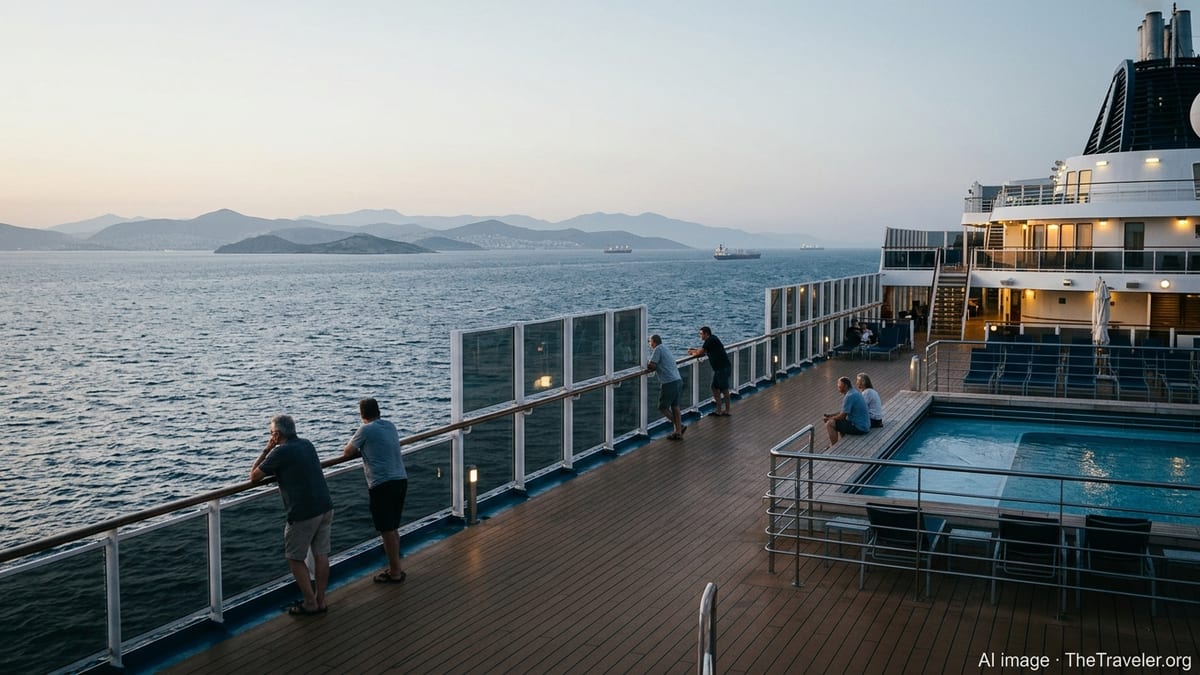
How the Iran War Spilled Into Mediterranean Cruise Planning
The Iran war that erupted on 28 February 2026, following large-scale strikes on Iranian targets and subsequent regional retaliation, has triggered immediate disruption across Middle East airspace and key maritime chokepoints. Publicly available situation reports show commercial traffic through the Strait of Hormuz and parts of the Red Sea has sharply reduced as ship operators avoid high-risk routes, widening the impact from energy shipping to passenger travel.
While most Mediterranean cruises do not sail into the Gulf, the Eastern Mediterranean and Suez Canal sit on the same broader corridor now affected by military activity, drone and missile strikes, and elevated war-risk insurance. Economic assessments of the conflict indicate that tourism to the wider eastern Mediterranean, including popular summer destinations such as Turkey and Greece, is already seeing a downturn as holidaymakers pivot to what they perceive as safer alternatives.
This change is hitting just as cruise lines finalize deployment for the crucial 2026 summer season. Many brands had been rebuilding itineraries in the region after years of pandemic recovery and previous Red Sea tensions, only to confront a new layer of geopolitical risk that complicates route planning and demand forecasts.
For travelers, the result is a more volatile landscape in which advertised itineraries may change at short notice, capacity may shift between regions, and perceptions of safety can influence pricing and availability well into the peak summer months.
Cruise Lines Cut Middle East Exposure and Reroute Ships
Even before the current war, several cruise operators had begun scaling back Middle East and Red Sea programs as Houthi attacks and regional unrest made Suez transits less predictable. AIDA Cruises, for example, canceled its entire 2025–2026 Orient season and reassigned AIDAprima to Northern Europe and Canary Islands routes, citing rising instability and the need to prioritize security. Similar moves by other brands effectively shifted ships that once linked Gulf ports with the Mediterranean into Western Europe and Atlantic markets.
The latest phase of the conflict is accelerating that trend. Industry briefings tracking the March 2026 crisis describe cruise ships avoiding the Strait of Hormuz entirely and remaining in port for extended periods. Posts from affected passengers and trade coverage point to ships, including MSC vessels, staying docked in Dubai while operators wait for clearer guidance on safe passage.
At the same time, knock-on effects are being felt in Egypt, where Nile river cruises have seen widespread suspensions in response to global travel advisories connected to the Iran war. Major international lines have halted Egypt programs through at least late March 2026, underscoring how a conflict centered in the Gulf can ripple across inland cruise products that rely on international air links and traveler confidence.
The practical implication is a rebalancing of cruise capacity away from Middle East gateways and vulnerable chokepoints towards more stable regions. For the Mediterranean, that means more ships concentrating on Western and central routes while Eastern Mediterranean deployments are reviewed week by week.
Why Demand for Eastern Mediterranean Sailings Is Dropping
Travel and financial market commentary published in early March highlights two forces depressing demand for Eastern Mediterranean cruises: security concerns and economic pressure. First, the proximity of many itineraries to conflict-adjacent waters is leading risk-averse travelers to postpone or redirect their plans, even when ports remain open. Reports on the broader economic impact of the Iran war note that tourism in countries bordering the eastern Mediterranean is already seeing travelers shift to other destinations for summer holidays.
Second, the war’s effect on oil prices and shipping costs is feeding into cruise economics. Analysis of major cruise operators stresses that volatile fuel prices and longer rerouting around high-risk areas erode margins, putting pressure on lines to adjust itineraries, tweak speeds and, in some cases, scale back less profitable or more exposed routes. These operational decisions can further dampen enthusiasm for itineraries that feel uncertain or prone to last-minute changes.
Historic experience with the Red Sea crisis and recent cancellations in the Gulf has also shaped traveler behavior. Cruise guests who saw itineraries altered or curtailed due to security advisories in previous seasons are now more cautious about committing to routes that rely on the Suez Canal or call in Israel, Egypt, Cyprus or Turkey, even if the itinerary is marketed primarily as a Mediterranean voyage.
Together, these factors are softening demand in the Eastern Mediterranean just as booking season for July and August sailings reaches its peak, creating both challenges and potential pricing shifts for consumers who remain flexible.
What This Could Mean for Your 2026 Summer Vacation
For travelers planning a 2026 summer cruise, the Iran war introduces a higher likelihood of itinerary changes, regional redeployments and shifting price dynamics, particularly on itineraries that touch the Eastern Mediterranean or rely on Suez Canal transits. Publicly available booking guidance from cruise lines and travel trade outlets suggests that companies are retaining the right to modify routes at short notice, often substituting alternative ports in Italy, Spain, France or the Adriatic if calls in the eastern basin become difficult.
One immediate consequence may be tightened availability on Western Mediterranean sailings as ships and customers migrate toward perceived safe havens such as the Balearic Islands, the French Riviera and the western Italian coast. Travelers who delay booking until late spring could find fewer cabin options on popular departures, even as select Eastern itineraries show softer demand and more aggressive promotions.
Travel insurance is becoming another critical consideration. Policy wording around war, terrorism and government travel advisories varies widely, and discussions in consumer forums already show confusion over what is covered when a conflict disrupts a cruise. Prospective passengers are being encouraged by travel professionals to scrutinize coverage for itinerary changes, cancellation for any reason add-ons and supplier default, especially when booking higher-priced suites or back-to-back voyages.
Flexibility will likely be a key advantage. Choosing refundable deposits where possible, favoring air arrangements with changeable tickets and building in a buffer day before and after cruise dates can help absorb schedule disruptions, particularly if airlines continue rerouting long-haul flights away from Gulf and Iranian airspace through at least May 2026.
How to Navigate Bookings in an Unsettled Season
Publicly available cruise deployment updates indicate that lines are concentrating on three main strategies to manage risk in summer 2026: consolidating ships in core Western Mediterranean hubs, extending seasons in Northern Europe, and promoting alternative sun routes such as the Canary Islands and Atlantic islands. Travelers who can be flexible with geography may benefit from this shift by discovering itineraries that were previously more seasonal or less widely marketed.
At the same time, observers note that cruise capacity does not simply disappear. Ships pulled from Middle East and Gulf programs must be absorbed somewhere, and this can create competitive pricing in regions that receive redeployed tonnage. For consumers, that may translate into value fares on shoulder-season Mediterranean voyages in May and June or on less traditional homeports that are suddenly served by larger or newer ships.
Given the fluid security picture, travel analysts advise monitoring itinerary change histories for specific ships and brands. Some operators have shown a pattern of early, proactive rerouting when risks rise, while others have tended to wait until closer to departure. Understanding that track record can help travelers decide how much uncertainty they are willing to accept when committing nonrefundable payments.
For now, the main message for would-be Mediterranean cruisers is not necessarily to abandon 2026 plans, but to approach them with heightened awareness. The Iran war has introduced new variables into an already complex region, and the coming months will test how resilient both cruise lines and their guests are in adapting to a shifting map of where, and how, they choose to sail this summer.