

More news on this day
The war in Iran is rapidly reshaping global air travel, with soaring fuel costs, closed Middle East airspace and emergency rerouting combining to push up fares and derail tourism plans worldwide.
Get the latest news straight to your inbox!
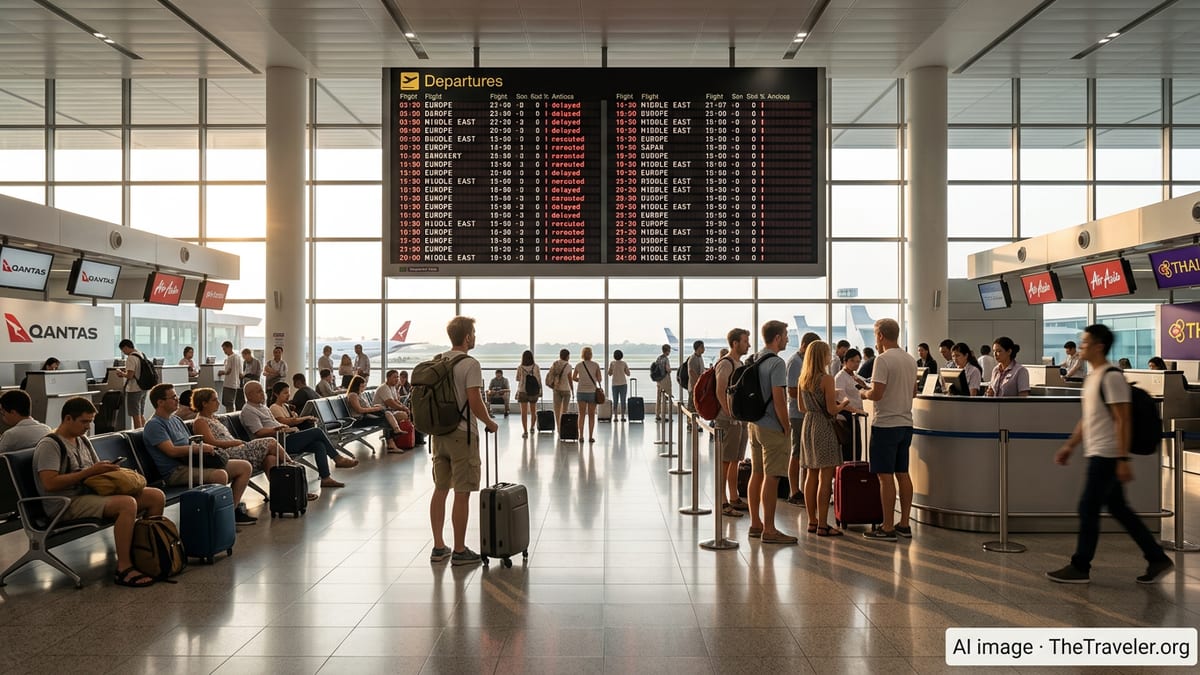
Airspace Closures Ripple Across Global Flight Networks
Since coordinated United States and Israeli strikes on Iran on February 28, 2026, large swathes of Middle East airspace have been shut or heavily restricted, forcing airlines to redraw some of the world’s busiest long-haul corridors almost overnight. Regulators in Iran, Iraq, Israel, Kuwait, Qatar, Bahrain, Syria and parts of the United Arab Emirates have imposed full or partial closures, while European and US safety agencies are advising carriers to avoid the entire conflict zone.
The disruption is hitting key Gulf hubs that normally act as the connective tissue between Europe, Asia, Africa and Oceania. Dubai, Abu Dhabi and Doha have all seen heavy schedule cuts, diversions or temporary suspensions, severing many of the cheap one stop options that underpinned the global tourism boom of the past decade. Thousands of flights have been re-routed further north or south, adding flight time and fuel burn at the very moment oil prices are spiking on war risk.
Travel advisories from multiple governments now warn of “widespread airspace closures, flight cancellations and other travel disruptions” linked directly to the Iran war. Even passengers not setting foot in the Middle East are finding their journeys extended, their connections broken and their ticket options dramatically more expensive as airlines scramble to rebuild viable networks around an expanding no fly zone.
Qantas Leads Price Hikes as Oil and Detours Bite
Qantas has moved quickly to raise international fares, explicitly citing the Middle East conflict and volatile jet fuel prices. The Australian flag carrier confirmed this week that ticket prices on overseas routes will rise by around 5 percent on average, with some Europe services seeing sharper jumps as demand floods away from disrupted Gulf and European carriers.
The airline has also reworked one of its flagship ultra long haul routes. The non stop Perth London service, once marketed as a direct bridge between Australia and Europe, now includes a technical stop in Singapore so crews can skirt the conflict zone. That change lengthens journey times and boosts fuel consumption, adding further pressure to pass on higher operating costs to passengers already facing limited alternatives.
Demand patterns are shifting just as fast. Qantas reports that its Europe flights via Singapore are now more than 90 percent full in March, roughly 15 percentage points higher than usual for this time of year. With cheaper fare classes selling out first, late bookers are left facing premium prices that travel agents say could worsen if jet fuel remains elevated and airspace restrictions extend into the northern summer season.
Thai Airways, Thai AirAsia and Regional Carriers Under Strain
In Southeast Asia, Thailand has emerged as a vivid case study in how the Iran war is distorting travel flows far beyond the battlefield. Routes linking Bangkok and other Thai cities to Europe have been forced onto longer northern tracks to avoid closed airspace over Iran and its neighbors, stretching flight times by up to 90 minutes and driving up fuel bills.
Thai authorities report that one way economy fares on some Bangkok London services have more than doubled, climbing from roughly 30,000 baht to over 70,000 baht on certain departure dates. Capacity cuts by Gulf carriers and detours by European airlines are funneling more passengers onto limited remaining seats, creating a classic supply squeeze that is pricing many leisure travelers out of the market.
Thai Airways has said its long haul network continues to operate, but industry analysts note that the carrier and its low cost rivals such as Thai AirAsia X are being forced to constantly adjust flight planning, crew scheduling and fuel hedging strategies as the security map shifts. Tour operators selling Thailand to European holidaymakers warn that if elevated fares persist into mid 2026, booking volumes for the next high season could fall sharply.
Pressure Builds on AirAsia and Budget Travel Models
Low cost groups like AirAsia, which rely heavily on tight turnarounds, dense seating and predictable fuel costs, are particularly vulnerable to the cascading effect of war related disruptions. While AirAsia’s core network does not run deep into the Middle East, it depends on feed from partner airlines and on stable Asia Europe traffic patterns that are now in flux.
Industry sources say the group is quietly repricing some longer haul and connecting itineraries to reflect higher fuel surcharges and the loss of cheap Gulf stopover options. With passengers from Australia, Southeast Asia and East Asia shifting away from disrupted hubs and onto indirect routings through South Asia or northern Europe, the ultra competitive, low margin model that made intercontinental travel more accessible is coming under renewed strain.
For backpackers, students and price sensitive families, the impact is already clear. The combination of fare hikes, reduced seat availability and longer travel times is eroding the feasibility of multi country trips that hopscotch across Europe and Asia on budget carriers. Travel agents report more customers scaling back itineraries, shortening stays or postponing long planned journeys rather than absorb sharply higher ticket prices.
Tourism Hotspots Face Cancellations and Booking Uncertainty
The toll is mounting on tourism dependent economies that sit well outside the conflict zone. Destinations from Thailand and Indonesia to southern Europe are seeing a spike in cancellations and date changes as travelers reassess plans in light of rising prices, longer routings and heightened perceptions of regional instability, even in countries not directly involved in the war.
Large tour operators say group bookings that rely on tight cost control are especially exposed. Locked in contracts negotiated months ago on the assumption of stable fuel prices and plentiful Gulf transit options are being rapidly overtaken by events. Some companies are absorbing part of the additional cost in the short term to avoid mass cancellations, but warn that future packages will be repriced higher if the Iran conflict drags on.
Individual travelers are also grappling with new layers of uncertainty. With airlines frequently updating schedules, adding technical stops or consolidating lightly booked services, it is becoming harder to predict whether a chosen routing will still exist by departure day. Experts advise passengers to build in longer connection times, consider fully refundable tickets where budgets allow and monitor airline travel advisories closely as the situation evolves from week to week.
For now, there is little clarity on when Middle East airspace may reopen or fuel markets stabilize. Unless the conflict eases and cross Gulf corridors are restored, the current spike in fares and the unraveling of carefully crafted global flight networks is likely to continue weighing on tourism numbers and upending travel plans well into the year.