

More news on this day
Escalating conflict involving Iran and its adversaries is spilling far beyond the Middle East, as new security bulletins, airspace disruptions and fears of retaliatory attacks unsettle tourism flows and cast a shadow over some of the world’s most recognizable landmarks.
Get the latest news straight to your inbox!
From Regional War to Worldwide Caution
What began as a fast-moving military confrontation centered on Iran and its rivals has rapidly evolved into a global security story reshaping how and where people travel. Since late February 2026, joint strikes on Iranian targets, retaliatory missile and drone attacks and a widening Strait of Hormuz crisis have pushed governments to reassess the exposure of civilians, including visitors, in crowded public places and transport hubs.
Publicly available advisories describe a heightened risk environment in which actors aligned with Iran, as well as opportunistic extremist groups, may look to strike symbolic Western interests and soft targets overseas. Tourist districts, embassies, commercial centers and major transport nodes are repeatedly identified as locations that could face elevated scrutiny, and in some cases, tighter access controls.
According to recent threat assessments and insurance industry guidance, the conflict’s reach is no longer confined to airbases and energy terminals. Instead, it is reshaping risk calculations for everything from city breaks in major capitals to long-haul itineraries that rely on Middle Eastern hubs as key stopovers.
Iconic Landmarks Under Tighter Guard
High-profile urban landmarks have become focal points of concern as security agencies and local administrations respond to warnings of possible retaliatory violence linked to the Iran war. Risk analyses circulated in early March highlight that globally recognized monuments, museums and waterfront promenades associated with Western culture or political power could be viewed as attractive targets by hostile actors.
In North America and Western Europe, major cities have confirmed visible increases in uniformed patrols, vehicle screening and surveillance around tourism magnets such as historic squares, government districts and entertainment zones. According to published coverage of recent security briefings, planners are paying particular attention to locations that combine dense crowds, live events and symbolic significance, including stadiums, concert venues and religious sites.
Travel and risk consultancies note that this shift is not limited to a few capitals. From Paris to New York, Rome to Washington, heightened protection of landmark areas is being presented as a precautionary response to a diffuse, evolving threat picture, rather than a reaction to specific plots. For travelers, the outcome is more visible security architecture around the very attractions that often define a destination.
Airspace Closures and Airport Disruption Ripple Worldwide
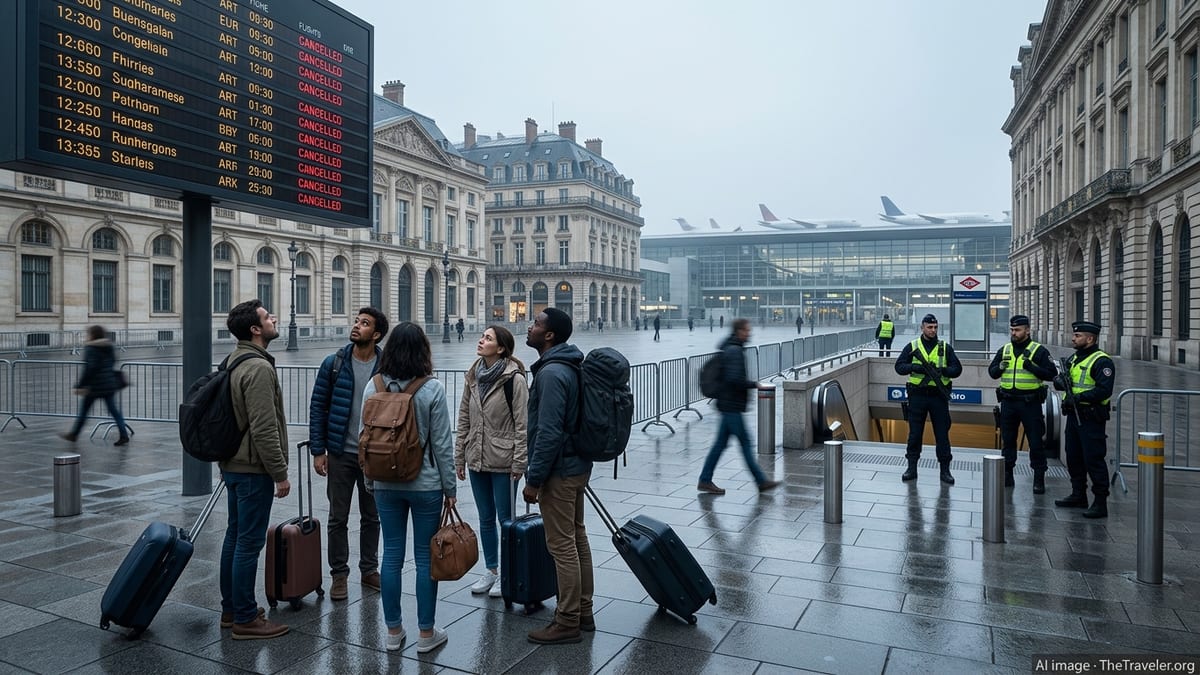
Nowhere has the immediate impact on tourism been more dramatic than in the skies. Airspace closures over Iran and parts of the Gulf, emergency restrictions around Qatar and the United Arab Emirates, and intermittent suspensions of routes to Israel and neighboring states have triggered a cascade of flight cancellations and diversions across multiple continents.
Industry analysis published in March 2026 estimates that tens of thousands of flights have been scrapped or rerouted since hostilities intensified on February 28. Carriers have cited evolving risk assessments, changes in insurance conditions and instructions from aviation regulators when suspending services over conflict-affected corridors. The knock-on effects are being felt far beyond the Middle East, as aircraft and crews are repositioned and complex long-haul networks are redesigned on short notice.
Major hubs that normally act as gateways between Europe, Asia and Africa have faced particularly acute disruption. Reports from Doha and Dubai describe periods of suspended commercial operations, curtailed schedules and priority given to evacuation and cargo flights. For stranded passengers, this has translated into lengthy delays, missed connections and, in some cases, abrupt changes to holiday plans that had relied on smooth transit through the region.
Government Warnings Reshape Traveler Behavior
Alongside the aviation turmoil, a wave of updated government advisories is reshaping how travelers evaluate risk. The United States already maintained a “do not travel” advisory for Iran prior to the current war, citing terrorism, civil unrest and the potential for arbitrary detention. Since mid 2025, it has also operated under a worldwide caution framework that underscores the possibility of Iran-related reprisals against American interests abroad.
Other governments have issued or renewed similar alerts, urging caution near diplomatic facilities, religious gatherings and locations associated with Israeli or Western symbols. Public messaging emphasizes that heightened vigilance, flexible planning and close monitoring of local media and official channels are now essential elements of international travel, particularly in and around the Middle East, North Africa and parts of Europe.
Travel insurance providers have responded by circulating detailed notices that war-related incidents are generally excluded from standard cover and may affect claims linked to cancellations or disruptions. These documents advise policyholders to review the fine print of their contracts, especially when booking itineraries that traverse known flashpoints or rely on carriers exposed to regional instability.
Tourism Industry Braces for a Prolonged Shock
The tourism sector, still rebuilding after the pandemic, is bracing for another deep shock. Industry-focused research released in March projects that international arrivals to the broader Middle East could fall sharply compared with previous forecasts, as travelers either postpone trips or switch to destinations perceived as safer or more stable.
Travel and aviation analysts describe a two-pronged challenge. On one side, security fears tied directly to Iranian threats and the conflict are depressing demand for certain destinations and prompting conferences, leisure trips and religious tourism to be cancelled or relocated. On the other, a surge in oil prices linked to the Strait of Hormuz crisis is pushing up fuel costs, leading airlines to reassess capacity, raise fares and trim marginal routes.
Market commentary suggests that the financial impact is already visible in the share prices of airlines, cruise operators and online travel agencies, with billions in market value erased in early March alone. Some experts predict a structural shift toward fewer but longer trips, as travelers look to maximize experiences while offsetting higher transport costs and added security friction.
Despite the turbulence, tourism bodies point to previous crises as evidence that travel demand can eventually rebound once security conditions stabilize and confidence returns. For now, however, the combination of Iran-linked threats, official warnings and ongoing travel chaos is forcing both travelers and industry leaders to navigate one of the most uncertain landscapes for global tourism in recent memory.