

More news on this day
As war rages in Iran and across the Gulf, the skies above one of the world’s busiest crossroads for international aviation have thinned to an eerie quiet, forcing airlines into costly detours that are stranding passengers and threatening to drive global airfares sharply higher just as demand for travel was returning to pre-pandemic strength.
Get the latest news straight to your inbox!
Closed Skies Over a Crucial Global Crossroads
The latest Iran war, which erupted after U.S. and Israeli strikes on multiple targets in Iran on February 28, has rapidly morphed into an aviation crisis radiating far beyond the Middle East. Iran has restricted its airspace and key Gulf states from the United Arab Emirates to Qatar and Kuwait have imposed sweeping closures or severe limitations, according to regional aviation authorities and flight-tracking data. Normally dense flight paths over Iran and Iraq now appear nearly empty as airlines divert away from perceived conflict zones.
Advisories from European and U.S. regulators urge carriers to avoid large sections of airspace covering Iran, Iraq, Israel, Jordan and much of the Persian Gulf, citing a high risk from missiles and drones. The European Union Aviation Safety Agency recently reiterated that operators should treat much of the region as high risk at all altitudes, effectively shutting off some of the most direct links between Europe, Asia and Africa. For carriers that built their networks around Gulf mega-hubs, the new reality is a patchwork of last-minute approvals and narrow corridors that can close with little warning.
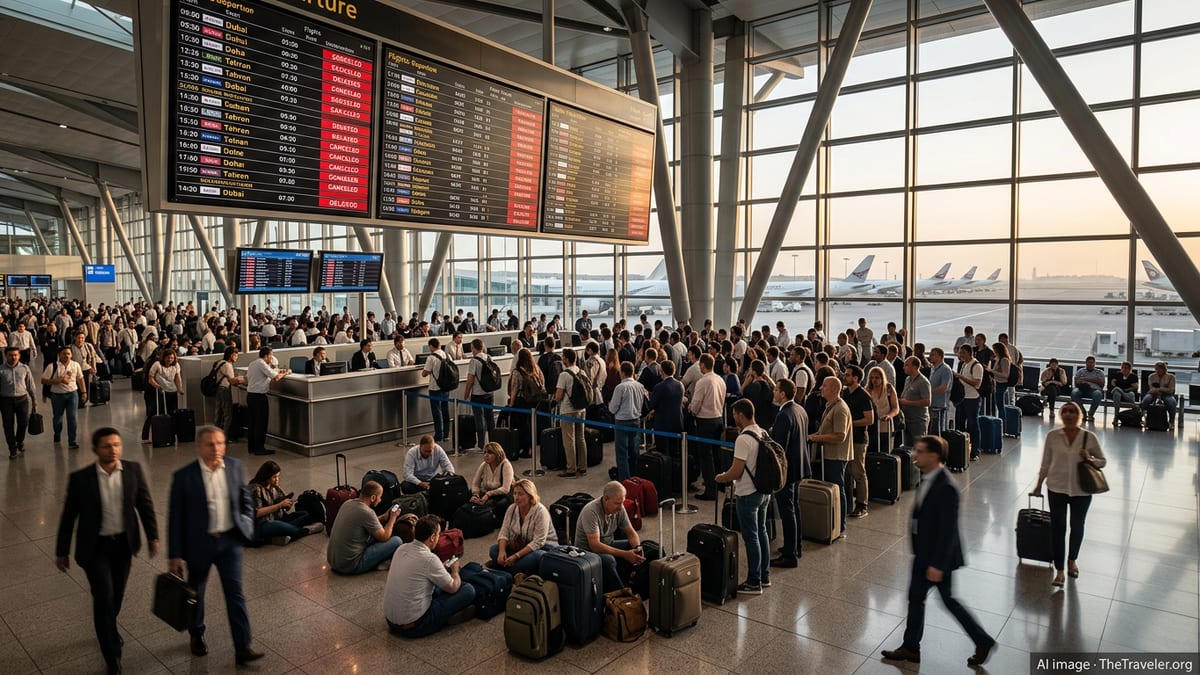
Airports that once marketed themselves as the world’s most reliable transit points are now symbols of vulnerability. Dubai, Abu Dhabi and Doha, which together handled hundreds of thousands of connecting passengers each day, have seen waves of cancellations and diversions as missiles and drones have targeted military sites and nearby infrastructure. Aviation analytics firms estimate that more than 1,800 flights were canceled across major Middle Eastern airlines in the first week of escalated hostilities alone, leaving terminals crowded with stranded travelers and mounting queues at rebooking counters.
Rerouted Flights, Longer Journeys and Ballooning Fuel Bills
With direct overflight of Iran, Iraq and parts of the Gulf off the table, airlines have begun redrawing their route maps in real time. Long-haul services linking Europe with South and Southeast Asia, as well as flights between North America and India or the Middle East, are being pushed north via Turkey, the Caucasus and Central Asia or, in some cases, south over the Arabian Sea. Security briefings circulating in the industry describe Europe to Asia sectors lengthening by up to two hours as jets are forced into dogleg routes that increase distance and time in the air.
Those detours translate directly into higher operating costs. Industry estimates shared with airline planners suggest that rerouting a single long-haul widebody flight around closed Middle East airspace can add 90 to 120 minutes of flying time and burn several additional tonnes of jet fuel. At the same time, Brent crude prices have spiked toward 90 dollars a barrel in recent days as traders brace for prolonged disruption to exports flowing through the Strait of Hormuz, the narrow waterway that handles a significant share of the world’s oil shipments.
For airlines, the squeeze comes on two fronts: more miles flown per flight and more expensive fuel going into every tank. Analysts note that jet fuel already accounted for close to a third of typical airline operating costs before the latest crisis. Now, with tankering and contingency fuel needs rising on conflict-adjacent routes, carriers are warning investors that their fuel bills could overshoot forecasts for 2026 by billions of dollars if the conflict drags on.
Operational complexity is compounding the financial strain. Dispatchers must juggle constantly changing airspace notices, limited refueling capacity at alternative airports and congestion at secondary hubs suddenly thrust into frontline roles. From Muscat and Fujairah in Oman to airports in Central Asia, smaller facilities are seeing a surge in diverted widebody traffic, testing their ground handling and maintenance capabilities as well as their fuel supplies.
Travelers Face Cancellations, Detours and Sticker Shock
For passengers, the conflict’s impact is being felt first in disruption and second in the wallet. Hundreds of thousands of travelers have been stranded or delayed as major Gulf carriers cancel departures and trim schedules, while European, Asian and North American airlines suspend flights into the region or reroute around it. Some travelers headed for leisure trips to Thailand or business meetings in India now find themselves on journeys that involve extra connections, overnight layovers or sudden diversions to unfamiliar airports.
U.S. and European governments have escalated travel advisories, with the U.S. State Department last week urging citizens to leave parts of the Middle East immediately due to security risks linked to the fighting. That has triggered emergency bookings on already busy routes out of the region, even as capacity is being cut. In Israel and neighboring states, recurring missile strikes and previous attacks on airports have made many global airlines wary of resuming service, further constraining options for those trying to depart.
All of this is feeding into higher fares. Before the latest escalation, ticket prices for flights touching the Gulf were already elevated after years of pandemic recovery and earlier regional conflicts. Now analysts at major travel platforms are warning that fares on some Europe to Asia and North America to India routes could climb sharply in coming weeks as airlines pass on higher fuel and insurance costs and reduce the number of seats on sale. A new report from aviation consultants projects double-digit percentage fare increases on routes most exposed to Middle East detours if hostilities and airspace closures persist through the northern summer.
The pain will not be shared equally. Travelers with flexible dates and multiple routing options may still find reasonable deals by avoiding traditional Gulf hubs and flying via Istanbul, Athens or northern European gateways. But price-sensitive passengers, migrant workers and travelers from smaller cities who rely on Gulf carriers for affordable one-stop connections between continents are likely to feel the steepest increases and longest delays.
From Oil Chokepoint to Global Inflation Risk
The crisis in the skies is intertwined with growing turmoil at sea. Iran’s attacks and the wider conflict have already disrupted traffic through the Strait of Hormuz, a vital oil and gas artery. Shipping insurers have raised war risk premiums and some tankers are avoiding the area, amplifying fears of a sustained squeeze on energy supplies. Economists warn that if flows through Hormuz remain constrained, the result could be a fresh wave of global inflation just as central banks were hoping to ease off interest rate hikes.
Higher jet fuel prices are an obvious pressure point for airlines, but they are far from the only concern. Supply chain experts point out that the Middle East conflict is also snarling cargo routes for pharmaceuticals from India, electronics and semiconductors from Asia, and a range of manufactured goods that commonly move by air when maritime channels are disrupted. Some of that volume is being shifted to longer air routes skirting conflict zones, adding both time and cost that may ultimately filter down to consumers in the form of higher prices.
Financial markets are reacting in real time. Airline stocks have seesawed as investors weigh the prospect of robust post-pandemic demand against the risk of higher costs and potential demand destruction if fares spike too far. Safe-haven assets such as gold have climbed, while shares in some Middle Eastern tourism and airport operators have slumped on expectations of prolonged disruption. Analysts caution that if the war were to expand or lead to a full blockade of Hormuz, the combined shock to oil, shipping and aviation could tip some economies toward recession.
For now, most major carriers insist they can absorb short-term cost spikes through fuel hedging and modest fare increases. The bigger risk, executives say privately, is a drawn-out stalemate that keeps airspace closed for months and entrenches new patterns of travel and trade that bypass traditional hubs. In that scenario, the current surge in travel costs might only be the first stage of a broader realignment of global air networks.
Uncertain Timelines and a New Geography of Flight
How long the disruption will last is a question no one in the industry can answer with confidence. Military analysts note that previous flare-ups involving Iran, including a 12 day confrontation in 2025, eased before causing lasting structural changes to global aviation. Yet the scale of the current conflict, which has seen strikes across multiple Gulf states and retaliatory attacks on infrastructure, has many airline planners bracing for a more prolonged crisis.
Regulators and aviation safety bodies are taking a deliberately cautious stance. European and U.S. authorities are signaling that even if active hostilities diminish, restrictions on overflying parts of Iran, Iraq and the wider conflict zone could remain in place until there is clear evidence that missile and drone threats have been contained. That could lock in longer routings and higher operating costs well beyond the formal end of major combat operations.
In the meantime, airlines are accelerating efforts to diversify their networks and reduce dependence on any single corridor. Some are adding capacity via Central Asia and the Caucasus, while others are strengthening partnerships with carriers in Turkey, India and Europe to offer alternate connections. New long-range narrowbody aircraft and ultra long-haul widebodies give some flexibility to bypass traditional hubs entirely on select routes, but those workarounds come with their own cost and fleet planning challenges.
For travelers watching fares climb and itineraries grow more complex, the war in Iran is a stark reminder that global mobility still depends on a fragile web of political stability and open skies. Until the missiles stop flying and regulators feel confident reopening the most efficient air corridors, the world’s passengers may find that their trips take longer, their tickets cost more and the once seamless experience of crossing continents through the Gulf’s glittering hubs has given way to a new, more turbulent geography of flight.