

More news on this day
A suspected Iranian drone strike on fuel storage tanks close to Bahrain International Airport has triggered a major fire on Muharraq Island, disrupting aviation operations and intensifying fears that the widening Gulf conflict is now directly targeting civilian air hubs and critical energy infrastructure.
Get the latest news straight to your inbox!
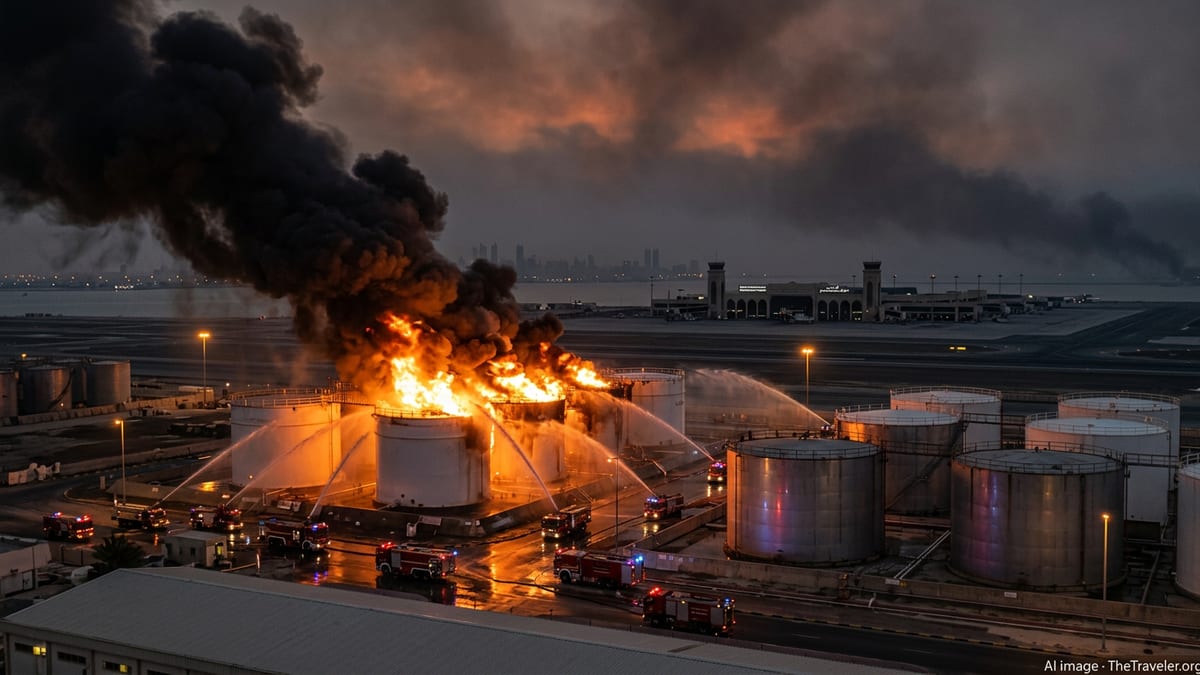
Fire Near Runways Sends Smoke Over Bahrain’s Air Gateway
The pre-dawn attack on Muharraq Island, which hosts Bahrain’s main international airport and adjoining fuel and oil storage facilities, sent plumes of thick black smoke over nearby neighborhoods and the airfield itself. Civil defense teams battled for hours to contain the blaze at the affected fuel depot, as images of burning tanks and orange-tinged skies circulated widely on social media and regional television channels.
Authorities described the incident as a deliberate strike on civilian infrastructure, saying that unmanned aerial vehicles believed to have originated from Iran hit a cluster of storage tanks used for jet fuel and other petroleum products. While early reports indicated no fatalities among airport staff or passengers, the scale of the fire prompted immediate concern over the safety of flight operations and the risk of secondary explosions.
Residents of Muharraq and parts of Manama were urged to stay indoors, close windows, and limit outdoor activity due to hazardous fumes. The Interior Ministry warned of potentially shifting wind patterns carrying smoke across densely populated districts, underscoring the environmental and public health dimensions of an attack ostensibly aimed at economic and strategic targets.
Airport authorities temporarily diverted or delayed flights as firefighters worked near sensitive aviation and fuel infrastructure. By mid-morning, operations were partially restored, but officials cautioned that schedules would remain fluid as safety checks continued around the perimeter of the affected fuel farm.
Airlines Divert Aircraft as Gulf Aviation Feels the Strain
The strike on Bahrain’s airport-adjacent fuel facility comes after days of mounting pressure on Gulf aviation networks, with regional carriers already rerouting aircraft and revising schedules in response to Iranian missile and drone activity. Bahrain’s civil aviation authorities confirmed that a number of passenger and cargo aircraft had been repositioned to airports in neighboring Saudi Arabia as a precaution against further strikes.
Travel industry analysts say the attack is likely to compound operational uncertainty for airlines that use Bahrain as a key hub for flights linking Europe, Asia and the broader Middle East. Even if runways and terminal buildings remain structurally intact, any damage to fuel infrastructure can force carriers to adopt costly workarounds such as tanker trucking from alternative depots or technical stops at other airports for refueling.
Passengers across the region have reported last-minute schedule changes, lengthier flight times due to rerouting around perceived danger zones, and elevated security screening at airports that only months ago marketed themselves as frictionless transit hubs. Travel agents in Manama and Dubai say they are fielding a surge of calls from worried customers seeking to rebook journeys away from potential flashpoints or postpone trips altogether.
Insurance costs for airlines and airport operators are also expected to rise if underwriters reassess the risk profile of Gulf aviation facilities. Industry observers note that while airports have long prepared for generic terror threats, a state-launched drone campaign targeting fuel farms and adjacent industrial zones poses a more complex challenge for risk mitigation and premium calculations.
Strategic Fuel Hub Becomes a Battlefield Target
Bahrain’s international airport and the surrounding Muharraq industrial belt form a critical node in the kingdom’s energy and logistics network. The area hosts jet fuel tanks for commercial aviation as well as larger storage installations tied into Bahrain’s refining and oil export system, making it a high-value target in any attempt to disrupt regional energy flows.
By striking fuel storage so close to the runways, Iran appears to be sending a dual message: that it can threaten both the movement of people through major air gateways and the movement of oil products through Gulf export infrastructure. The attack follows earlier Iranian strikes and attempted strikes on airport facilities and energy depots in other Gulf states, signaling a broader campaign aimed at raising the economic cost of the ongoing conflict for countries aligned with Washington and its allies.
Security experts point out that fuel farms are inherently vulnerable to drone and missile attacks, given their large above-ground tanks and the difficulty of hardening such extensive sites without significantly altering airport layouts. Although many Gulf facilities have upgraded defenses with radar, interception systems and blast walls, the events near Bahrain International Airport suggest that even layered protections may not fully prevent damage when salvos are large or coordinated.
For Bahrain, a nation that has invested heavily in projecting an image of stability and connectivity, images of burning tanks beside its air gateway cut sharply against years of branding the kingdom as a low-risk aviation and business hub. The attack may also force a review of how closely clustered key fuel assets are to runways, terminal zones and residential neighborhoods on compact Muharraq Island.
Travelers Face New Security Reality Across the Gulf
The incident is reshaping the experience of travel in and out of Bahrain, as heightened alert levels become visible at every stage of the passenger journey. Road checkpoints on approaches to the airport have multiplied, security personnel are more heavily armed, and overhead, travelers can at times glimpse military aircraft and surveillance drones patrolling airspace that was previously dominated by commercial jets.
Inside terminals, announcements about potential delays due to “security conditions in the region” have become a recurring background soundtrack, and airport lounges are filling with travelers stuck between tight connections and rolling disruptions. Some foreign embassies have quietly advised their citizens to keep flexible itineraries, avoid nonessential transits through the most exposed hubs, and register their travel plans in case consular support is needed.
For Bahrain’s tourism sector, the timing is especially challenging. The kingdom has been working to attract more stopover and weekend visitors, positioning its museums, waterfront developments and historic neighborhoods as an easy add-on for Gulf and European travelers. Now, tour operators worry that images of fires near the airport and warnings to stay indoors will overshadow recent marketing campaigns and lead to cancellations of spring and early summer trips.
Still, hoteliers in Manama report that some long-stay business travelers and expatriate workers are opting to remain in place rather than endure the uncertainty of multiple flight segments through a volatile airspace. This dynamic could cushion immediate occupancy losses even as short-break leisure arrivals soften.
Regional Tensions Deepen as Infrastructure Comes Under Fire
The attack on fuel storage by Bahrain International Airport is the latest episode in a rapid escalation that has drawn key Gulf travel and trade corridors into the center of the conflict. In recent days, Iranian projectiles and drones have been blamed for hitting or attempting to hit airports, desalination plants, refineries and commercial shipping, raising fears of a broader economic shock if the strikes continue.
Diplomatic efforts at the United Nations and in Gulf capitals have so far failed to halt the tit-for-tat pattern of attacks and retaliatory strikes. Regional governments are warning that repeated blows to energy and transport infrastructure could ripple through global supply chains, pushing up fuel prices, straining airline profitability and potentially reshaping traditional long-haul routes between East and West.
For now, Bahrain is focused on firefighting, damage assessment and reassuring both residents and international partners that it can keep its air gateway functioning safely. But the attack on the Muharraq fuel facility underscores how quickly the map of perceived safe passage in the Gulf can change, forcing travelers, airlines and airport operators to adapt to an environment in which strategic infrastructure is no longer viewed as off-limits.
As smoke gradually clears from the skies near Bahrain International Airport, the lingering question for the travel industry is not only how badly operations have been disrupted today, but how deeply confidence has been shaken in the long-term reliability of the region’s busiest aviation crossroads.