

More news on this day
Iran’s sweeping retaliatory missile and drone strikes across the Gulf have damaged some of the world’s most high-profile travel hubs, hitting landmark hotels and major airports, crippling flight operations and thrusting long-assumed notions of regional safety into sudden doubt.
Iconic Gulf Landmarks Pulled Into the Line of Fire
Dubai’s reputation as a safe, glittering crossroads between East and West took a direct hit as Iranian projectiles and debris struck both its main international gateway and some of its most recognizable hotels. Local authorities confirmed that a concourse at Dubai International Airport sustained damage, injuring airport staff and forcing emergency teams to sweep terminals that had, only hours earlier, been packed with transit passengers. The world’s busiest international hub has since been largely at a standstill, its vast network of long-haul connections abruptly severed.
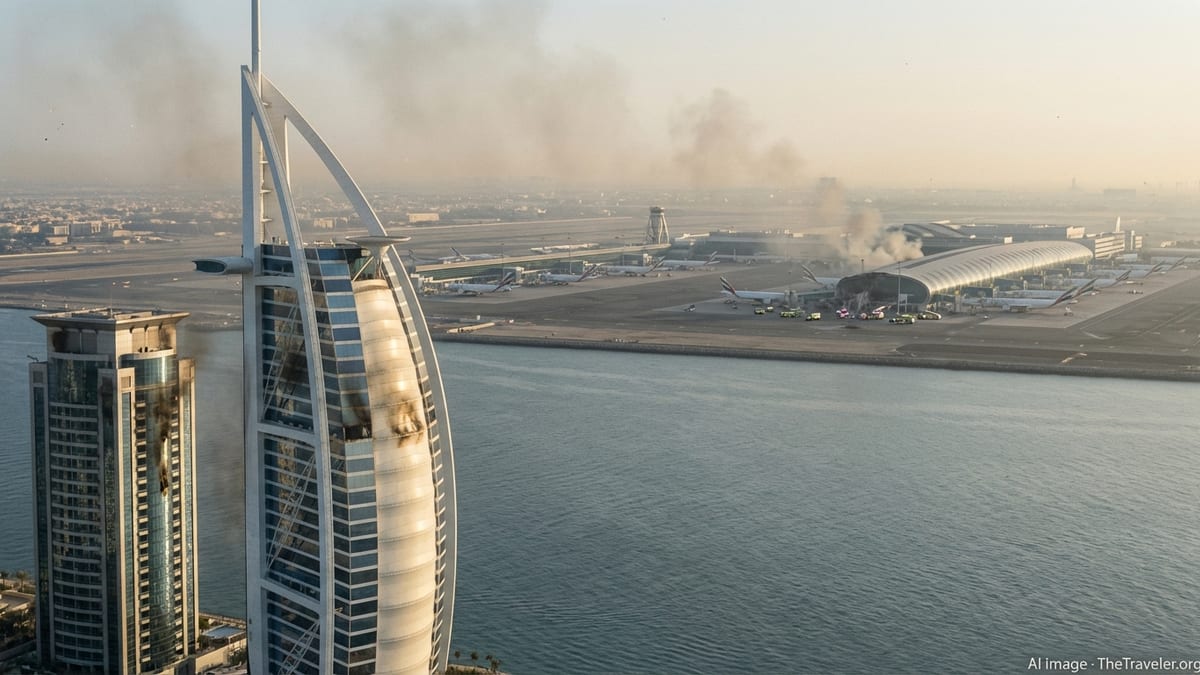
Nearby, the sail-shaped Burj Al Arab, one of the most photographed hotels on the planet and a symbol of the city’s luxury brand, was scorched on its outer facade after debris from an intercepted drone ignited a fire. Civil defence crews moved quickly to contain the blaze and reported no casualties inside the hotel, but dramatic images of smoke curling around the building’s white curves have ricocheted across global media, instantly reframing how many travelers perceive Dubai’s waterfront skyline.
Other high-end properties were also caught up in the bombardment. Fires were reported at a hotel on Palm Jumeirah and at Dubai’s Fairmont hotel complex, prompting hurried evacuations of guests and staff. The incidents mark one of the first times that such a dense cluster of iconic leisure properties, long marketed as an oasis of calm amid regional volatility, has been directly affected in a single night of strikes.
Beyond the immediate damage, hotel operators and tourism officials are bracing for a longer shadow. “These brands trade on predictability and security,” said one regional hospitality analyst. “Seeing their facades lit by explosions instead of fireworks fundamentally shakes visitor confidence, especially among high-spending leisure and business guests.”
Airports Across the Gulf Disrupted as Routes Collapse
The attacks were not confined to Dubai. Officials and state media across the Gulf reported damage to at least five airports in four Arab countries, including the United Arab Emirates, Kuwait, Bahrain and Iraq. Kuwait International Airport temporarily halted departures and arrivals after a drone strike damaged facilities and raised concerns over the safety of runway operations and terminal structures.
In Bahrain, authorities said a drone hit infrastructure at Bahrain International Airport, causing material damage and triggering a rapid security lockdown. The island kingdom, home to the United States Fifth Fleet, also saw separate strikes closer to military and security sites. As a precaution, parts of Manama’s waterfront commercial zone were cordoned off, disrupting both business travel and the flow of regional visitors who typically combine short breaks with work trips.
Further west, airports associated with or adjacent to United States military installations, including those near Abu Dhabi and in northern Iraq, also reported incidents tied to missile or drone activity. While many incoming projectiles were intercepted, falling debris still caused fires, minor structural damage and, in some cases, casualties among airport personnel. Airspace closures quickly cascaded as civil aviation regulators prioritised risk avoidance, forcing aircraft already in the air to divert and grounding thousands more before departure.
By Sunday, flight-tracking data showed a thick band of no-go airspace stretching over large parts of the Gulf, with services by leading carriers such as Emirates, Etihad and Qatar Airways severely curtailed or suspended. Aviation analysts warn that even a short-lived shutdown will take days to unwind as aircraft and crew are displaced around the world, leaving travellers stranded in cities as far afield as Singapore, London and Johannesburg.
Stranded Travellers and Surging Anxiety on the Ground
Inside the affected hubs, scenes of quiet efficiency that normally define Gulf airports gave way to confusion and anxiety. At Dubai International, passengers reported huddling in interior corridors and service areas as security announcements instructed them to move away from exterior glass and boarding gates. With information screens flickering with mass cancellations, many queued for hours at airline desks that were themselves struggling to reach operations teams scattered across time zones.
Hotels that escaped physical damage nonetheless found themselves transformed into ad hoc shelters. In both Dubai and Abu Dhabi, properties near the airport and along key highways welcomed passengers whose flights had been cancelled after midnight, often providing emergency blankets, meals and late check-outs as guests refreshed bookings on overburdened apps. Some hotel managers described lobbies crowded with families trying to keep children calm as air raid alerts and social media videos reinforced the sense that nowhere in the region felt entirely secure.
Across the water in Bahrain, the United States embassy issued an unusually stark warning that hotels in Manama might be targeted in future attacks after an international chain property was hit, causing injuries. The advisory urged American citizens to avoid hotels in the capital, a recommendation that rippled far beyond diplomatic circles as multinational firms circulated similar guidance to staff and contractors. For a destination that has long marketed itself as a laid-back weekend escape for Gulf residents, the suggestion that hotels could be deliberate targets marked a chilling shift.
Travel insurers, meanwhile, have started fielding surging calls from policyholders concerned about both immediate trip disruption and broader security risks. Industry experts say that while many policies cover delays and cancellations, far fewer offer robust coverage for conflict-related risks in active war zones, leaving some travellers unsure whether to stay put, reroute or cancel entirely at their own expense.
Tourism and Investment Outlook Darkens
The strikes come at a sensitive moment for Gulf tourism, which has spent recent years repositioning itself as a global leisure powerhouse rather than just a transit corridor. Dubai, Abu Dhabi, Doha and other cities have collectively invested tens of billions of dollars in theme parks, museums, convention centres and luxury resorts designed to attract visitors for longer stays. That strategy relies heavily on the perception that, whatever happens elsewhere in the Middle East, these hubs remain neutral, stable and insulated from direct conflict.
Iran’s decision to target or threaten sites in the United Arab Emirates, Bahrain and Kuwait punctures that narrative. Even if the physical damage to hotels and terminals proves repairable within weeks, the psychological effect on potential visitors and investors may linger far longer. Early indications from regional booking platforms and tour operators point to a spike in cancellations for March and April, particularly among first-time visitors and group tours who are more risk-averse than seasoned business travellers.
Corporate travel demand, a mainstay of Gulf occupancy rates outside peak holiday periods, also appears vulnerable. Several multinational banks and energy companies with regional headquarters in Dubai and Manama have reportedly activated contingency plans, instructing employees to work remotely or relocate temporarily to secondary hubs such as Riyadh or Muscat. Conference organisers are weighing whether to shift upcoming events to alternative cities in Europe or Asia, fearing that renewed strikes or extended airspace closures could derail large gatherings at short notice.
Real estate and hospitality analysts stress that the Gulf has shown remarkable resilience after past shocks, from financial crises to pandemics. Yet they acknowledge that the current confrontation, which explicitly links global travel infrastructure with military flashpoints, could mark a turning point. One consultant described it as “a stress test of the region’s entire value proposition as a safe, connected playground for the world.”
Regional Safety Perceptions Face a Critical Test
Beyond the immediate logistics of diversions and damage assessments, the broader question now confronting travellers and the industry alike is whether the Gulf can still be treated as a relatively safe backdrop to global connectivity. For years, destinations such as Dubai, Abu Dhabi and Doha have positioned themselves as havens of order and predictability sandwiched between more volatile neighbours. Their success as aviation and tourism superhubs has depended on that contrast.
The images emerging this week tell a different story: concourses shrouded in smoke, waterfront landmarks streaked with burn marks, and guests being escorted through hotel lobbies under the glow of emergency lighting. While many of the strikes appear to have been aimed at military or strategic assets, the damage to civilian hotels and airports underscores how thin the line now is between targeted retaliation and collateral impact on everyday travellers.
Security experts caution that risk levels can change quickly as political calculations shift in Tehran, Washington, Tel Aviv and the Gulf capitals. For now, major tour operators are advising clients to monitor official travel advisories closely, build flexibility into itineraries and avoid nonessential transit through the most affected hubs. Some carriers are exploring longer alternative routings over the Indian Ocean and Mediterranean, though these add time and cost to already complex operations.
For millions of would-be visitors, the decision in the coming weeks may hinge less on technical safety assessments and more on emotion. The Gulf’s glittering hotels and seamless airports have long symbolised a promise that, here at least, geopolitics stayed safely on the horizon. Iran’s latest strikes have brought that horizon uncomfortably close, leaving the region’s travel industry scrambling to show that its foundations remain secure even as missiles and drones test the limits of its resilience.