

More news on this day
Air travel across the Middle East has entered a new phase of disruption as Iraq joins Syria, Lebanon, Jordan, Iran and several Gulf states in sharply restricting or closing airspace, forcing widespread cancellations, diversions and last minute rerouting for passengers on Emirates, Qatar Airways, Turkish Airlines, flydubai and many other carriers.
Get the latest news straight to your inbox!
A Rapid Escalation in Regional Airspace Restrictions
Publicly available aviation notices and regional security updates indicate that large parts of the Middle East sky are now either closed or heavily restricted to civilian traffic. Recent conflict involving Iran, Israel, the United States and allied forces has triggered successive rounds of drone and missile activity, prompting governments from Iraq and Iran to Jordan, Syria, Lebanon and several Gulf states to tighten control of their airspace for safety reasons.
Advisories compiled in early March 2026 show that Iraq has moved from intermittent route restrictions to broad airspace closures, aligning with similar measures already in place in Syria and along key corridors over Jordan and Lebanon. Analysts note that these countries sit on some of the most important east–west aviation highways, meaning that even temporary shutdowns create ripple effects across Europe–Asia and Africa–Asia traffic.
Industry assessments tracking the wider economic impact of the 2026 Iran war describe regional aviation as operating at a fraction of normal capacity, with certain hubs effectively cut off from long haul traffic while strikes, near misses and military activity continue. Where airspace remains technically open, conflict zone guidance from regulators has led many airlines to avoid these routes entirely, further shrinking available options for travelers.
The current disruption follows earlier waves of closures, including coordinated shutdowns by Iraq, Jordan, Lebanon, Syria and others during the April 2024 Iranian drone and missile attack on Israel. The difference in 2026 is the breadth and duration of restrictions, now covering multiple neighboring states at the same time and persisting for weeks rather than hours or days.
Major Gulf and Regional Carriers Forced to Cut and Reroute
The most visible impact for travelers has been on the big transfer airlines that rely on Middle East hubs. Operational briefings from corporate travel managers and airline updates compiled by travel management and consulting firms in March 2026 show Emirates, Qatar Airways, flydubai and other Gulf carriers operating far below normal schedules, with some routes temporarily suspended altogether.
One regional advisory summarizing airline status reported that Qatar Airways had suspended services to Iran, Iraq and Syria for an extended period, while other carriers continued to operate only on heavily modified routings, often with additional fuel loads to skirt the affected airspace. Separate economic analysis notes that Emirates and Qatar Airways, normally among the world’s largest long haul operators, have experienced a near total cessation of some overflight-dependent services while multi national closures remain in effect.
Turkish Airlines, which usually offers extensive connections between Europe, the Middle East and Asia via Istanbul, has also been drawn into the disruption. Passenger reports and schedule changes show select flights being rerouted around closed sectors, adding significant flight time and sometimes requiring technical stops or last minute aircraft and crew swaps. Although Turkish Airlines has preserved more of its network than some Gulf rivals, its ability to offer fast trans Middle East connections has been curtailed by the patchwork of national restrictions.
Low cost and regional carriers such as flydubai have likewise trimmed services to high risk destinations including Iraq, Iran, Jordan, Lebanon and Syria, according to airline notices monitored by travel forums and corporate travel desks. For passengers, the result is not only cancellations but also a sharp reduction in alternative same day options once a flight is disrupted.
What Travelers Are Experiencing on the Ground
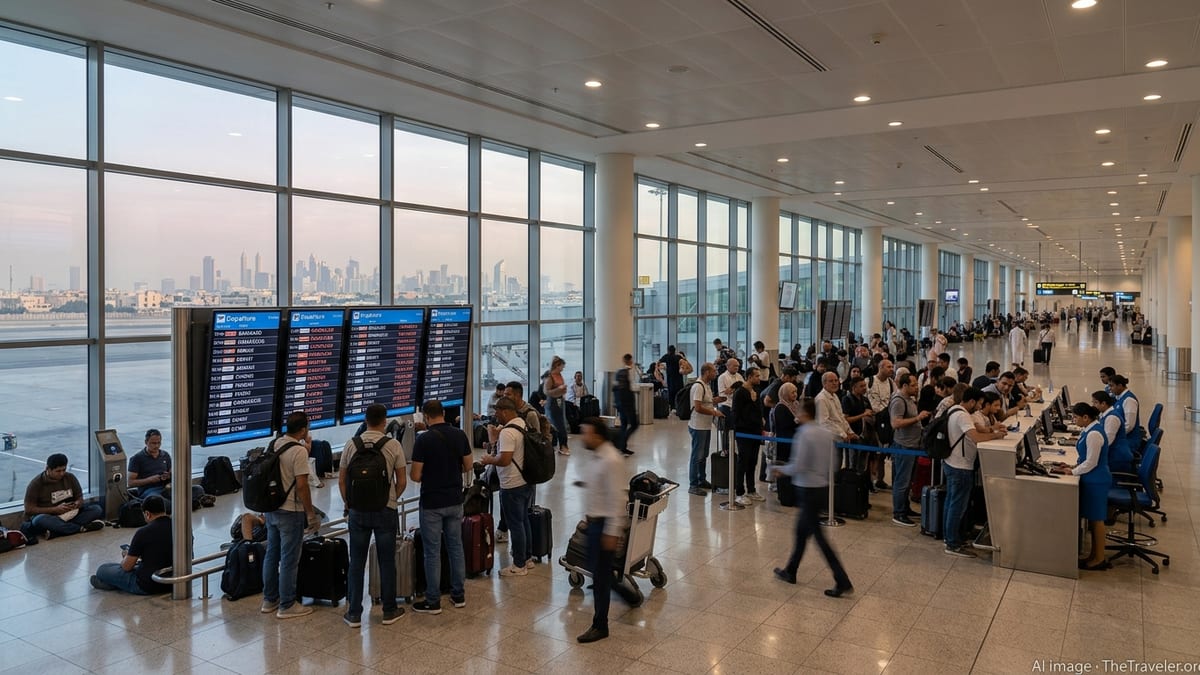
For individual travelers, the crisis is playing out as sudden cancellations, rolling delays and opaque rebooking processes. Online passenger reports and airline advisories describe situations where flights that initially appeared on schedule were later pulled hours before departure as new airspace notices came into effect or as military activity spiked along planned routings.
Travelers connecting through major hubs such as Dubai, Doha, Istanbul and Amman have reported being held on the ground, rebooked onto indirect itineraries that avoid the Gulf altogether, or in some cases left waiting for several days for the next available seat. Flight tracking data and schedule changes indicate that carriers are often unable to guarantee onward connections because routings must be recalculated day by day in response to fresh security information.
Advisories from global mobility and tax firms warn corporate travelers and employers that airspace closures across Iran, Iraq, Israel, Jordan, Qatar, Bahrain, Kuwait, Syria and the United Arab Emirates have created widespread knock-on disruption. Even travelers not originally scheduled to transit the region, such as those flying between Europe and South or East Asia, can be affected by diversions that add hours to flight times or force aircraft to refuel outside their usual network.
Airport conditions vary by country, but notices from port and aviation authorities highlight restrictions on crew changes, limits on ground operations and a focus on essential or repatriation flights where security conditions allow. Passengers are being urged, often through airline channels and travel management alerts, to avoid going to the airport until their flight status has been reconfirmed on the day of travel.
Key Risks and Practical Steps for Affected Passengers
While the security context is complex, the immediate risks for travelers fall into several practical categories. Flight safety remains the primary concern, and there is broad alignment among airlines and regulators that routes directly over active conflict zones or within reach of ongoing missile and drone activity should not be used for civilian traffic. This has prompted conservative routing choices that sacrifice speed and schedule reliability in favor of wider separation from military operations.
Schedules are also unstable. Timetables that appear normal several days in advance can change rapidly when a country issues a new airspace notice or extends an existing closure. Travelers who booked long haul itineraries via regional hubs months ago now face a significantly higher chance of missed connections or unplanned overnight stays if a critical sector is pulled from operation.
Travel management companies and airline policy summaries recommend several steps: monitor bookings closely in the 48 hours before departure, use airline apps and official communication channels to track last minute changes, and be prepared for rerouting via alternate hubs in Europe or South Asia that bypass the Middle East. Many airlines, including Emirates and Qatar Airways, have introduced flexible rebooking and refund options for passengers whose flights are canceled due to the crisis, but processing times can be lengthy due to high call volumes.
Travelers are also being advised to build extra time into any essential journey, travel with digital copies of documents and contact details for their airline and insurer, and avoid planning tight same day connections in or near the affected region. For nonessential trips that would require multiple transits through closed or high risk airspace, postponement or rerouting via entirely different corridors is increasingly being viewed as the most reliable option.
Outlook for Tourism and Long Haul Travel Through the Region
The broader impact on tourism is already significant. Reports examining the economic consequences of the 2026 Iran war point to a sharp downturn in visitor arrivals across affected countries, particularly those like Jordan and Lebanon that had been working to rebuild tourism in recent years. With airspace closures making direct access difficult and insurers reassessing coverage, many leisure travelers are choosing alternative destinations or postponing Middle East trips altogether.
For global tourism flows, the disruption at major hubs such as Dubai and Doha carries outsized importance. Before the latest escalation, these airports handled a large share of world long haul transit traffic, linking Europe and Africa with South and East Asia and Australasia. With operations curtailed and multiple neighboring airspaces effectively off limits, airlines are shifting capacity to secondary hubs and overland corridors, but these adjustments take time and often involve longer flying times and higher costs.
Industry observers note that recovery will depend not only on ceasefires or de-escalation, but also on the speed with which regulators and insurers are prepared to downgrade risk assessments. Even after earlier crises in 2024 and 2025, airlines were slow to resume overflights across certain parts of Iraq, Syria and Iran, preferring to keep detours in place until confidence in long term stability improved.
For now, travelers planning to fly with Emirates, Qatar Airways, Turkish Airlines, flydubai and other carriers that normally cross Middle Eastern airspace should expect continued uncertainty. The situation remains fluid, and while limited corridors may reopen as security conditions evolve, aviation and travel experts broadly anticipate an extended period of disrupted schedules and altered routings across the region’s skies.