

More news on this day
Ireland has sharply tightened its travel advice for the Middle East, adding Qatar to a widening group of high-risk destinations that already includes the United Arab Emirates, Egypt, Bahrain, Oman, Saudi Arabia and Lebanon, as regional conflict, airspace closures and mass protests disrupt mobility across the region.
Get the latest news straight to your inbox!
Irish Travel Advice Escalates Across the Gulf
Publicly available travel guidance from Ireland now groups much of the Gulf and eastern Mediterranean under its highest or near-highest alert categories, reflecting what officials describe elsewhere as a rapidly evolving security landscape. Recent parliamentary statements and media reports indicate that Ireland advises against all travel to the core conflict zones while urging citizens to avoid non-essential trips to a broad swathe of neighbouring states.
According to reporting on updated advisory maps, Qatar, Saudi Arabia, Bahrain and Lebanon have all moved into stricter categories in recent weeks, aligning them with a regional pattern in which traditional stopover hubs are treated as part of a wider risk corridor rather than isolated safe transit points. The shift places Qatar alongside states such as the United Arab Emirates, Egypt and Oman in guidance that calls for heightened caution and detailed contingency planning before departure.
The tougher stance follows a period of intense diplomatic and consular activity, with Irish coverage highlighting contingency planning for evacuation flights and consular support for thousands of citizens caught up in sudden flight cancellations. The expanded cautionary language underlines that citizens can no longer assume that well-connected Gulf hubs will function as reliable back doors out of the wider conflict zone.
While Ireland’s travel advice is non-binding, it carries significant weight for insurers, tour operators and corporate travel planners, many of whom use such ratings to determine whether trips can proceed and under what conditions. The latest changes are therefore expected to ripple quickly through holiday bookings and business itineraries involving the Gulf.
Airspace Closures And Disrupted Flight Networks
The recalibrated Irish guidance comes as large sections of Middle Eastern airspace remain constrained or intermittently closed due to the regional conflict. Aviation-focused bulletins and risk assessments describe extended restrictions affecting the skies above Bahrain, Iran, Iraq, Israel, Jordan, Kuwait, Lebanon, Oman, Qatar, the United Arab Emirates and Saudi Arabia, with operators urged to reassess routing and altitude for any remaining services.
Specialist shipping and aviation advisories from early March pointed to the closure of Qatari airspace and widespread suspension of commercial flights following Iranian missile strikes and heightened military activity. Later security analyses note that, although some operations have partially resumed, airports in Qatar and Bahrain in particular have seen services largely halted or heavily reduced, triggering knock-on disruption far beyond the region.
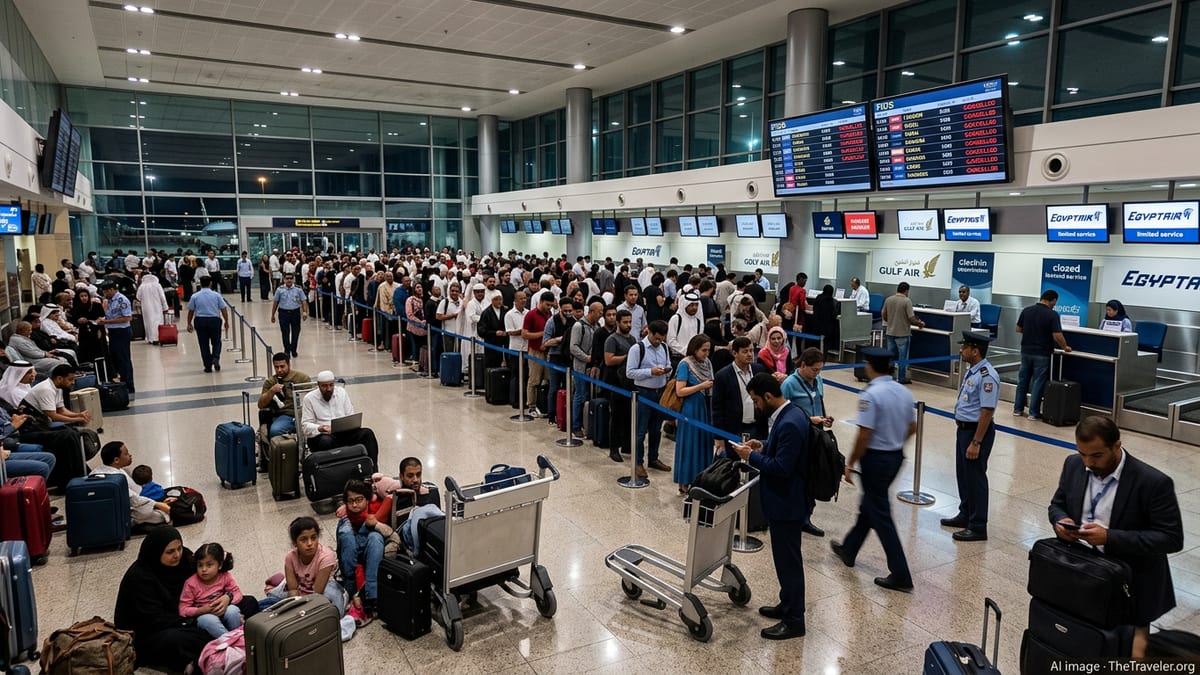
Flight cancellations and diversions associated with these closures have been described in European media as the worst shock to global aviation since the pandemic, with long-haul services forced to detour around conflict areas and hub-and-spoke networks suddenly losing key connection points. This has further complicated the position of Irish travellers attempting to transit through Doha, Dubai, Abu Dhabi or Riyadh, as routings that were routine only months ago now require frequent last-minute changes.
Europe’s aviation safety regulators have responded by extending conflict-zone advisories across much of the region, urging carriers to avoid specific flight information regions or operate only under stringent risk assessments. Airlines that continue to serve select cities are doing so with altered flight paths, contingency fuel and enhanced crew briefings, measures that may keep limited connectivity alive but leave schedules fragile and subject to abrupt cancellation.
Security Tensions And Street Protests Across The Region
The travel turbulence is rooted in a broader security crisis that has cascaded across the Middle East since late February. Extensive news coverage traces the immediate trigger to large-scale United States and Israeli strikes on Iranian targets, followed by retaliatory attacks and missile launches affecting Gulf states including Qatar. These events have set off waves of demonstrations and clashes in multiple capitals, adding an unpredictable ground-level dimension to the aerial risk.
Analyses of recent unrest describe mass protests in cities such as Baghdad and other regional centres, where anger over the widening conflict and domestic grievances has brought crowds into streets near government complexes and foreign diplomatic districts. Some of these gatherings have turned confrontational, with reports of barricades, security-force deployments and sporadic violence that can flare with little warning.
Within this context, travel advisories for countries such as Lebanon, Bahrain and Saudi Arabia emphasise the possibility of sudden protests and road closures in urban areas popular with visitors. Guidance commonly urges travellers already in-country to maintain a low profile, avoid large gatherings and remain alert to local media and official announcements, recognising that demonstrations can disrupt both internal transport and access to airports at short notice.
The combination of airspace constraints and volatile street-level conditions explains why states that might previously have been treated as safe detours are now bracketed with higher-risk neighbours. For Irish travellers contemplating trips to the region for tourism, work or family reasons, that reclassification signals that even short stays or onward connections may involve exposure to fast-changing security dynamics.
Knock-On Impacts For Irish Travellers And The Tourism Sector
The Irish tourism and aviation sectors are already feeling the effects of the new advisory environment. Industry reporting notes that package operators and travel agencies are scrambling to rebook or reroute clients who had planned spring and early-summer holidays using Gulf hubs as gateways to Asia, Africa and Australasia. Some carriers have introduced flexible change policies for tickets involving Doha or major United Arab Emirates and Saudi cities, but capacity constraints make alternative routings difficult to secure.
Travel insurers are also reassessing their exposure, with policy documents typically excluding cover for war, civil unrest and government-imposed airspace closures. Consumer advocates warn that Irish travellers who choose to proceed with trips against explicit advice may find themselves without recourse if flights are cancelled, transit connections severed or destinations become inaccessible mid-journey.
For inbound tourism to countries such as Qatar, the United Arab Emirates, Bahrain, Oman, Saudi Arabia, Egypt and Lebanon, Ireland’s more severe advisories add to a series of international warnings that collectively risk depressing visitor numbers. Hospitality analysts suggest that even travellers from countries with less stringent guidance may be deterred by the perception of a region-wide crisis and recurring images of airport disruption and street protests.
Irish-based communities with family links across the Gulf and Levant face particularly difficult choices, balancing the desire to visit relatives against the prospect of being stranded or forced to shelter in place. Consular messaging highlighted in domestic media encourages these travellers to register their details, keep travel documents up to date and ensure they have contingency funds in case commercial routes are disrupted again.
What Prospective Visitors Need To Consider Now
For individuals in Ireland still contemplating travel to the Middle East, the emerging pattern points to a more complex risk calculation than in previous crises. Publicly accessible guidance suggests that would-be visitors should verify the latest national and airline-specific advisories immediately before booking, recognising that conditions can shift within days or hours.
Observers note that travellers who proceed despite the current advisories may need to prepare for prolonged layovers, reroutings through unfamiliar airports and the possibility that return flights could be delayed or reorganised at short notice. Some security consultancies also recommend maintaining digital and physical copies of important documents, carrying essential medications in hand luggage and avoiding tight connections that depend on a single high-risk hub.
The situation has reinforced the importance of monitoring both aviation-specific information, such as conflict-zone notices, and broader political developments, including protest movements and civil unrest that can affect airport access. While certain routes and destinations remain technically open, the convergence of airspace restrictions, volatile security conditions and swelling demonstrations means that travel to or through Qatar, the United Arab Emirates, Egypt, Bahrain, Oman, Saudi Arabia, Lebanon and neighbouring states now carries significantly elevated uncertainty compared with only a few months ago.