

More news on this day
Irish citizens stranded across the Gulf region amid escalating hostilities have begun returning home after an emergency Government charter flight, routed from Oman via Cairo, landed safely in Dublin in the early hours of Sunday, offering a 24-hour lifeline to families desperate for news.
A High-Stakes Journey From the Gulf to Dublin
The charter flight, arranged by the Department of Foreign Affairs as commercial links thinned out across the Gulf, departed Muscat in Oman on Saturday evening local time after days of uncertainty for would-be passengers. Many had first endured long overland journeys from the United Arab Emirates and neighbouring states as airspace disruptions and security fears mounted.
On board were close to 190 passengers, including children and infants, according to officials. They had been identified as priority cases among thousands of Irish citizens registered in the wider Middle East as tensions boiled over and travel advisories hardened against non-essential journeys to the region.
After leaving Muscat, the aircraft was routed to Cairo, where it made a technical stop before continuing on to Dublin. The schedule, repeatedly described by officials as fluid, ultimately evolved into a near 24-hour odyssey from initial check-in in Oman to arrival on Irish soil.
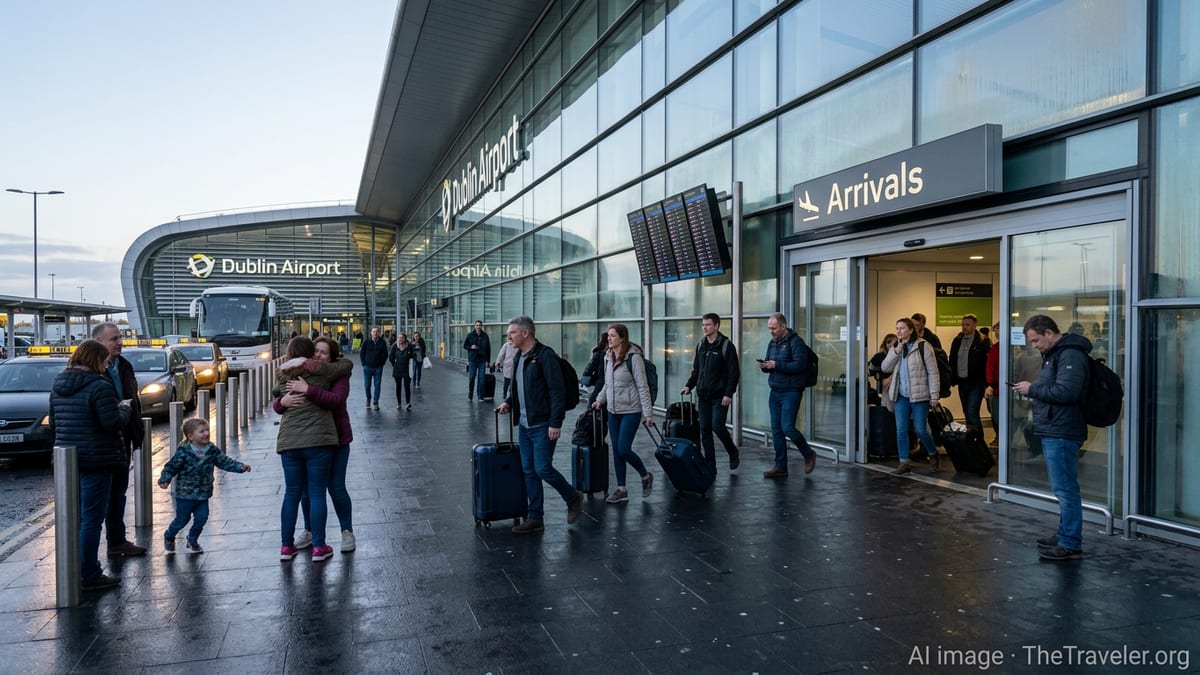
At Dublin Airport, the charter’s touchdown shortly after dawn was met with quiet applause from tired passengers and emotional embraces in the arrivals hall, where families had waited through the night for confirmation that the flight had cleared its final leg safely.
Families Reunited After Days of Anxiety
For relatives gathered in Dublin, the flight’s safe arrival brought an end to days of mounting worry as images of missile strikes and closed terminals from across the Gulf dominated news bulletins. Many had seen plans for routine holidays, work trips or connecting flights unravel as airports in the region curtailed services and airlines scrambled to reroute aircraft.
Parents spoke of children sleeping in hotel lobbies or friends’ apartments while waiting for word of a way home. Some recounted repeatedly rebooked and cancelled flights from the United Arab Emirates as carriers paused operations or diverted away from affected airspace, leaving Irish travellers largely dependent on piecemeal commercial options or the promised Government charter.
Inside the terminal, scenes were a mix of exhaustion and relief. Some returning passengers, wrapped in airline blankets and still clutching carry-on bags, moved quickly through arrivals to reunite with relatives who had driven through the night from across the country. Others paused to speak quietly with airport staff and consular officials who had tracked the flight’s progress from Muscat to Cairo and onward to Dublin.
For many families, the journey’s end also brought an abrupt psychological shift, from anxiously monitoring news alerts from the Gulf to the familiar surroundings of Dublin Airport. Several travellers described feeling the full weight of the ordeal only once they had stepped into the arrivals hall and seen loved ones waiting.
How the Emergency Charter Was Organized
The charter operation was the culmination of an intense week of crisis planning in Dublin as the Department of Foreign Affairs upgraded travel advice for Gulf states and began mapping out worst-case scenarios for Irish nationals. Officials activated their consular crisis mechanisms, drawing on embassies across the region and a dedicated team at headquarters to track citizens, assess options and coordinate logistics.
With commercial routes increasingly constrained and security conditions deteriorating, Muscat in Oman emerged as the most viable hub from which to stage a repatriation flight. Diplomats and crisis planners worked with airline partners to secure an aircraft, crew and a safe routing corridor that would allow the flight to operate despite broader disruptions in Middle East airspace.
Irish citizens in the United Arab Emirates and neighbouring countries were urged to make their way, where feasible, towards Oman, in some cases boarding Government-facilitated buses or arranging their own overland transport across borders. Priority on the charter was given to those considered most vulnerable, including families with young children, older travellers and those with medical needs.
Once airborne, the flight was closely monitored by officials in Dublin and in embassies along the route. The scheduled stop in Cairo provided a refuelling and crew rest window while also offering additional contingency options should conditions in the Gulf or over the eastern Mediterranean shift further during the journey.
A Region in Crisis and a Fragile Travel Network
The operation unfolded against a backdrop of rapidly escalating tensions in the Gulf, with reports of missile and drone attacks targeting infrastructure in the United Arab Emirates and other states contributing to a patchwork of airspace restrictions and last-minute flight cancellations. Airlines operating through major hubs such as Dubai and Abu Dhabi were forced to cancel services, reroute aircraft or rely on longer, more circuitous paths to Europe and beyond.
For Irish travellers, the effects were immediate. Popular corridors between Dublin and Asia or Australia, which typically rely on Gulf hubs for onward connections, became unreliable almost overnight. Holidaymakers, migrant workers, business travellers and those in transit through the region suddenly faced closed check-in desks, crowded customer service counters and limited clarity on when normal operations might resume.
The Irish Government had already moved to advise against non-essential travel to the United Arab Emirates and other Gulf states, prompting tour operators to review itineraries and insurers to reassess cover. Against that shifting backdrop, the charter flight from Oman was framed as an exceptional measure, a targeted safety valve for those who had been unable to secure a commercial route home despite repeated attempts.
Diplomatic sources acknowledged that the regional situation remains highly volatile, with the potential for further disruption in the days ahead. While Sunday’s flight has eased immediate pressure on some families, officials stressed that it could not be assumed to signal a broader return to normal travel patterns through the Gulf.
What This Means for Irish Travellers and Future Response
In the wake of the charter’s arrival, Irish authorities are urging citizens still in the Gulf who wish to leave to continue pursuing commercial options where available, maintaining close contact with airlines, travel agents and local embassies. Travellers are being encouraged to register their details with the Department of Foreign Affairs, enabling consular teams to relay updated advice and assess demand for any further assisted departures.
The episode has also sharpened focus on the vulnerabilities inherent in global air networks that rely heavily on a small number of strategic hubs. For Ireland, whose long-haul connectivity is often routed through the Gulf, the crisis has underlined how quickly those arteries can constrict when geopolitical tensions rise, with knock-on effects for tourism, business travel and diaspora links.
Within Government, Sunday’s operation is being studied as a live test of Ireland’s consular support structures in a fast-moving crisis. Officials are expected to review the timeline from the initial travel advisories to the decision to charter an aircraft, examining how passenger lists were prioritised, how communication with citizens in the region was managed and what additional capacity might be required if similar events occur in future.
For the families reunited in Dublin, however, the focus remains immediate and personal. After days of uncertainty, Sunday’s charter flight has delivered what many had begun to fear might be out of reach: a safe return home and the chance, at least for now, to leave the turbulence of the Gulf behind.