

More news on this day
As airlines lean harder on last-minute upsells to squeeze revenue from every seat, more economy passengers are being offered cut-price upgrades to premium economy at check-in. The offers can look tempting, but the value is far from guaranteed.
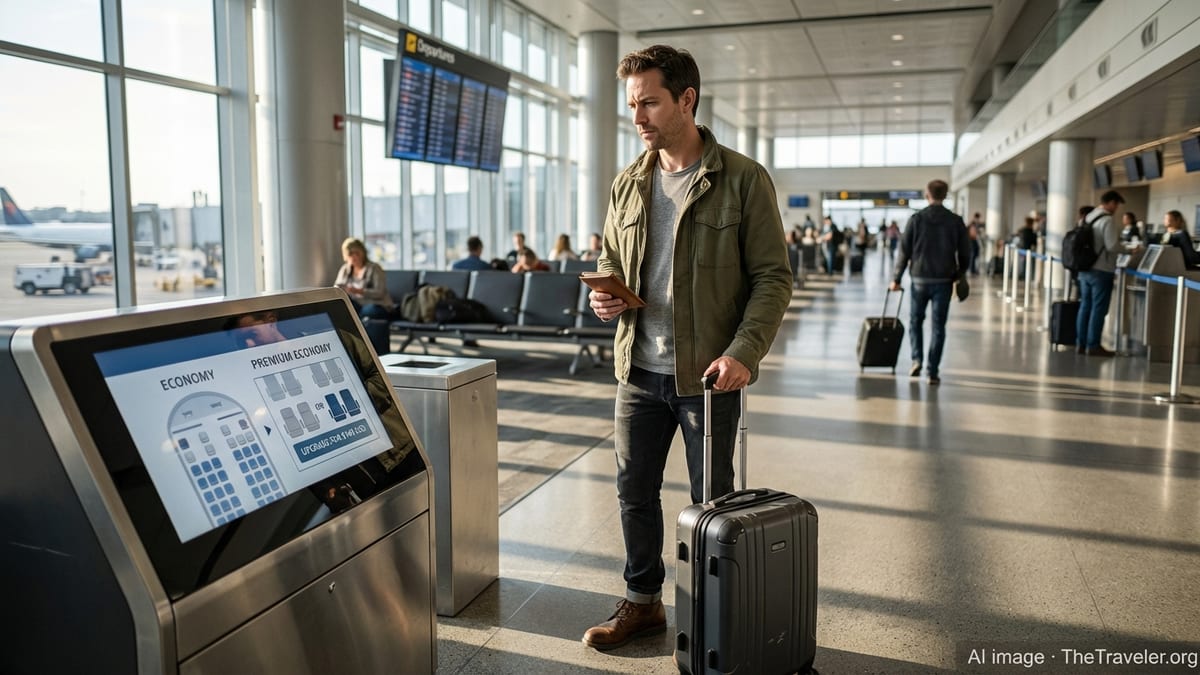
Why Airlines Push Last-Minute Premium Economy Upgrades
Airlines have quietly turned day-of-travel upgrades into a core revenue strategy, using dynamic pricing tools to sell otherwise empty premium seats. Carriers from the Lufthansa Group to major U.S. airlines now surface upgrade offers in their apps, during online check-in and at airport kiosks, typically within 24 to 48 hours of departure. If premium economy isn’t full, those seats are increasingly sold off at discounted fixed prices instead of left unsold.
Recent guidance from Lufthansa illustrates how systemized the practice has become. The group allows fixed-price upgrades from economy to premium economy during online check-in in the 48-to-24-hour window before departure, subject to availability. Similar patterns are emerging across large network carriers, which use real-time demand data to decide how aggressively to discount a seat that is about to take off empty.
For travelers, this means that the familiar “Would you like to upgrade?” prompt at check-in is no longer a random bonus but the end point of a calculated revenue-management process. The airline already knows how many unsold premium economy seats it has, what they were originally priced at and how much it is willing to accept at the last minute.
The result is a growing class of passengers who board with mixed feelings: pleased to have more space than economy, but unsure whether they paid a smart price or fell for a hard-to-resist offer on the brink of boarding.
What You Actually Get When You Move Up to Premium Economy
Despite wide variation between carriers, premium economy has settled into a relatively consistent sweet spot between standard economy and business class. On international routes, passengers can usually expect wider seats, a few extra inches of pitch, deeper recline and a more substantial leg rest or footrest. The cabin is typically smaller and quieter than economy, with upgraded meals, more generous drinks service and improved in-flight entertainment screens.
For long-haul flights of six hours or more, those differences can be meaningful. Extra legroom and a better recline angle make it easier to sleep, and a smaller cabin reduces foot traffic and noise. That can translate into arriving far less fatigued, particularly on overnight sectors where the ability to doze for even a few hours matters more than any ground perk.
What passengers often overlook in the heat of a check-in offer is what is not included. Day-of upgrades rarely change the underlying ticket rules; the fare conditions for changes and refunds usually remain those of the original economy ticket. Baggage allowances may or may not improve, depending on the airline’s policy. Lounge access almost never comes bundled with a premium economy upgrade bought at check-in, even though the cabin branding can imply a quasi-business-class experience.
Understanding this distinction is critical. If your main goal is a better seat and a quieter cabin on a long flight, the value proposition can be strong. If you are expecting business-class-style ground services, you are likely to be disappointed, regardless of how good the in-flight product feels once you sit down.
How Pricing Works and When the Numbers Add Up
Pricing of check-in upgrades is highly fluid, but broad patterns are emerging. On European carriers, upgrades from economy to premium economy on long-haul routes often fall in the range of roughly 200 to 400 dollars when offered close to departure, according to recent upgrade-fee overviews. On shorter regional legs, the cost can dip under 100 dollars, while on busier long-haul flights or peak dates, offers can climb well above that range.
Crucially, these figures are rarely published in advance. Instead, algorithms weigh factors such as remaining seat inventory in premium economy, historic demand on the route and how many passengers have already paid for higher cabins. If a flight has a cluster of unsold premium economy seats on the morning of departure, the system may quietly push aggressive discounts through the app and check-in kiosks. If the cabin is already close to full, any upgrade price that appears is likely to be much higher.
Travelers who have monitored prices across several days report that upgrade fees can fall closer to departure, but not in a predictable way. One Lufthansa passenger, for example, saw an initially high premium economy upgrade quote drop to around 200 dollars per person in the week before departure when booked through the airline’s app. Others have found that the lowest offers surfaced only at online check-in, within 24 hours of take-off, leaving little time to compare or second-guess.
From a pure value standpoint, consumer advocates suggest one threshold as a rough guide: if the upgrade costs less than roughly half the fare difference between economy and premium economy at the time you originally booked, it is often a reasonable deal, especially on overnight or ultra-long-haul sectors. Paying close to the full original fare gap, by contrast, usually makes less sense when you are forfeiting advance seat selection and other planning advantages.
When Last-Minute Upgrades Backfire for Travelers
The biggest risk with waiting for a check-in upgrade offer is straightforward: the seats may never materialize. Airlines have become adept at managing premium economy load factors, often selling those seats earlier to status passengers or corporate travelers. On many popular routes, the cabin now routinely departs full, leaving little scope for deep, last-minute discounting at the airport.
There is also a psychological trap. Once you have committed to a long-haul itinerary, standing at a kiosk after security, the prospect of more space can feel irresistible. Yet the lack of transparency at that moment can work against travelers. You will rarely know whether other passengers are seeing the same price, whether the offer has already dropped earlier in the day or whether a better deal might have been available weeks before.
Operational quirks can compound the uncertainty. On some codeshare routes, passengers report being told that upgrades are only possible at the airport even when online options seemed to exist earlier. On others, system glitches have shown upgrade prices that agents later refused to honor, citing incorrect displays and insisting on fees two or three times higher once the booking was reprocessed.
For travelers on tight budgets or rigid corporate policies, these inconsistencies can lead to frustration or unexpected costs. A passenger who builds a trip around the expectation of a cheap check-in upgrade and then finds a full cabin or a sharply higher price at the counter has little recourse but to remain in economy.
How to Improve Your Odds and Protect Your Wallet
Experts say the best approach is to treat check-in upgrades as a bonus, not a strategy. If a long flight will be miserable in standard economy, it is safer to book premium economy in advance at a price you can accept rather than gambling that the airline will discount it on the day. For trips where you could live with economy but would happily pay for extra comfort at the right price, a check-in offer can be the right tool, provided you decide your ceiling ahead of time.
Frequent flyers also stress the importance of monitoring upgrade options early and often. Many major airlines now let passengers view and sometimes purchase fixed-price upgrades in their apps days before departure, with prices that move as load factors change. Checking regularly from about a week out to the 24-hour mark can give a clearer sense of the range, making it easier to recognize a genuine bargain when it appears at check-in.
Finally, travelers should be clear about what they value. On overnight or ultra-long-haul flights, a modestly priced premium economy upgrade that significantly improves sleep can be worth more than a larger spend on a short daytime hop. Conversely, if lounge access, extra baggage or flexible changes matter more than the onboard seat, it may be wiser to invest in a higher fare or elite status benefits rather than a one-off, last-minute upsell.
For now, the airline’s algorithms hold most of the cards. But by understanding how same-day upgrades are priced and what they truly deliver, passengers can decide when the gamble at check-in is worth taking and when to walk away.